If you're searching for "how to structure a cold email sequence," you're not really asking about how many follow-ups to send.
You're asking how to turn total strangers into real sales conversations without sounding like spam, destroying your deliverability, or wasting weeks on sequences that don't work.
Cold email sequences (a planned series of outreach emails) have become essential to B2B sales in 2026. Sending one email and hoping for a reply doesn't cut it anymore. Prospects are buried in messages, and your single email gets lost in the noise.
This guide gives you the complete system:
• The sequence architecture (what each email should accomplish)
• The proven cadence (when to send each message)
• Copy frameworks that actually get replies
• The deliverability and compliance rules you can't ignore in 2026
• Complete plug-and-play examples you can adapt in 20 minutes
By the end, you'll have a repeatable framework for building sequences that book meetings, not just send emails.
Why Cold Email Follow-Ups Get More Replies Than First Emails
If you're still relying on single cold emails, here's the reality: most replies come from follow-ups, not your first message.
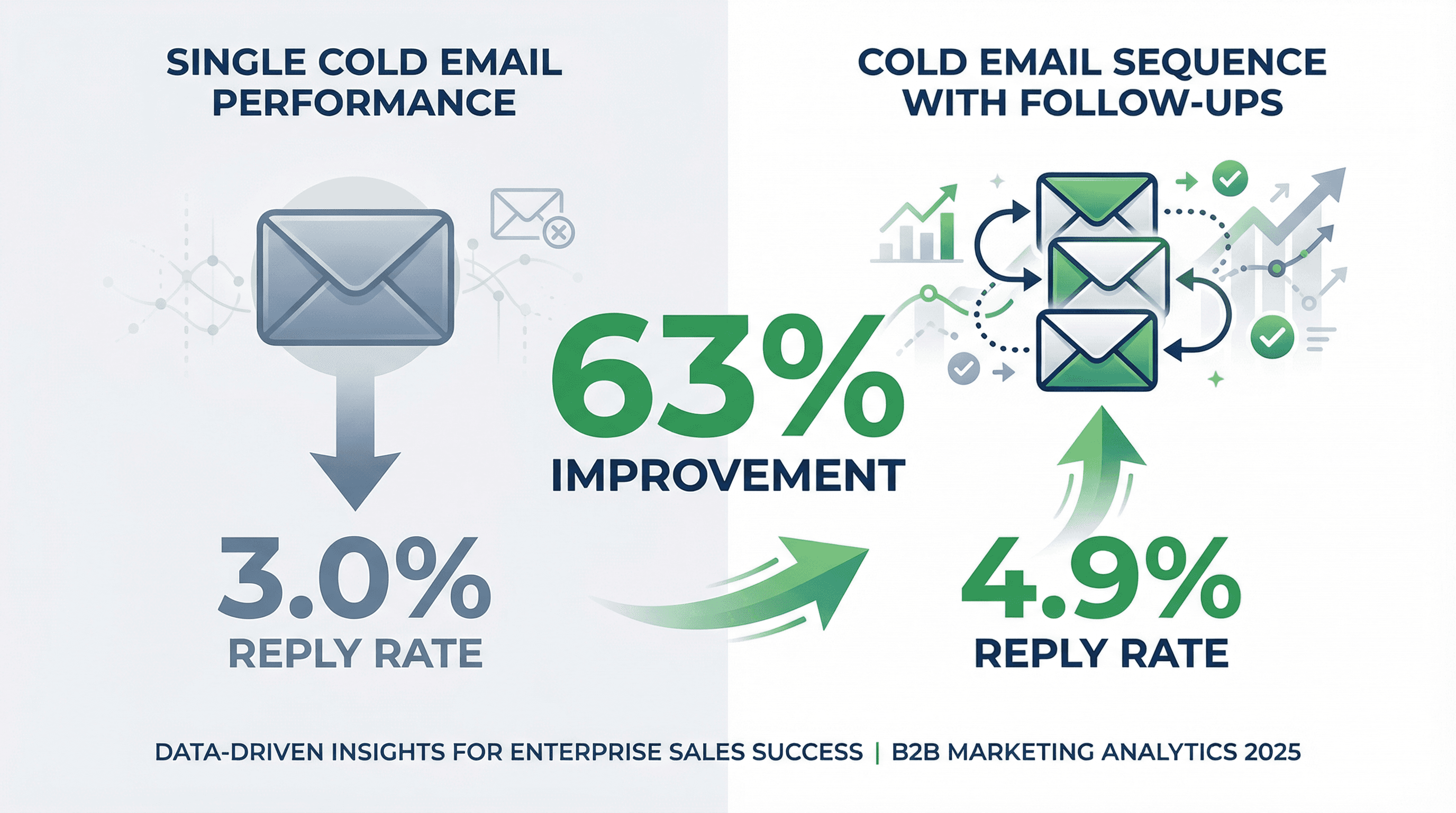
The numbers tell the story:
Research analyzing 11 million cold emails found campaigns with follow-ups averaged 4.9% reply rates compared to just 3% for single-email campaigns. That's a 63% improvement just from adding follow-ups.
At Outbound System, we track this across our 1,000+ B2B clients. Our 2026 data shows 58% of all cold email replies come from follow-ups rather than the initial message. The first email often gets lost in the chaos. The second or third email brings it back to the top of their inbox.
Studies found adding just one follow-up email can boost average reply rates from 9% to around 13%. That's massive ROI for one additional email.
Why does this work? People are busy. Your email might arrive at a terrible moment (right before a meeting, during a fire drill, on a Friday afternoon). A polite follow-up gives them a second chance to engage when the timing's better.
But there's a limit.
Send too many follow-ups and you cross from persistent to annoying. We'll cover the optimal number in the next section.
3 Layers Every Successful Cold Email Sequence Needs
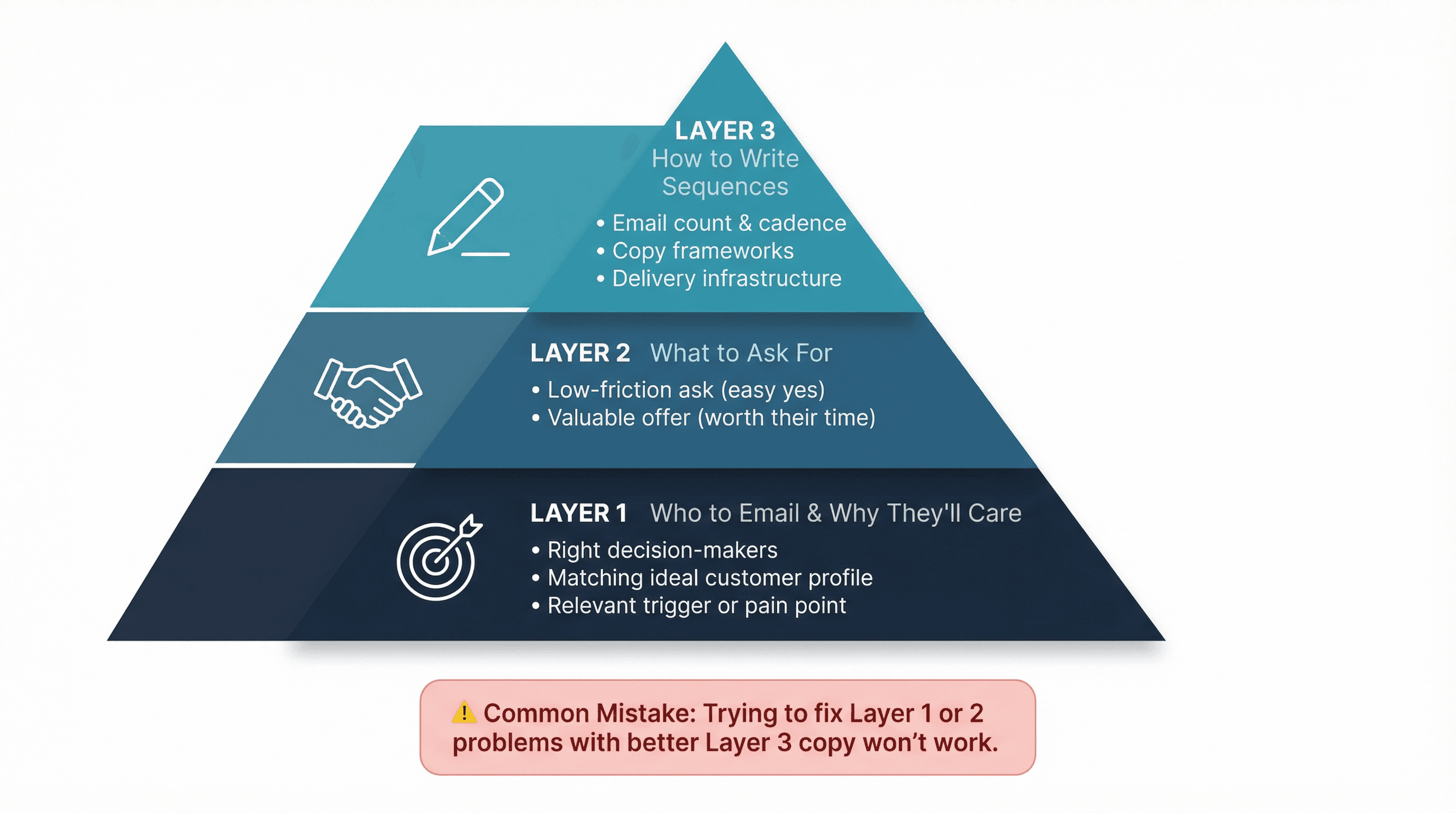
Most people obsess over their email copy (Layer 3) and completely ignore Layers 1 and 2. Then they wonder why their "perfect sequence" gets zero replies.
A sequence only works when all three layers are solid.
Layer 1: Who to Email and Why They'll Care
This is your list quality and segmentation. You need:
→ The right people (decision-makers who can actually say yes)
→ At the right companies (matching your ideal customer profile)
→ With a relevant trigger or pain point (why now matters to them)
Bad Layer 1 kills everything else. The best copy in the world won't save you if you're emailing people who don't have the problem you solve.
Layer 2: What to Ask For in Your Cold Emails
What are you actually requesting? Common options:
→ Book a 15-minute call
→ Get a referral to the right person
→ Get permission to send something useful
Your offer needs to be low-friction (easy to say yes to) and valuable (worth their time). A 15-minute chat where you'll help them solve X problem? That's compelling. A 60-minute product demo with no clear benefit? That's a hard pass.
Layer 3: How to Write Cold Email Sequences That Convert
This is what most guides focus on entirely. It matters, but only if Layers 1 and 2 are already dialed in.
Layer 3 includes:
→ How many emails to send
→ What each email should accomplish
→ The copy frameworks that earn replies
→ The technical delivery infrastructure (more on this later)
The common mistake: trying to fix a Layer 1 or 2 problem with better Layer 3 copy. It won't work. Get your targeting right, make your offer compelling, then optimize your messaging.
How Many Emails Should Be in a Cold Email Sequence?
The sweet spot in 2026 is 4 total emails (one initial message plus three follow-ups), spread over roughly 2 to 3 weeks.
Here's why:
Industry research surveyed 217 decision-makers and analyzed 11 million cold emails sent in 2024. The findings:
Decision-makers actually appreciate follow-ups. 48% said they appreciate them, and 27% don't mind them. Only a small minority find them annoying.
After the third follow-up, you start paying a deliverability tax. Unsubscribe rates grow and spam complaints increase. You're burning goodwill and hurting your sender reputation.
So the default that's both safe and effective: 4 emails total (1 initial + 3 follow-ups).
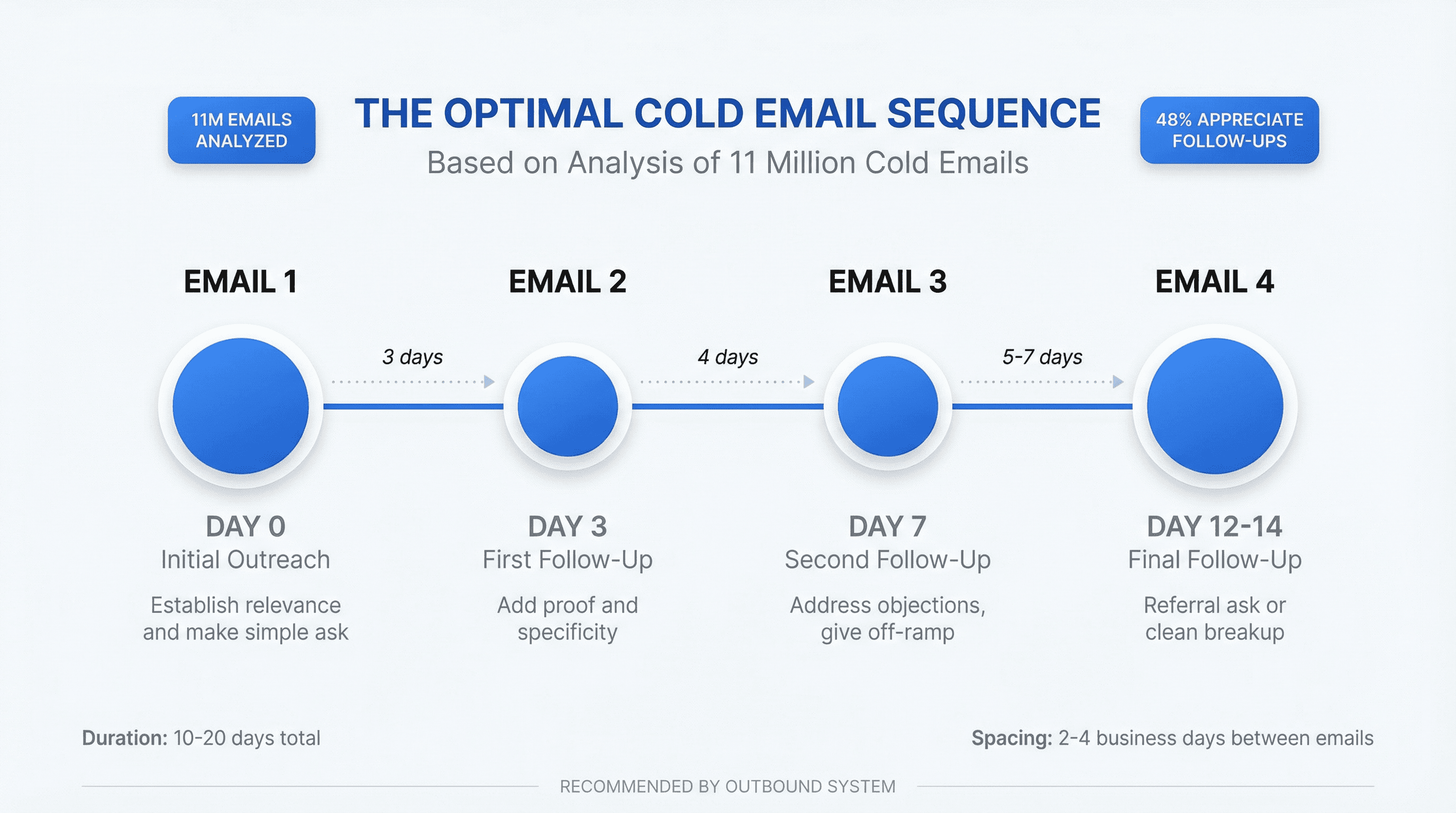
Type | Day | Purpose | |
|---|---|---|---|
Email 1 | Initial | Day 0 | Establish relevance and make simple ask |
Email 2 | Follow-up | Day 3 | Add proof and specificity |
Email 3 | Follow-up | Day 7 | Address objections, give off-ramp |
Email 4 | Follow-up | Day 12-14 | Referral ask or clean breakup |
This gives you enough touches to capture attention without crossing into spam territory.
How Long Should a Cold Email Sequence Run?
Spreading your sequence over a couple of weeks is standard. Don't blast emails daily. Give prospects breathing room over 10 to 20 days. Long enough to include multiple touchpoints, but not so long that context gets lost or your message goes stale.
How Many Days Between Cold Email Follow-Ups?
Best practice is 2 to 4 business days between each email. This balances persistence with respect.
Our follow-up guide at Outbound System specifically calls out 3 days after the initial email as a strong default for your first follow-up. Your prospect's inbox is a queue, not a filing cabinet. You're fighting against meetings, Slack messages, internal fires, and the fact that "I'll reply to this later" often becomes "I forgot this exists."
Spacing gives them multiple chances to see your message without making you look like you're camping in their inbox.
When Should You Send a 5th Email?
If your deal size is huge (enterprise accounts, $50k+ ACV), you might justify a 5th touch. But you must earn it with real value. Don't just send another "checking in" message.
When to Stop Sending Cold Email Follow-Ups
Research shows that after email #3, reply rates drop sharply and unsubscribe rates triple. Four emails without any response is usually your cue to stop. Beyond that, you hit diminishing returns and risk annoying prospects or damaging your sender reputation.
What Goal Should Your Cold Email Sequence Have?
Every sequence should be built around one job. Mixing goals creates confusion and kills conversion.
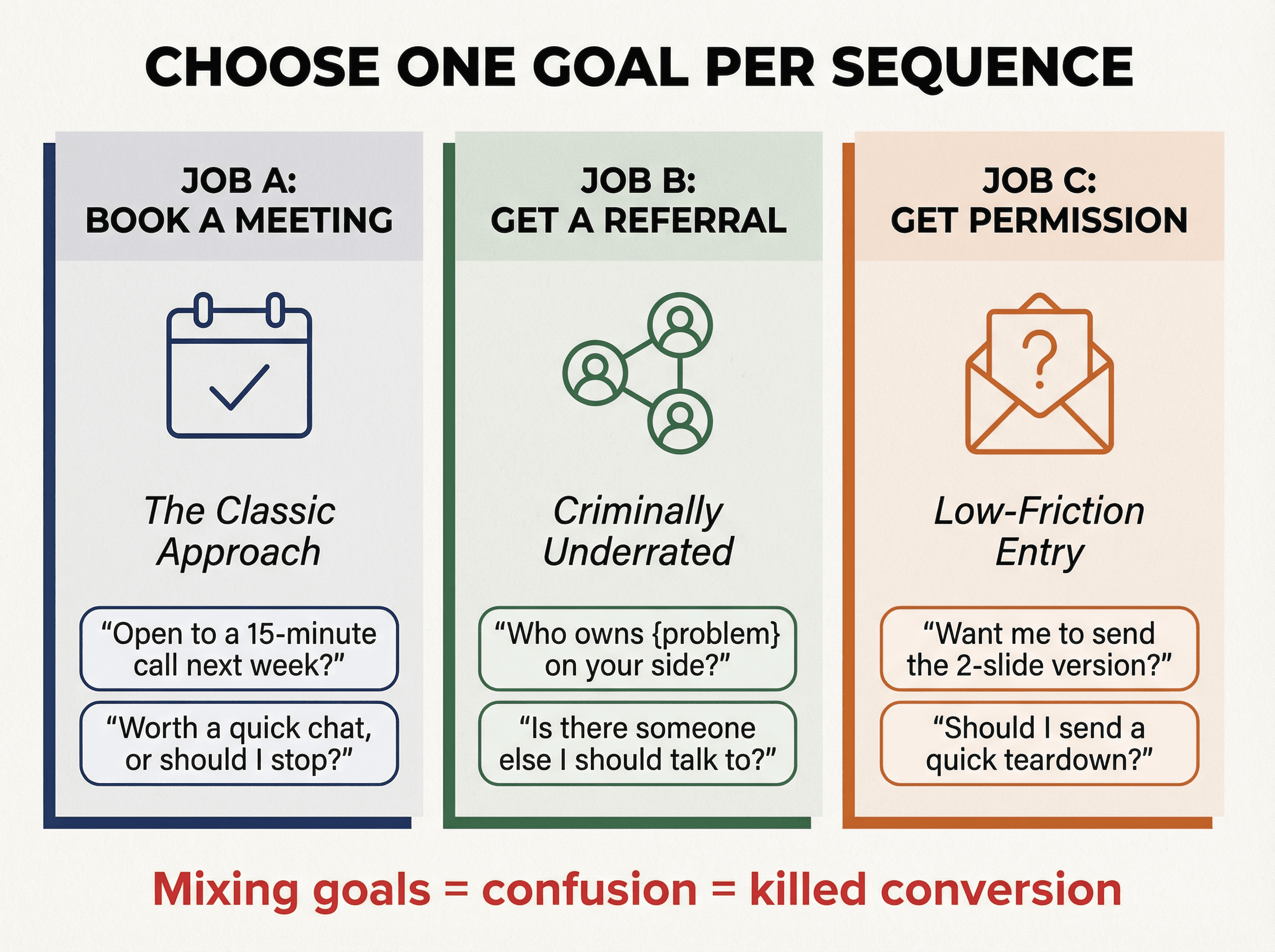
Choose one:
Job A: Book a Meeting (The Classic)
Best when your offer is easy to explain in 1-2 sentences and you have clear proof (case studies, results, credible outcomes).
CTA examples:
"Open to a 15-minute call next week?"
"Worth a quick chat, or should I stop?"
Job B: Get a Referral (Criminally Underrated)
Studies found referral requests were the most effective follow-up type in analysis of cold email campaigns. This works incredibly well when you're not sure you found the right person.
CTA examples:
"Who owns {problem} on your side?"
"Is there someone else I should talk to?"
Job C: Get Permission to Send Something (Low-Friction)
Best when your offer needs context: complex product, enterprise sale, technical solution.
CTA examples:
"Want me to send the 2-slide version?"
"Should I send a quick teardown of your current setup?"
Pick ONE job per sequence. If you ask for a meeting in email 1, a referral in email 2, and permission to send something in email 3, you're just confusing people. Confusion kills replies.
What to Write in Each Cold Email: Email-by-Email Breakdown
Most sequences fail because they repeat the same pitch four times with slightly different wording.
Your prospect didn't reply to email 1 for a reason. Maybe they didn't see it. Maybe they saw it but don't trust you. Maybe timing's wrong. Maybe you have the wrong person entirely.
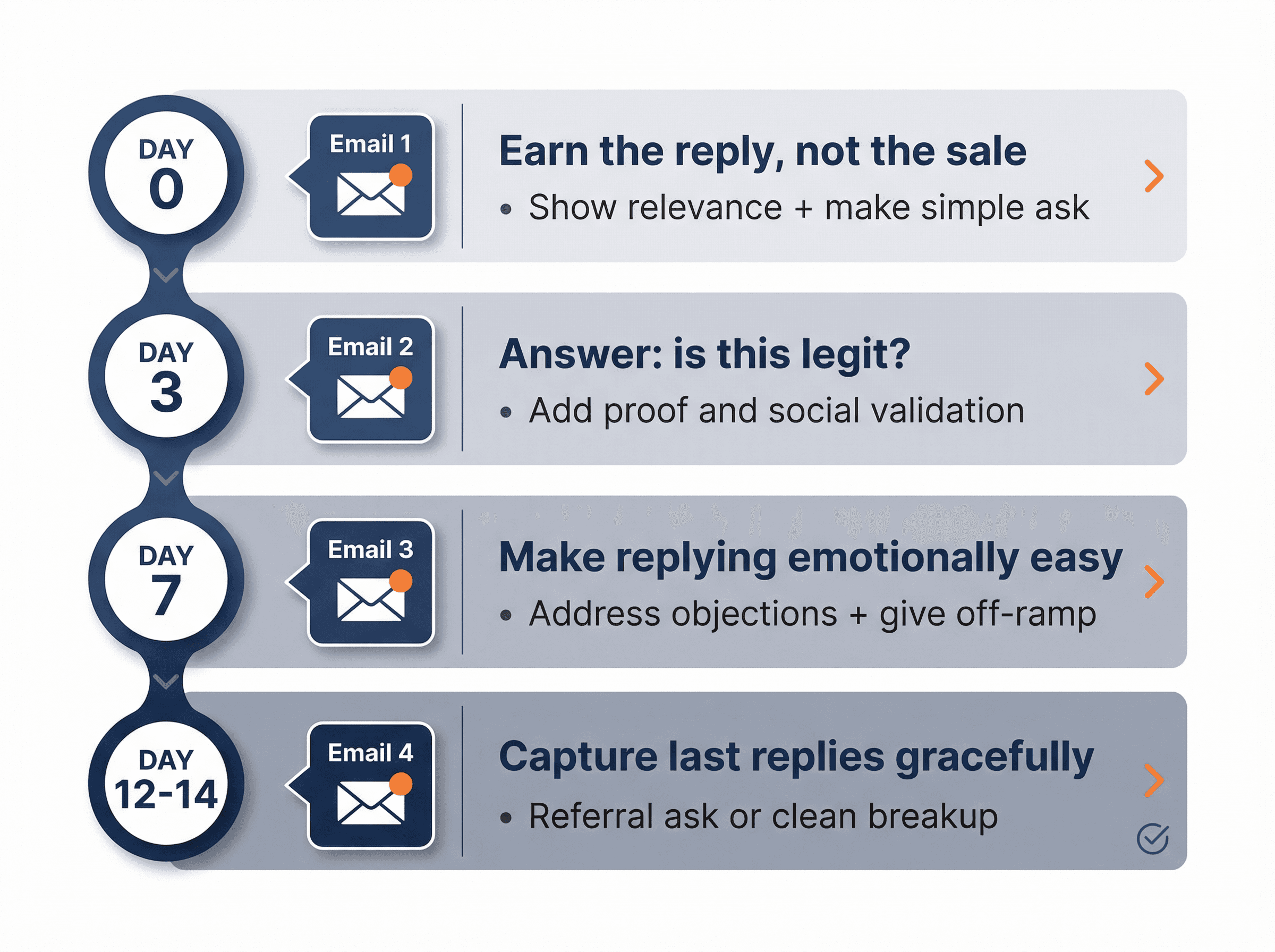
Think of your sequence as progressive objection handling. Each email removes one reason to ignore you.
Email 1: What to Write in Your First Cold Email
Goal: Earn the reply, not the sale.
Your first email should answer three questions instantly:
① Why them? (Show you understand their context)
② Why you? (What specific outcome do you deliver)
③ What's the ask? (Make it easy to say yes or no)
Structure:
→ 1 line: why them (signal that this isn't mass spam)
→ 1 line: why you (specific outcome they care about)
→ 1 line: proof (optional but powerful)
→ 1 line: the ask (yes/no question)
Example skeleton:
"Noticed {trigger} at {company}."
"We help {similar companies} do {specific outcome} without {common downside}."
"Recently did {result} for {peer company}."
"Worth a 15-minute chat, or not a priority?"
The tone should be helpful and tailored, not a generic sales pitch. You're aiming to spark interest and establish credibility. Start with a strong, personalized opening that shows why you're reaching out to them specifically.
Keep it to 50-125 words. B2B decision-makers don't have time for essays.
Email 2: What to Write in Your Second Cold Email
Goal: Answer "is this legit or another random tool?"
If Email 1 doesn't get a response, Email 2 should build on it by offering new value or social proof. Research shows this message often yields the best reply rates, so make it count.
Add one new proof element:
→ A mini case study (one sentence)
→ A specific metric (if you can back it up)
→ A relevant observation about their market
Common approach:
"Hi {Name}, wanted to follow up and share a quick example. A company similar to yours saw {specific metric improvement} by {solution}. Here's what changed: {one-line explanation}."
By providing a tangible example or useful insight, you're demonstrating credibility and giving them a reason to respond.
Avoid:
"Just bumping this to the top of your inbox..."
That's lazy. Add value or don't send the email.
Email 3: What to Write in Your Third Cold Email
Goal: Make replying emotionally easy.
By the third touch, you've shown value twice. If there's still no reply, it helps to address potential objections or give them an off-ramp.
This is where you remove pressure:
"I might be off. Is {problem} even on your radar this quarter?"
"If this isn't relevant, I'll close the loop."
Why this works: Giving people permission to say no often gets them to engage. You're removing the social pressure of feeling like they have to be interested. It makes replying feel lower-stakes.
Another effective approach is the objection handler:
"I understand timing or fit might not be right. Often I hear companies worry about {common objection}. If that's the case, we have a way to {reassure or solve that}."
You might phrase it as: "Would a 15-minute chat be worth it to discuss if this could fit, or is there someone else I should be talking to?"
This gives them an easy out to refer you or express disinterest, rather than just ignoring you.
Email 4: What to Write in Your Final Cold Email
Goal: Capture last replies without harming your sender reputation.
The final email is commonly known as a "breakup email." It serves two purposes: gives the prospect one last gentle nudge and graciously offers to close the loop.
You have two good options here:
Option A: Referral Ask (Often Highest Leverage)
Studies found referral requests can be highly effective as a follow-up type. Even if this person isn't interested, they might know who is.
"If you're not the right person, who owns {area} on your team?"
"I haven't heard back, so I assume this isn't a fit. Is there someone else I should reach out to instead?"
Option B: Clean Breakup
"Should I stay in touch for later, or close this out?"
"Hi {Name}, I haven't heard back, so I assume now isn't the right time. If there's no interest, let me know and I won't clutter your inbox. If you'd prefer I reach out later or talk to someone else, I'm happy to do that too. Thanks for your time."
A classic subject line is "Permission to close your file?" which immediately signals this might be the last email.
Why send a breakup? Some prospects truly intend to respond but keep forgetting. A courteous close-out can prompt them to finally reply ("Sorry, I've been meaning to get back to you..."). And for those uninterested, you've shown respect for their time by not hounding them indefinitely.
Critical rule: Stop after this email. If four emails haven't gotten a reply, further persistence will annoy recipients or trigger spam complaints. Respect the silence.
Cold Email Copywriting Rules That Get Replies
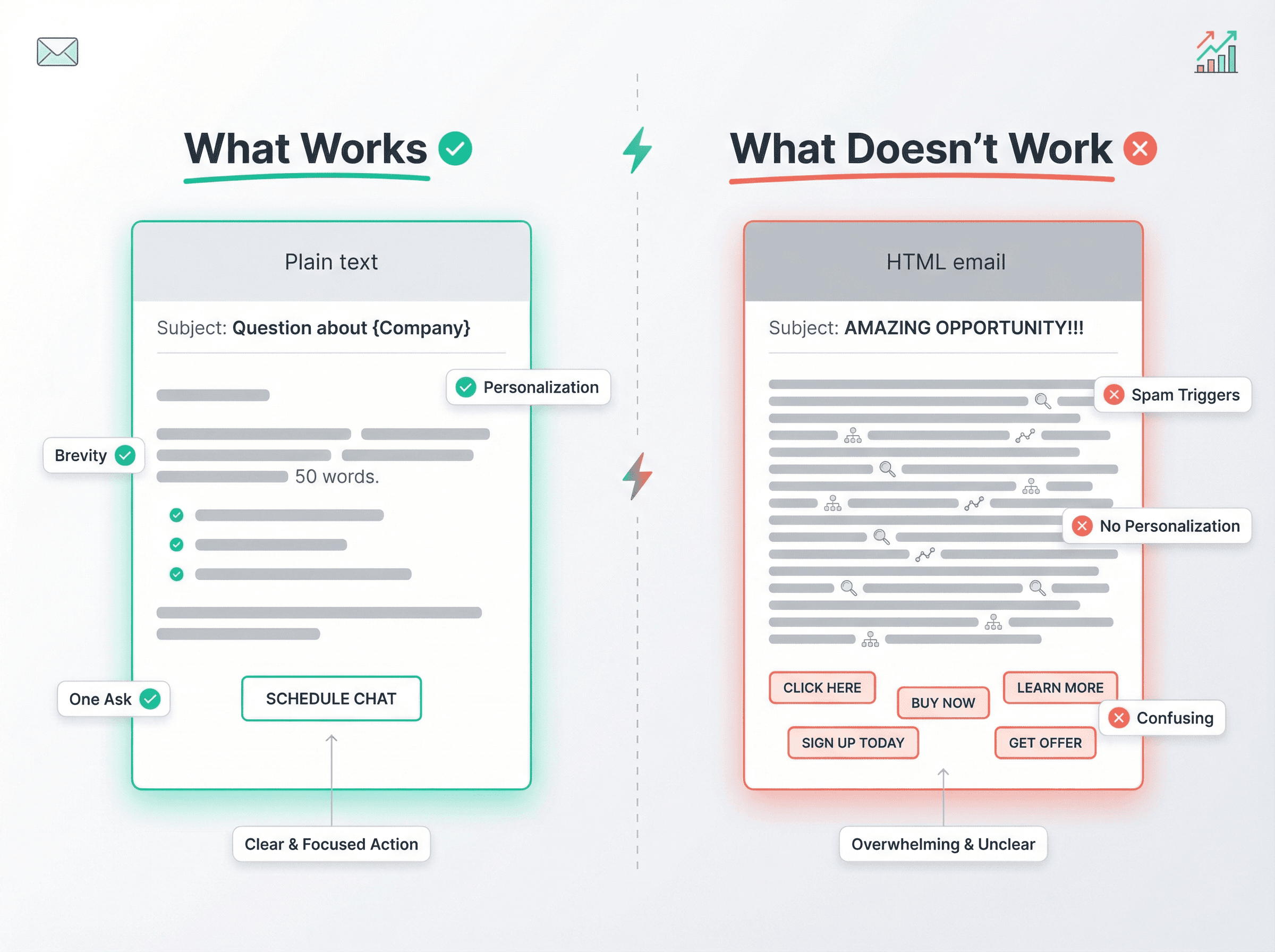
The mechanics of what you write matter as much as the structure.
Should Cold Emails Be Plain Text or HTML?
You're sending cold outbound, not a newsletter. Keep it clean:
No images (they trigger spam filters and look like marketing)
No attachments (security risk for recipients)
Minimal links (only if the link IS the offer, like a Loom teardown)
Studies found tracking pixels correlate with lower reply rates. This matches what deliverability experts have said for years. Plain text emails that look like they came from a human perform better than heavily formatted HTML emails.
Stick to 50-125 words per email for B2B cold outreach. Use short paragraphs or bullet points to break up text. Make your key point extremely clear and front-loaded. The reader should grasp the gist almost instantly.
How to Personalize Cold Emails Without Being Creepy
Personalization isn't "I saw your dog's name on Instagram."
Real personalization is:
→ "I understand your context"
→ "This is relevant to your world"
→ "This isn't a mass blast"
Research shows lack of relevancy is the #1 reason decision-makers don't respond (71%). Generic templates kill conversion.
So the best personalization is situational, not "fun facts."
Use the prospect's name, company, industry specifics, and any relevant trigger events or insights you've gathered. Refer to something specific (a recent funding announcement, a role change, a common connection).
This shows recipients these emails are for them, not generic spam blasted to thousands.
What Subject Lines Work Best for Cold Emails?
Google explicitly warns against misleading headers/subjects and fake "re:" or "fwd:" unless it's actually a reply or forward.
Keep it boring:
"Quick question"
"{company} + {outcome}"
"{topic}"
"Re: {topic}" only if it's truly a reply
Keep them brief (5-7 words if possible) and personalized (e.g., "Idea for {Company}" or "Question about {Goal}"). The subject is the gatekeeper. Make it intriguing but not spammy. Avoid all-caps or gimmicky clickbait.
When Is the Best Time to Send Cold Emails?
There's conflicting advice here:
Research suggests decision-makers are pretty indifferent to when you email. Outbound System has published guides on best sending times, but we frame it as starting defaults plus testing for your specific audience.
The reality: Timing matters less than relevance and deliverability. Pick business hours (9am-5pm in their timezone), then test to see what works for your audience.
How to Add Value in Cold Email Follow-Ups
Before sending any follow-up, ask yourself: "What value am I providing in this email?"
If the answer is "none" or "just reminding them I exist," rewrite it.
Every touchpoint is an opportunity to offer something helpful:
→ A piece of advice
→ A relevant resource
→ A fresh perspective on their problem
→ A quick industry insight
Never send a blank "Just following up on my last email..." message with nothing new to say. That's a fast track to being ignored (or marked as spam).
Instead, enrich each follow-up. Share a quick tip, a statistic, a client example, a link to a useful article or toolkit. This "give before you ask" approach builds goodwill and credibility.
What Call-to-Action Works Best in Cold Emails?
The goal of your sequence is typically to book a meeting or call. But you need to earn that with a clear and easy call-to-action.
A "low-friction" CTA means it's a small ask, not a big commitment:
Instead of "Would you like a 1-hour product demo next week?", say "Are you available for a 10-15 minute chat?" Shorter time implies less hassle.
Instead of "Let me know when you can hop on a call," give specific options to reduce decision fatigue: "Do any of these times work: Tues 2pm or Wed 10am?"
Another effective tactic is the one-click approach: "If you're interested, just reply 'Yes' and I'll send over a couple of times."
Only ask one thing in your email. Don't confuse the reader with multiple CTAs. Pick one next step and make it clear.
Email Deliverability Rules for Cold Outreach in 2026
If you ignore this section, your sequence "structure" won't matter because you won't hit inbox.
Starting in 2024, Gmail, Yahoo, and Microsoft (Outlook) all tightened their requirements for bulk senders. These aren't optional. They're the new baseline.
Gmail Email Requirements (Starting February 1, 2024)
Google's email sender guidelines say that starting Feb 1, 2024, senders must meet requirements when emailing Gmail accounts:
Requirement | Details |
|---|---|
Authentication | SPF or DKIM (and DMARC for bulk senders sending more than 5,000 messages per day) |
Spam Rate | Keep spam rates in Postmaster Tools below 0.3% |
Unsubscribe | If you send more than 5,000 messages/day, marketing/subscribed messages must support one-click unsubscribe via list-unsubscribe headers |
No Deception | Don't use misleading formatting tricks ("re:", hidden content, fake personalization) |
What this means for sequence structure:
→ Fewer, higher-quality touches beat tons of low-quality touches
→ Stop after your sequence ends (don't keep "bumping" forever)
→ Always include a clean opt-out (even for cold outbound)
Yahoo Email Requirements (Enforcement Starting February 2024)
Yahoo's sender requirements say enforcement began in Feb 2024:
Requirement | Details |
|---|---|
Spam Rate | Spam complaint rate below 0.3% |
Authentication | For bulk senders: SPF + DKIM + DMARC (at least p=none) |
Unsubscribe | Support one-click unsubscribe via list-unsubscribe + visible link, and honor unsubscribes within 2 days |
What this means:
→ Your last emails (email 4/5) matter because unsub/spam complaints spike when people get annoyed
→ Make the final touch a clean close or referral ask, not "checking in again"
Microsoft Outlook Email Requirements (April 2025 Update)
Microsoft's Defender for Office 365 blog announced (Apr 2, 2025; updated Apr 30, 2025) new requirements for domains sending more than 5,000 emails/day:
Requirement | Details |
|---|---|
Authentication | SPF, DKIM, DMARC required |
Enforcement | Non-compliant messages may be routed to junk first, and later rejected |
What this means:
→ If you scale, you need real infrastructure and authentication
→ "Spray and pray" is dead; it creates bounces/complaints and tanks reputation
These rules fundamentally changed how cold email works at scale. You can't just spin up a Gmail account and blast thousands of emails anymore. You need proper infrastructure.
Is Cold Email Legal? B2B Compliance Basics
Not legal advice, but here's the practical version.
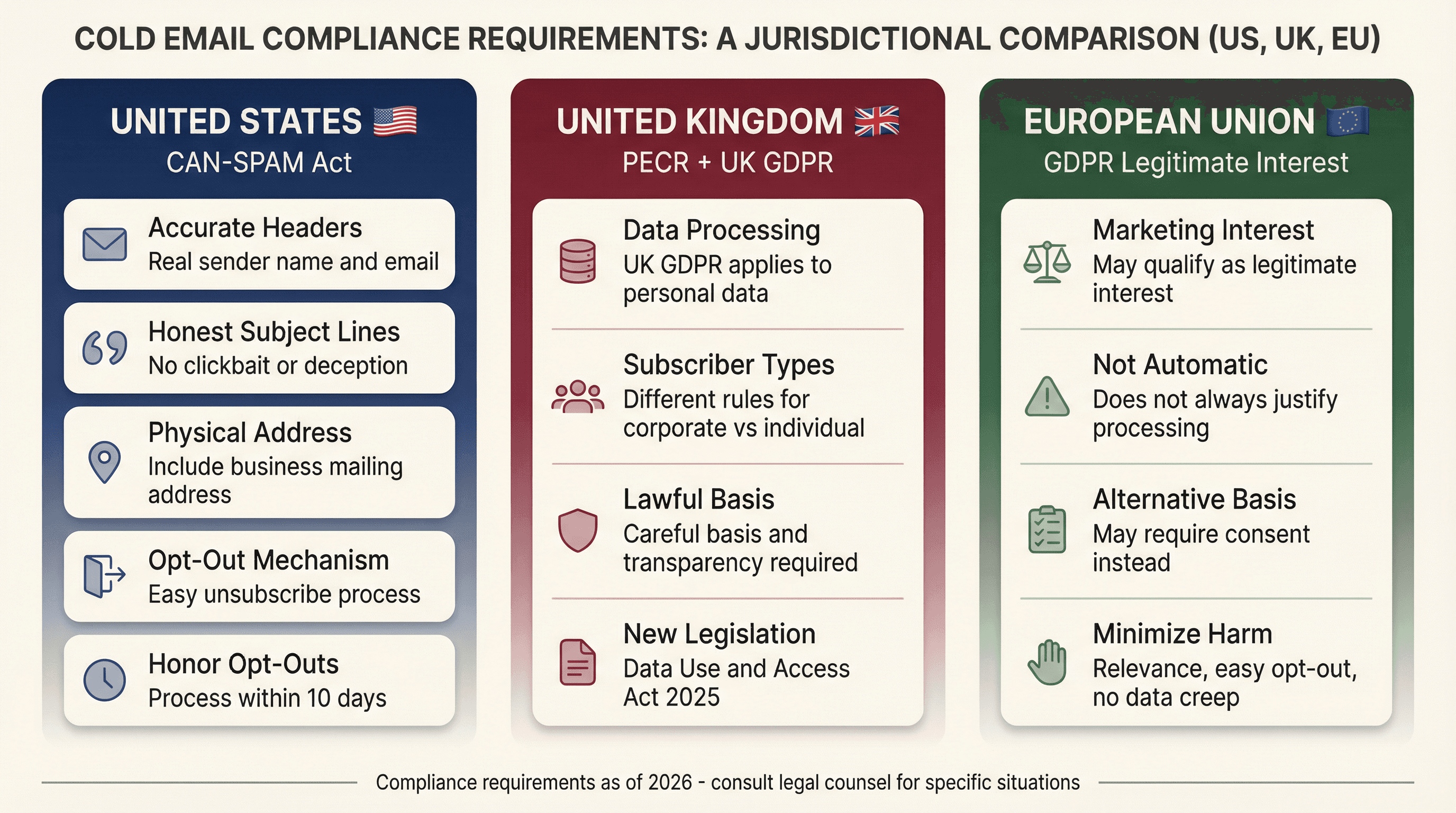
US Cold Email Requirements (CAN-SPAM)
The FTC's CAN-SPAM compliance guide makes it clear the law covers commercial messages, including B2B:
Requirement | What It Means |
|---|---|
Accurate headers | Your "From" name and email must be real |
Honest subject lines | No clickbait or deception |
Physical address | Include your business mailing address |
Opt-out mechanism | Make it easy to unsubscribe |
Honor opt-outs | Process unsubscribe requests within 10 days |
Sequence implication: Build opt-out and identity clarity into every email, not just email 1.
UK Cold Email Requirements (PECR + UK GDPR)
The UK ICO notes B2B marketing is still regulated:
UK GDPR applies when you process personal data, even in a business context
PECR rules differ for "corporate subscribers" vs "individual subscribers" (sole traders, some partnerships)
Their guidance is under review due to the Data (Use and Access) Act coming into law on June 19, 2025
Sequence implication: If you're emailing UK leads, you need to be extra careful about lawful basis and transparency.
EU Cold Email Requirements (GDPR Legitimate Interest)
The EDPB's guidelines on legitimate interest (Oct 2024 version for public consultation) state:
Processing personal data for direct marketing purposes may be regarded as a legitimate interest (recital 47), but it does not mean direct marketing always qualifies
Some cases may require a different legal basis such as consent
Sequence implication: If you're outbounding into the EU, don't wing it. Use counsel, and design sequences to minimize harm: relevance, easy opt-out, and no data creep.
Cold Email Sequence Planning Framework (Copy This)
Copy this into a doc and fill it out. This forces you to think through Layers 1, 2, and 3 before writing a single email.
1) Audience Micro-Segment
Title: ______ (e.g., "VP of Sales at B2B SaaS companies")
Company type: ______ (e.g., "50-200 employees, selling to enterprise")
Trigger: ______ (e.g., "Just raised Series A")
Pain: ______ (e.g., "Outbound pipeline is inconsistent")
"Why now": ______ (e.g., "Need to prove ARR growth to investors")
2) Offer (What You're Asking For)
15 min call / referral / permission to send: ______
What they get: ______ (e.g., "Framework to add 20 qualified meetings per month")
What it costs them (time/risk): ______ (e.g., "15 minutes, zero commitment")
Proof: ______ (e.g., "Helped 3 similar companies add $500k pipeline in 90 days")
3) Objections Map (These Become Your Follow-Ups)
Objection 1: "not relevant" → follow-up angle: ______
Objection 2: "no trust" → follow-up angle: ______
Objection 3: "not now" → follow-up angle: ______
Objection 4: "wrong person" → referral ask: ______
4) Sequence Plan
Email 1 (relevance): ______
Email 2 (proof): ______
Email 3 (disqualify): ______
Email 4 (referral/breakup): ______
This framework forces clarity. If you can't fill it out, your sequence isn't ready.
Cold Email Sequence Templates You Can Copy
These are plug-and-play templates. Customize the {variables} for your use case.
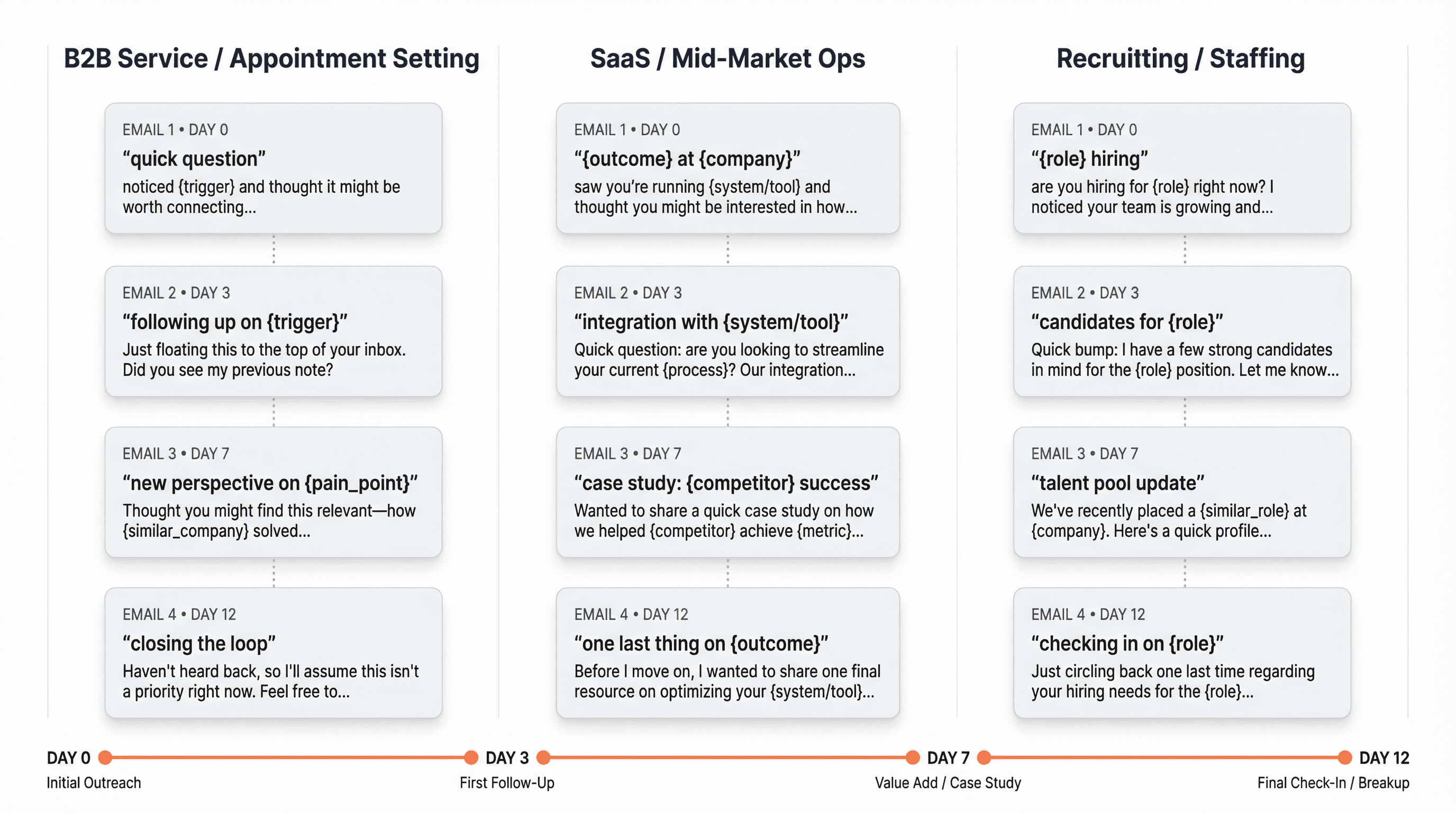
Sequence 1: B2B Service (Appointment Setting / Lead Gen)
Email 1 (Day 0)
Subject: quick question
"{first_name}, noticed {trigger}.
Do you have a reliable way to generate {type of meetings} right now, or is pipeline mostly {current source}?
If it's on your radar, I can share a simple breakdown of what's working for similar {industry} teams. Open to 15 mins?"
Email 2 (Day 3)
Subject: quick question
"Quick follow-up. We recently helped a {peer company type} go from {starting point} to {result} by changing two things:
{change}
{change}
Worth seeing if that applies to {company}, or should I stop?"
Email 3 (Day 7)
Subject: quick question
"I might be off here. Is {problem} even something you'd want to fix this quarter, or is it handled?"
Email 4 (Day 12)
Subject: quick question
"Last one from me. If you're not the right person for {area}, who is? I'll reach out to them instead."
Sequence 2: SaaS (Mid-Market, Selling to Ops/IT)
Email 1
Subject: {outcome} at {company}
"{first_name}, saw you're running {system/tool}.
Teams using that usually hit {pain} once they scale past {threshold}.
We help ops teams cut {metric} by {mechanism}.
Worth a quick chat to see if it's relevant?"
Email 2
Subject: {outcome} at {company}
"Two quick notes:
• The fastest win is usually {win} (takes ~{time})
• Second is {win} (stops {bad thing})
Want the 2-slide overview?"
Email 3
Subject: {outcome} at {company}
"If you're already happy with {current state}, totally fair.
What matters more for you right now: {priority a} or {priority b}?"
Email 4
Subject: {outcome} at {company}
"Closing the loop. Should I follow up later in the year, or is this a 'no'?"
Sequence 3: Recruiting / Staffing (High Competition Market)
Keep it brutally specific and low-fluff.
Email 1
Subject: {role} hiring
"{first_name}, are you hiring for {role} in {location} right now?
We've been able to deliver {type of candidates} in ~{timeframe} for {similar company type}.
If you want, I can send 2 anonymized profiles."
Email 2
Subject: {role} hiring
"Can send the profiles if helpful. Are you looking for {option a} or {option b}?"
Email 3
Subject: {role} hiring
"Wrong timing, or wrong person?"
Email 4
Subject: {role} hiring
"Who owns hiring for {function} on your team?"
How Outbound System Builds Cold Email Sequences at Scale
Building and managing cold email sequences that consistently hit inbox and book meetings isn't simple when you're operating at scale.
At Outbound System, we run sequences for 1,000+ B2B clients across industries. Here's how we handle the infrastructure, deliverability, and optimization challenges that kill most DIY efforts.
Private Microsoft Azure U.S. IP Infrastructure
Most teams use shared IP pools (like your standard Gmail or email automation tool). The problem? You're sharing reputation with thousands of other senders. If they get flagged for spam, you suffer too.
We use 350 to 700 dedicated Microsoft Azure U.S. IP inboxes depending on the plan. This distributed sending approach keeps each inbox's volume low (mimicking natural human patterns) while maintaining overall scale through parallelization.
Why Microsoft specifically? Better inbox placement rates compared to shared infrastructure. Our clients see 98% primary inbox placement across Gmail, Outlook, and Yahoo.
9-Step Waterfall Enrichment for Data Quality
Bad data kills deliverability. Hard bounces damage your sender reputation. Incorrect emails waste your sequence slots.
Our data pipeline uses 9-step waterfall enrichment combining:
→ Syntax validation checks
→ SMTP ping verification
→ Historic bounce data analysis
→ Engagement signal evaluation
This happens before any sequencing begins. Result: minimal bounces, higher reply probability.
AI Personalization + Human Copywriting
We combine human-written copy with AI-powered personalization at the line level. Human copywriters establish the core value proposition and structure. AI systems generate personalized lines based on prospect data, company information, and relevant triggers.
This approach drives 6-7% average response rates across our client base (significantly higher than industry averages of 1-3%).
Multi-Channel Coordination (Email + LinkedIn)
Email sequences work better when combined with other touchpoints. We often set up coordinated email + LinkedIn cadences (12 touches over 3 weeks) where LinkedIn interactions are interwoven with the email sequence.
This creates familiarity and trust. By the time they see email 3, they've also seen your LinkedIn profile, maybe connected, and received a thoughtful message there.
Dedicated Strategist for Testing and Optimization
Every client gets a dedicated account strategist who:
→ Analyzes performance data (reply quality, meeting conversion)
→ Runs A/B tests on messaging, segments, and offers
→ Refines approach based on what's actually working
This isn't "set it and forget it." We treat sequences as living systems that improve over time.
Real Results
Across our 1,000+ clients:
52M+ cold emails sent
127K+ leads generated
$26M in closed revenue
98% inbox placement
6-7% average response rates
Read detailed case studies showing how specific clients achieved results.
Want to see if this approach fits your outbound motion? Book a 15-minute consultation and we'll walk through your specific use case.
How to Track and Improve Cold Email Sequence Performance
A sequence should never be "set and forget." You need to track the right metrics and iterate based on real data.
What Metrics Matter Most for Cold Email Sequences?
① Reply rate by step (which email generates replies)
Track this for each email in your sequence. Often you'll find Email 2 or 3 performs better than Email 1. This tells you where to focus optimization efforts.
② Positive reply rate (not just auto-replies)
Filter out "I'm not interested" and "remove me" responses. What percentage of replies are genuinely positive or neutral?
③ Meeting rate (meetings booked / leads contacted)
This is your north star. Replies are nice, but booked meetings are what matter.
④ Bounce rate + spam complaints + unsub rate (deliverability health)
Keep bounce rates minimal (under 2%) and spam complaint rates extremely low (under 0.1%). These directly impact your sender reputation.
And again: don't use opens as your "truth" metric. Apple's Mail Privacy Protection preloads pixels and inflates opens. Replies are a better proxy for actual engagement.
Monitor Replies and Adjust
Pay attention to how prospects interact:
Stop the sequence immediately if the prospect replies. Don't be that person whose automation keeps emailing after a response. It's embarrassing and kills trust.
Track which emails in your sequence get the most replies. Many sales teams find the first follow-up (Email #2) has the highest conversion rate of all touches. If that's true for you, invest more effort optimizing Email 2.
The idea is to iteratively improve your sequence using real data, not guesses.
Maintain Deliverability Hygiene
This is behind-the-scenes, but absolutely vital. No matter how perfectly crafted your sequence is, it won't matter if your emails don't reach the inbox.
Keep bounce and complaint rates low (complaints under 0.1%, bounces under 2%)
Always include a clean opt-out (even for cold outbound)
Ensure all the basics (SPF, DKIM, DMARC) are configured correctly
Consider tools for inbox placement testing if you suspect deliverability problems
At scale, deliverability becomes the constraint that limits everything else. That's why Outbound System built private infrastructure specifically to solve this problem.
Why Smaller, More Targeted Segments Get Better Results
Research found a striking pattern:
Campaigns with 50 recipients or fewer averaged 5.8% reply rates
Campaigns with 1,000+ recipients averaged 2.1% reply rates
That's a 176% difference just from segment size.
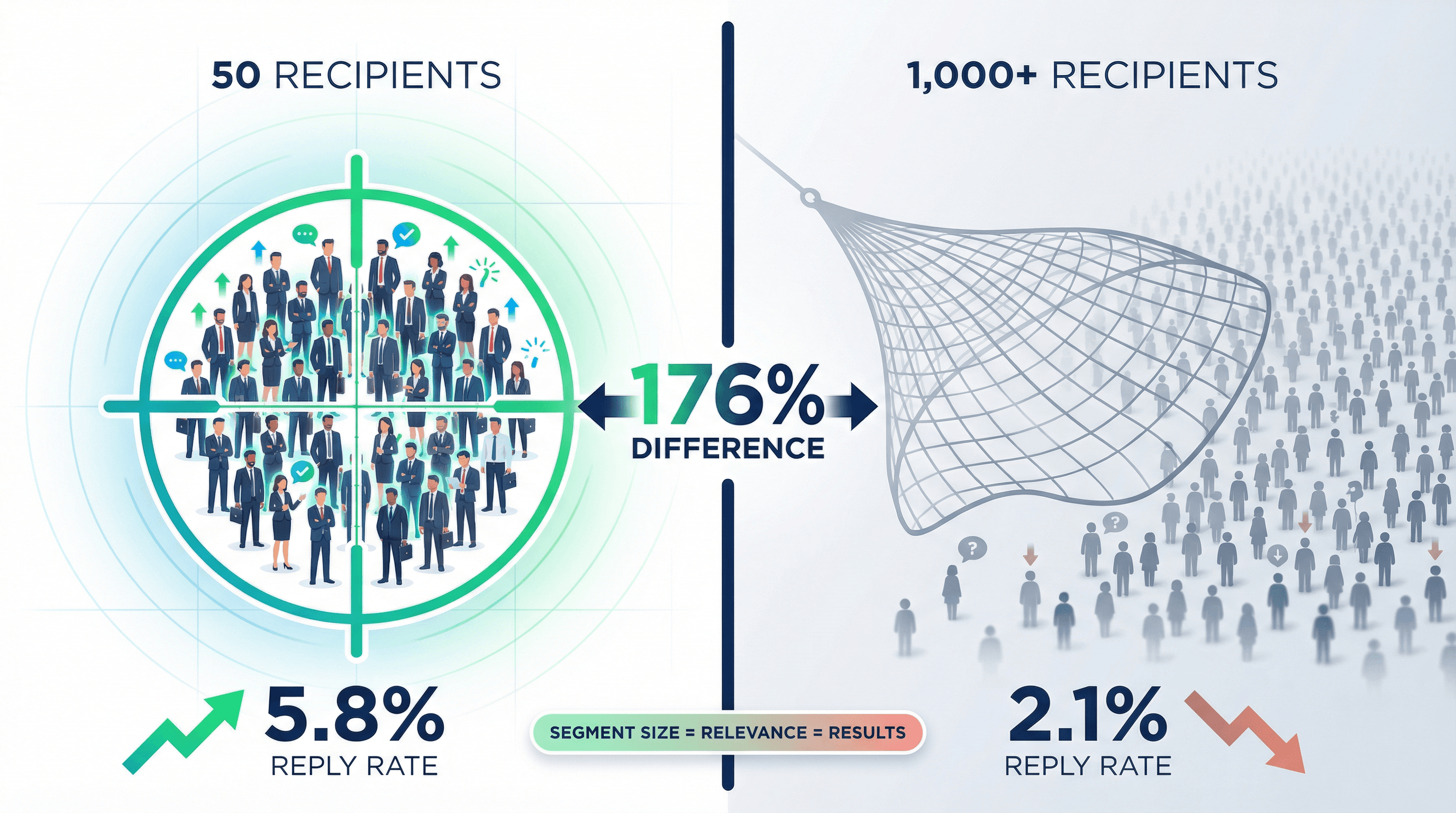
Translation: The best "sequence structure" is often just smaller segments with sharper relevance.
So instead of writing one 5-step sequence for 2,000 leads, write 3 versions of a 4-step sequence, each for a micro-segment of ~50-200 leads.
The copy can be more specific. The proof can be more relevant. The offer can be more tailored.
This is harder operationally (you need better data and more copywriting), but the results are dramatic.
How to Combine Email With LinkedIn and Phone Outreach
Although this guide focuses on email, the most effective outreach often combines email with other touchpoints (LinkedIn, phone, direct mail).
You can structure a multi-channel sequence where, for example:
Day 0: Send Email 1
Day 2: Connect on LinkedIn
Day 4: Send Email 2
Day 6: LinkedIn message
Day 9: Send Email 3
Day 11: Phone call attempt
Day 14: Send Email 4 (breakup)
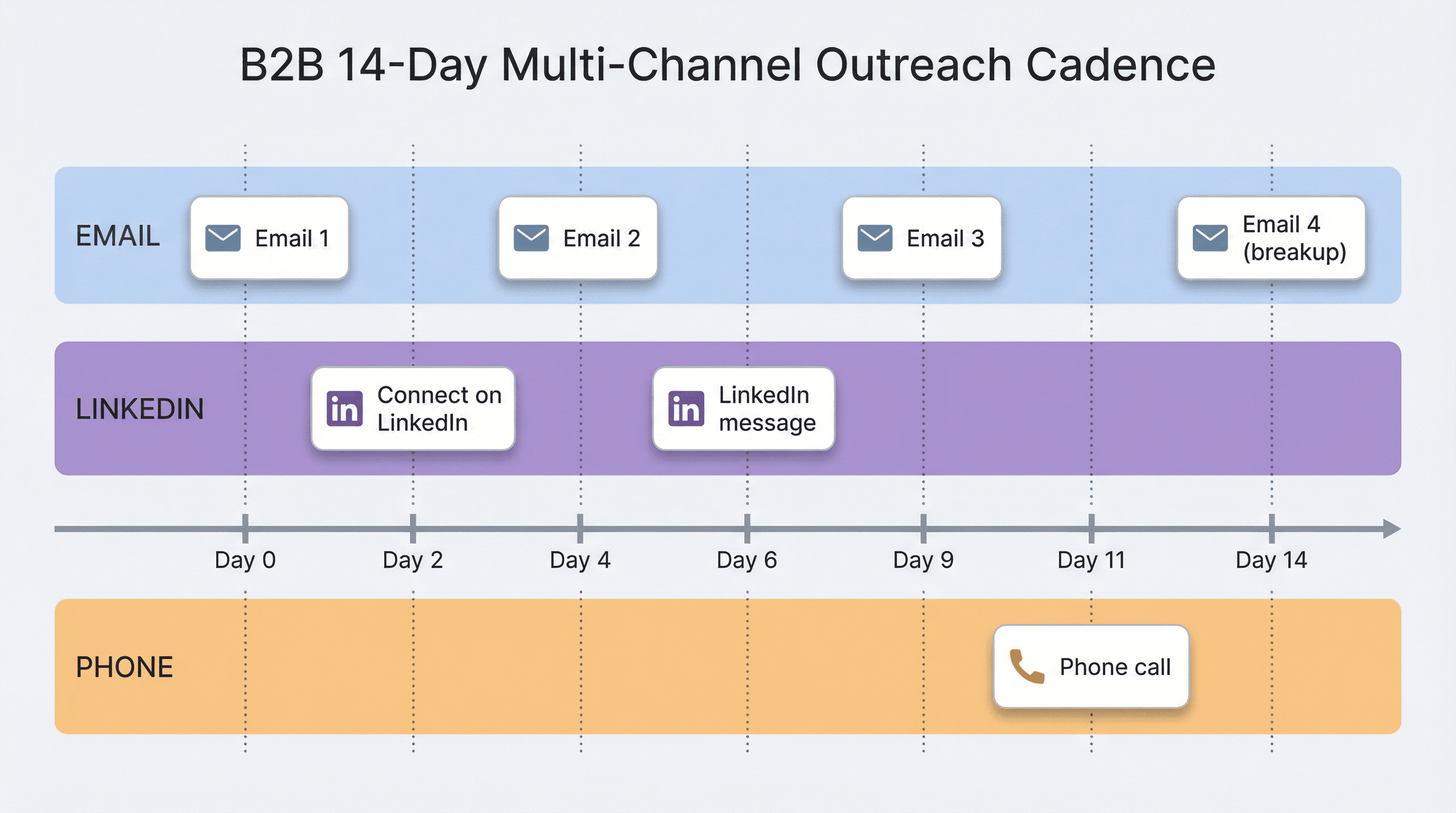
Research shows multi-channel approaches can improve overall response rates by creating familiarity and trust. Outbound System often sets up coordinated email + LinkedIn cadences (12 touches over 3 weeks) for clients, where LinkedIn interactions are interwoven with the email sequence.
The core structure of your email sequence remains the foundation. You're simply adding other touches in between to increase contact points and build recognition.
Cold Email Sequence Checklist: What Works in 2026
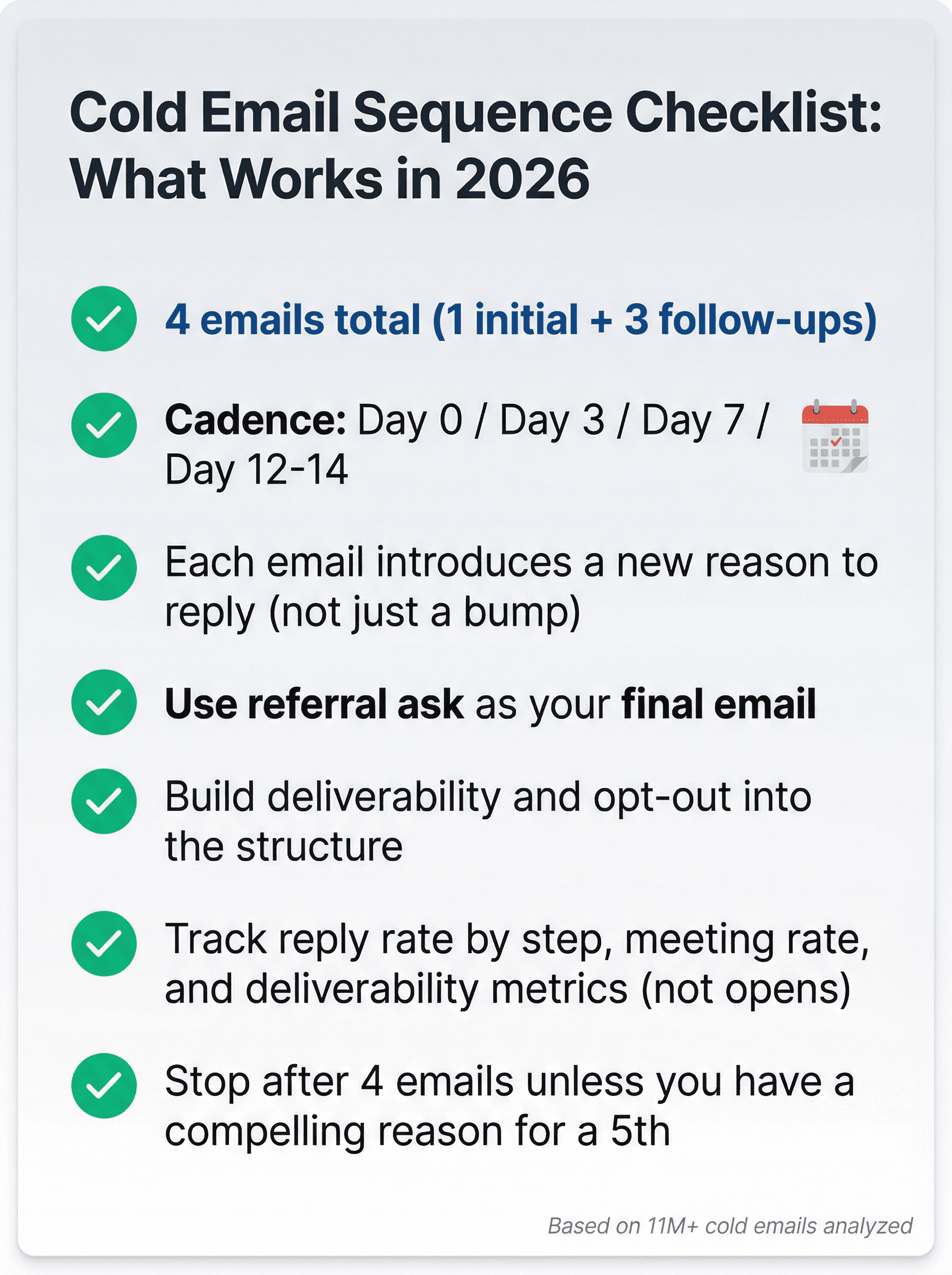
If you want a default that's hard to mess up, use this:
4 emails total (1 initial + 3 follow-ups)
Cadence: Day 0 / Day 3 / Day 7 / Day 12-14
Each email introduces a new reason to reply (not just a bump)
Use referral ask as your final email because it's effective and low-friction
Build deliverability and opt-out into the structure because Gmail/Yahoo/Outlook got stricter starting 2024-2025
Track reply rate by step, meeting rate, and deliverability metrics (not opens)
Stop after 4 emails unless you have a compelling reason (and value) for a 5th
Cold Email Sequence FAQ: Your Questions Answered
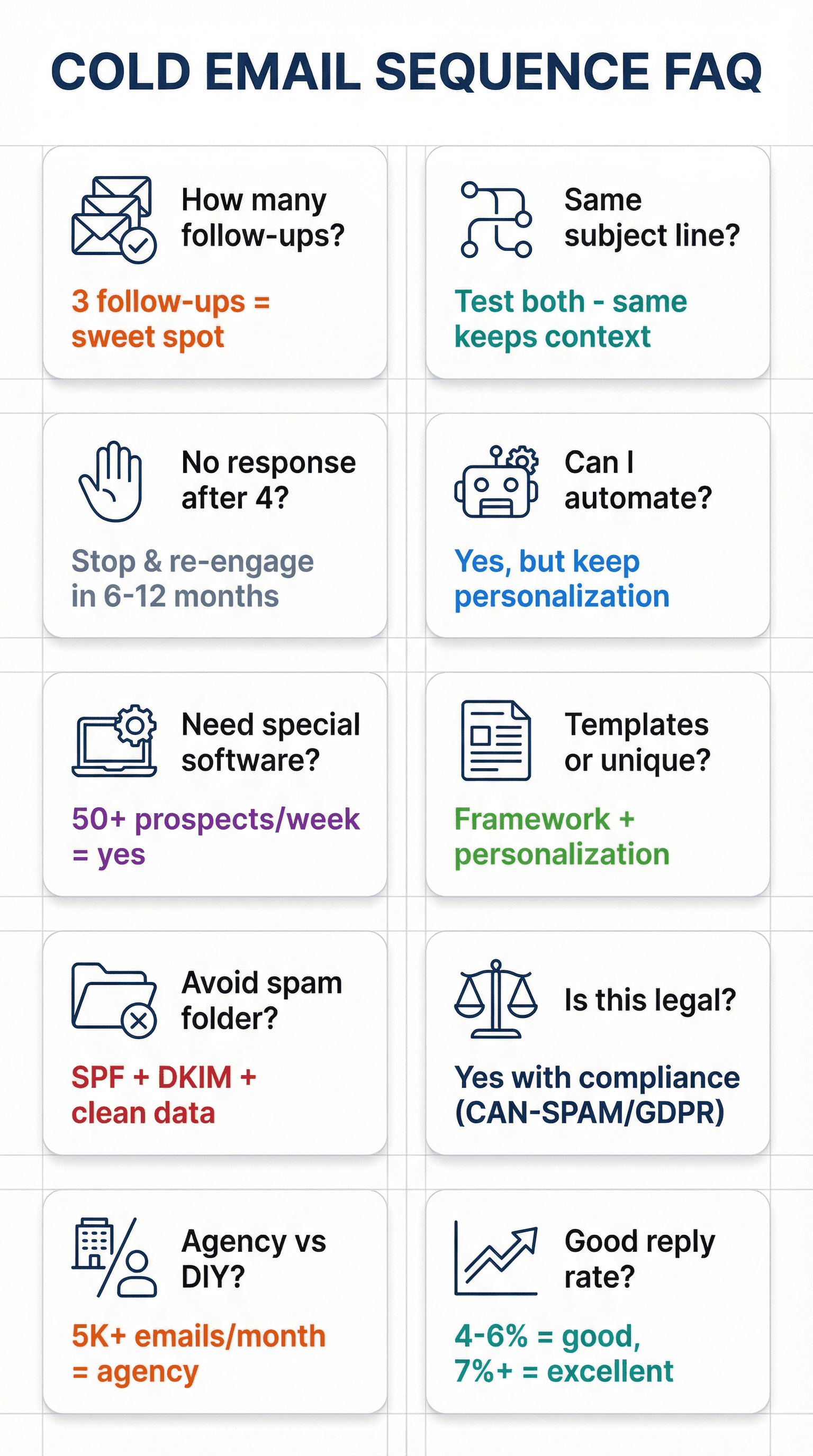
How many follow-ups is too many?
Three follow-ups (four emails total) is the sweet spot. After that, unsubscribe rates and spam complaints spike. Research shows reply rates drop sharply after the third follow-up, so you're burning goodwill for minimal gain.
Should I use the same subject line for all emails in the sequence?
It depends. Using the same subject line keeps emails in one thread (which some people prefer for context). But it also makes it obvious you're following up. Test both approaches. Common pattern: use the same subject for emails 1-3, then change it for email 4 (the breakup).
What if they don't respond to any of my emails?
Stop after 4 emails. Mark them as "not interested for now" and move on. You can re-engage them in 6-12 months with a completely fresh sequence if circumstances change (new trigger, new offer, new angle).
Can I automate this entire sequence?
Yes, but carefully. Use automation tools that:
→ Stop the sequence immediately when someone replies
→ Let you customize variables and personalization
→ Handle unsubscribes automatically
→ Track deliverability metrics
Never use automation as an excuse to skip personalization or relevance. Automated spam is still spam.
Do I need special software to run cold email sequences?
Not necessarily. You can start with manual follow-ups using Gmail or Outlook. But if you're doing any volume (50+ prospects per week), you'll want:
→ A CRM or email automation tool
→ Proper deliverability infrastructure (SPF/DKIM/DMARC)
→ Clean data and enrichment
At scale, the infrastructure matters a lot. That's why many companies use agencies like Outbound System rather than building it in-house.
Should I write unique emails for every prospect or use templates?
Use templates as frameworks, not copy-paste scripts. Your structure should be repeatable (that's efficient), but your personalization should be specific (that's effective).
Good approach:
→ Template: "We help {industry} companies do {outcome} without {common pain}"
→ Personalized fill-ins: "{industry} = B2B SaaS", "{outcome} = add 20 qualified meetings monthly", "{common pain} = burning cash on tools"
How do I avoid the spam folder?
Focus on three things:
Technical setup: SPF, DKIM, DMARC configured correctly
List quality: Clean data, minimal bounces, relevant targeting
Engagement signals: High positive reply rates, low complaints/unsubs
Outbound System achieves 98% inbox placement by using private Microsoft infrastructure, triple-verified data, and careful volume management. At scale, you need real infrastructure.
Is cold email legal? What about GDPR?
Cold B2B email is legal in most jurisdictions (US, UK, EU) if done correctly. Requirements:
US (CAN-SPAM): Include opt-out, physical address, accurate headers
UK (PECR + GDPR): Lawful basis for processing, transparency, easy opt-out
EU (GDPR): Legitimate interest may apply, but depends on context
This isn't legal advice. Work with counsel if you're unsure about your specific situation. Read our compliance guide for more details.
When should I use an agency vs doing it myself?
Use an agency when:
→ You're sending more than 5,000 emails per month (deliverability gets complex)
→ You don't have in-house expertise for copywriting, data enrichment, and deliverability
→ Your time is better spent on sales calls and closing deals
→ You want to test faster and scale without hiring a team
DIY when:
→ You're just starting (under 500 emails per month)
→ You have very unique positioning that requires deep customization
→ You have in-house talent and time to manage it
Outbound System starts at $1,499/month with month-to-month contracts (no long-term commitment). For many teams, that's cheaper than hiring an SDR and faster than building infrastructure yourself.
What's a good reply rate for cold email?
Industry benchmarks:
1-3% = average for most cold outbound
4-6% = good (you're doing better than most)
7%+ = excellent (tight targeting, great copy, strong infrastructure)
Outbound System's client average is 6-7% positive reply rates thanks to private infrastructure, quality data, and dedicated optimization. But reply rate matters less than meeting rate and deal quality.
Conclusion: Build Sequences for Conversations, Not Campaigns
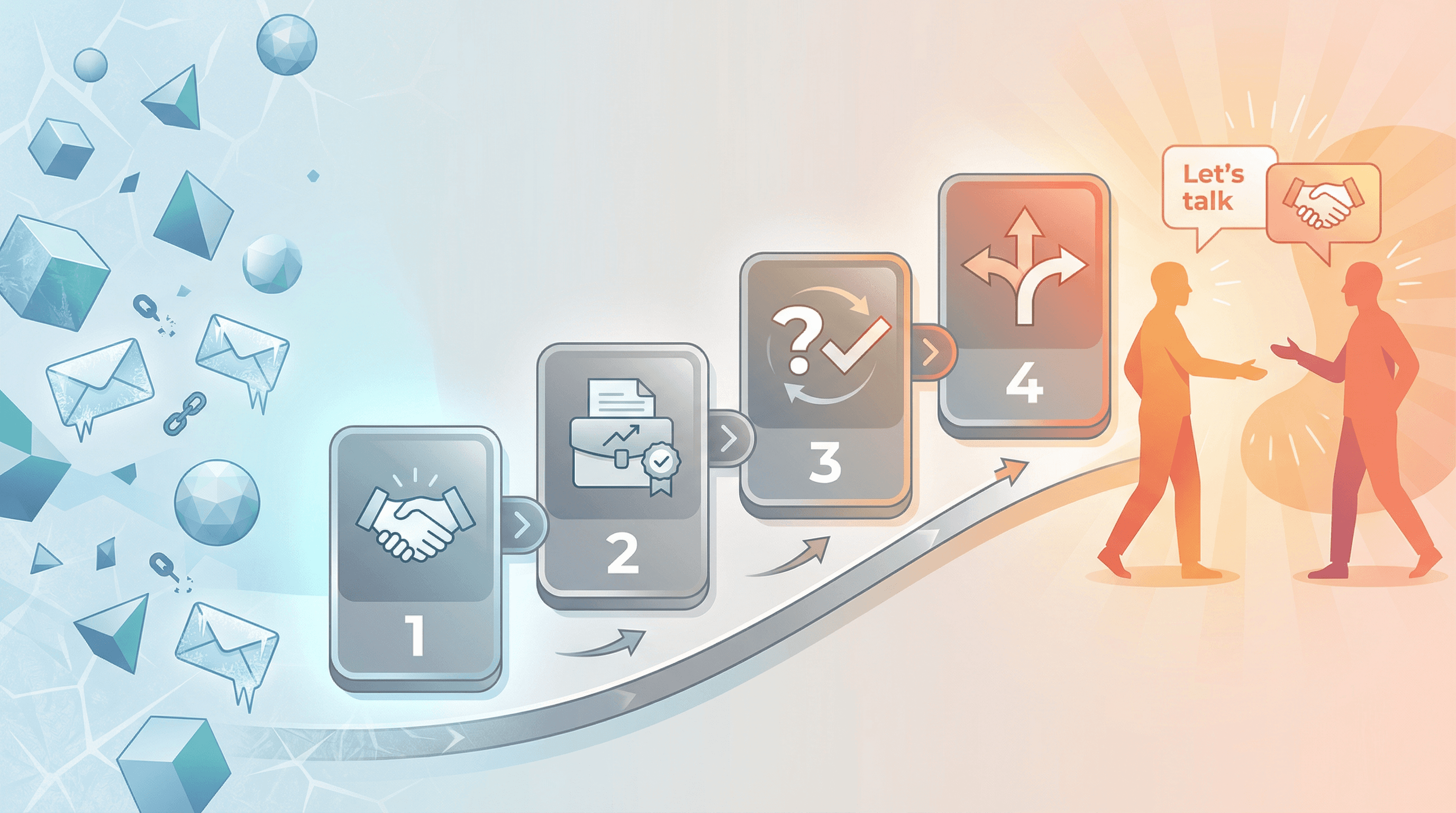
A well-structured cold email sequence is your best shot at turning cold prospects into warm leads. By thoughtfully planning multiple touches and making each one count, you dramatically increase the odds of breaking through the noise.
Key takeaways:
Use multiple emails to follow up because most prospects won't reply to the first message. Aim for 4 emails over 2 weeks as a starting point, spaced a few days apart.
Plan each email with a purpose: Introduce value, follow up with proof, tackle objections, then gracefully bow out if needed. Each email should add a new insight or angle so the sequence feels helpful, not repetitive.
Keep it personal and genuine: Write as if you were emailing one person, not a list. Personalization and relevance are non-negotiable in 2026 outreach.
Mind your tone and length: Short, friendly, and focused wins. Provide value, ask simple questions, and make your call-to-action easy to say "yes" to.
Don't overdo it: There's a fine line between persistence and pestering. Data shows 2-3 follow-ups is usually optimal. Beyond 4 emails, responses drop off and risks rise.
Respect the 2026 deliverability rules: Gmail, Yahoo, and Microsoft all tightened requirements starting in 2024. Proper infrastructure, clean data, and low complaint rates are non-negotiable now.
Above all, remember that the goal of a cold email is to start a conversation, not close a deal on the spot. Structure your sequence to gradually open the door, not shove it open.
By the end of your well-crafted sequence, the prospect should feel like they've received a handful of genuinely useful notes from a professional who understands their needs, not a barrage of sales spam.
When done right, a cold email sequence creates a dialogue. Even if the first couple emails are met with silence, the third or fourth might hit on the exact pain point or moment when the prospect is ready to engage.
Use the strategies in this guide as a framework, and adjust the specifics to fit your audience and offering. With the right structure and content, your cold emails will transform from unwanted intrusions into welcomed insights.
And those prospects you've been chasing will start replying: "Let's talk."
Want help building sequences that actually book meetings? Book a 15-minute consultation with Outbound System and we'll walk through your specific use case.