If you're trying to decide between cold email and LinkedIn outreach for your B2B lead generation, you're asking the wrong question.
The real question isn't "which one?" It's "how do I use both together without looking like spam?"
We've sent over 52 million cold emails and managed 600+ LinkedIn profiles at Outbound System. Here's what actually works in 2026.
Cold Email vs LinkedIn: Which Gets Better Results?
Cold email wins on scalable reach. You can contact people whether they're active on LinkedIn or not. But deliverability got stricter in 2024 and stayed that way. Inbox placement isn't guaranteed without serious infrastructure.
LinkedIn wins on context and trust. Social proof, profile-based personalization, warmer perception. But it's a rented channel with platform limits and strict rules against automation.
The highest-performing outbound teams in 2026? They run coordinated multi-touch sequences. LinkedIn creates familiarity. Email creates scale and direct asks. The combo boosts reply quality and meeting conversion.
If you only remember one thing: Email is a distribution channel. LinkedIn is a trust channel. The best systems use both deliberately.
Cold Email vs LinkedIn Response Rates: What the Data Shows
Let's cut through the noise with real numbers.
Cold Email Response Rates in 2026
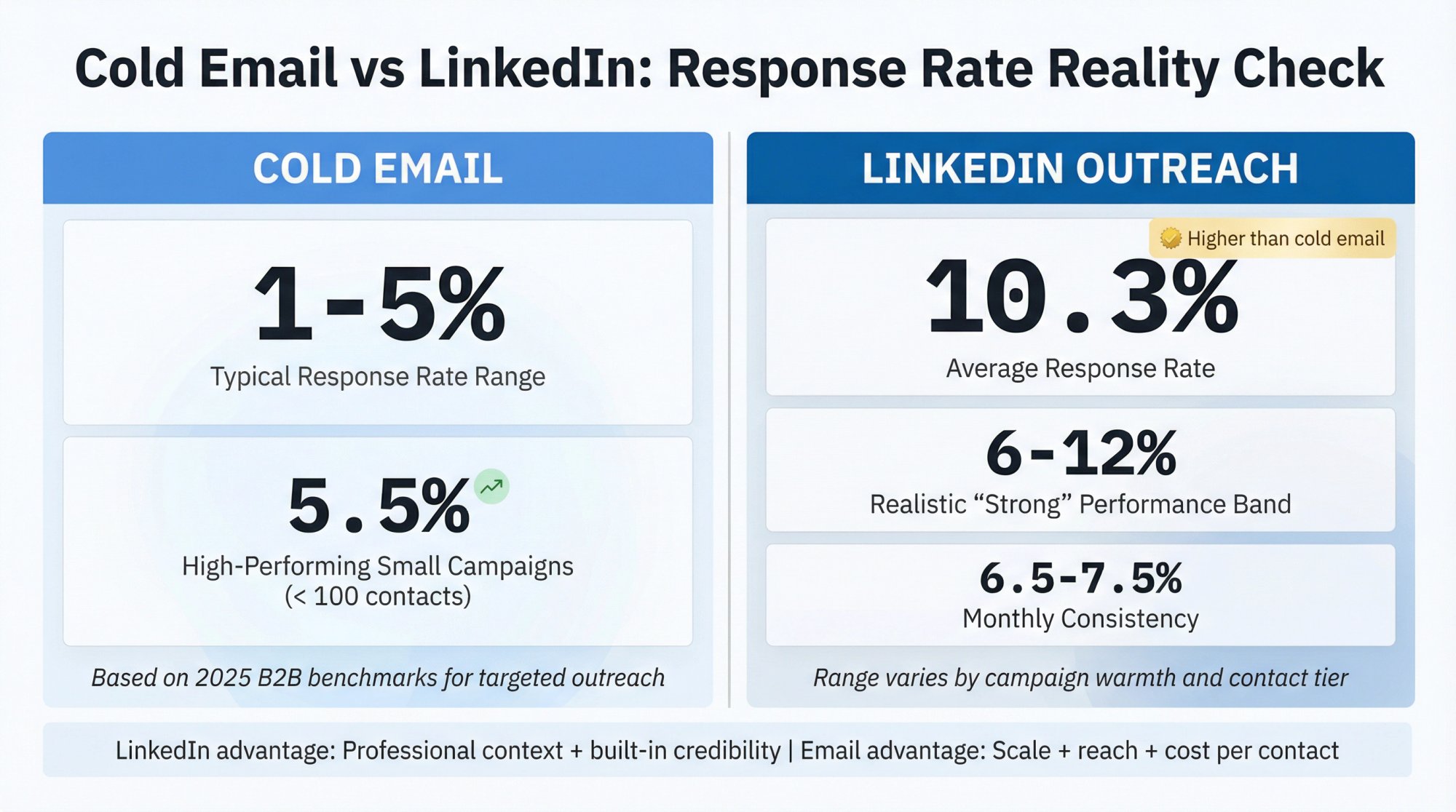
Multiple 2025 sources converge around mid-single-digit reply rates for strong B2B cold email programs. We're talking 1-5% as a broad average range, with better performance in tighter targeting and smaller segments.
Research highlights that smaller campaigns (fewer than 100 recipients) can yield stronger reply rates around 5.5%. Messaging 1-2 contacts per company outperforms blasting everyone at the same account.
Reality check: if someone promises "20% reply rate at scale" without caveats, assume sampling bias, tiny lists, or they're counting auto-replies.
LinkedIn Outreach Response Rates Compared to Email
Industry analysis reports LinkedIn response rates averaging 10.3% in recent datasets. That's notably higher than cold email benchmarks in the same comparison.
Recent LinkedIn outreach studies report reply rates by month generally ranging 6.5-7.5% throughout the year, staying stable across months.
Why the difference? Two reasons:
Different datasets and definitions (connection DMs vs message requests vs mixed outreach types)
LinkedIn performance is highly sensitive to pre-existing proximity (first-degree connections reply more than cold message requests)
Practical interpretation: 6-12% is a realistic "strong" LinkedIn reply rate band for well-run outreach, depending on how warm the channel is and what counts as a reply.
The LinkedIn advantage: Messages arrive in a professional context where recipients are already in "business mode." Your profile is attached to every message, providing instant credibility that cold emails can't match.
Why Cold Email Still Works for B2B Lead Generation
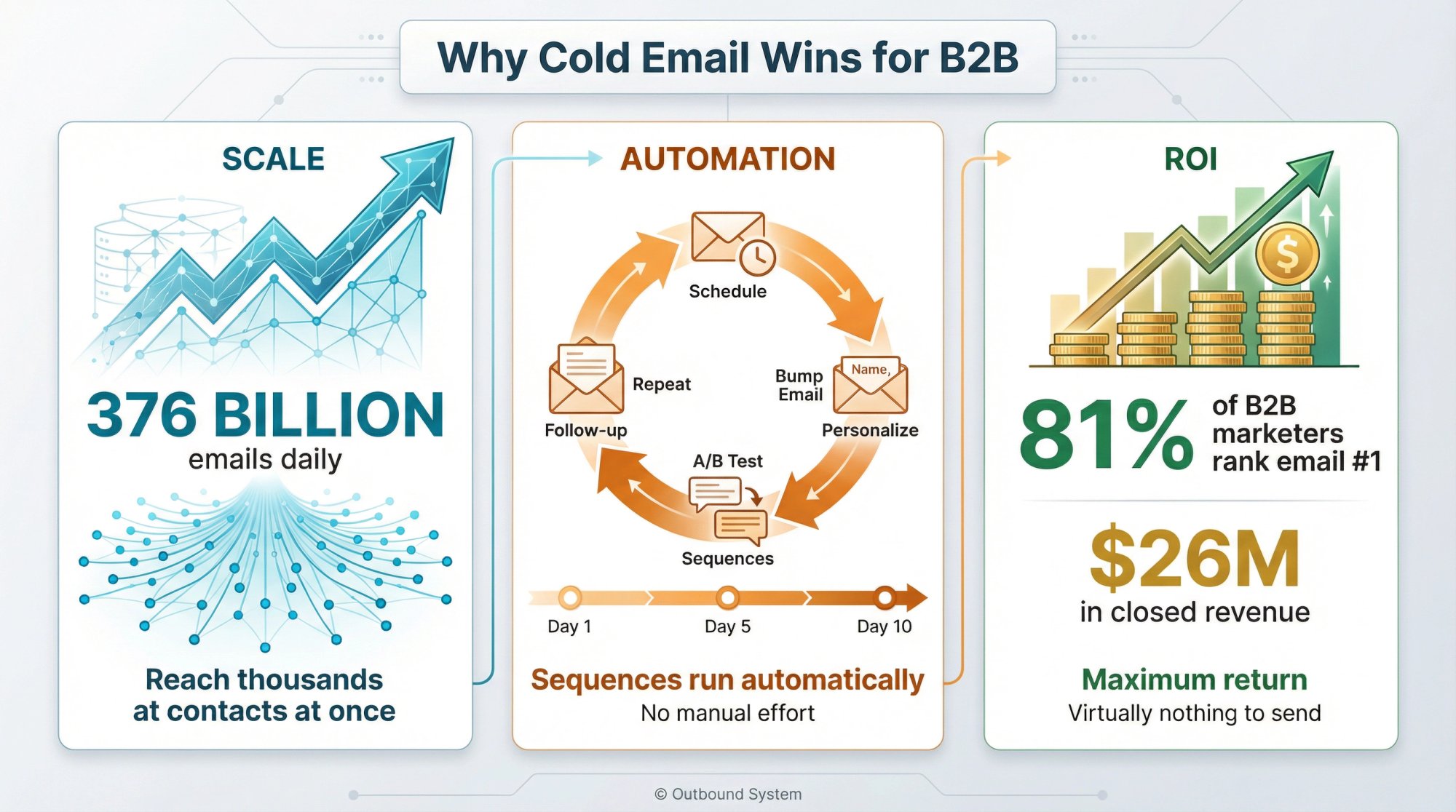
Email is still king for business communication. Over 376 billion emails are sent daily, and the average office worker receives 121 emails per day.
Here's why cold email remains essential:
How to Scale Cold Email Beyond LinkedIn's Limits
You can reach hundreds or thousands of contacts at once with proper systems. LinkedIn caps you at around 80-100 connection requests per week. If you need to test multiple segments fast or cover a large total addressable market, email is your answer.
Cold Email Automation vs LinkedIn's Platform Restrictions
Modern sales engagement platforms let you schedule follow-ups, personalize fields, and A/B test messaging at scale. You can design multi-step sequences (initial email, bump email, follow-up with new info) that send automatically until a reply comes in.
This programmatic approach ensures you consistently touch leads multiple times without manual effort.
Cold Email ROI: Why 81% of B2B Marketers Choose Email
Once you have a prospect's address, sending an email costs virtually nothing. The marginal cost per additional email sent is negligible. This is why 81% of B2B marketers rank email as their most effective channel according to recent industry surveys.
We've helped clients generate $26 million in closed revenue from email outreach campaigns. The ROI is there if you execute properly.
When to Use Cold Email vs LinkedIn for Complex Sales
Emails can be as long as needed and include attachments or rich formatting. You can introduce your company, provide case study PDFs, or include detailed pitch decks. LinkedIn messages are capped at 300 characters for connection notes and work better as short bursts.
If your sales process requires sharing proposals, demos, or technical details upfront, email gives you the canvas.
Cold Email Challenges in 2026 You Need to Know
Here's the hard truth about cold email in 2026.
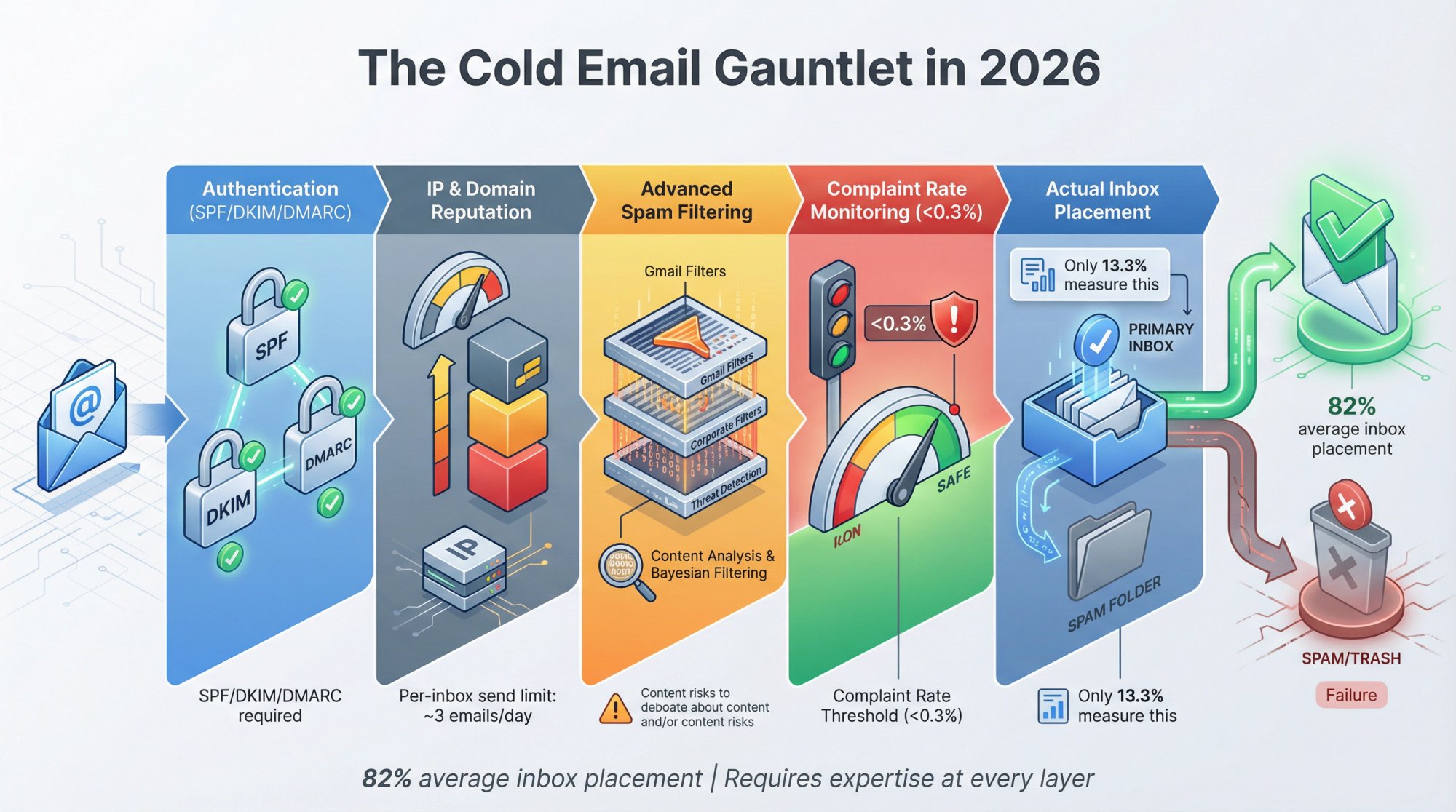
How to Fix Cold Email Deliverability Issues
The biggest hurdle? Actually reaching the inbox. Corporate email systems and services like Gmail aggressively filter anything that looks like spam.
It's estimated that only about 82% of cold emails land in the primary inbox on average (and far less if best practices aren't followed).
Google's sender guidelines now include requirements like:
• Authentication (SPF/DKIM/DMARC)
• Keeping spam complaint rates low (under 0.3%)
• One-click unsubscribe for higher-volume senders
• Processing unsubscribes quickly
Maintaining high deliverability requires warmed-up domains and IPs, proper authentication, sending from reputable infrastructure, and keeping complaint rates low.
At Outbound System, we solve this with 350-700 Microsoft U.S. IP inboxes (depending on tier) that send only ~3 emails each per day. This mimics natural human sending patterns and maintains our 98% inbox placement rate.
How Email List Quality Affects Cold Outreach Success
Bad data leads to bounces, which hurt sender reputation and waste effort messaging people who aren't there or aren't relevant.
We use a 9-step waterfall enrichment and triple verification system that combines multiple data vendors with rule-based enrichment. The process includes:
• Syntax validation checks
• SMTP ping verification
• Historic bounce data analysis
• Engagement signal evaluation
The goal? Minimize hard bounces (which damage sender reputation) and maximize reply probability by ensuring contact accuracy before outreach begins.
Why Most Cold Email Teams Fail at Deliverability
Industry research from 2024 found that open/click rates and "delivery rate" were the most-used metrics. Only 13.3% used inbox placement reports, despite inbox placement being the clearest indicator of where mail lands.
Know the difference between "delivered" and "inboxed." Many teams misinterpret "delivery rate" and fly blind on the metric that actually matters.
LinkedIn Outreach Benefits for B2B Sales in 2026
LinkedIn has emerged as a powerhouse for B2B prospecting. As of 2025, LinkedIn boasts over 1.2 billion users (with ~310 million monthly active users) worldwide. It's THE social network for professionals.
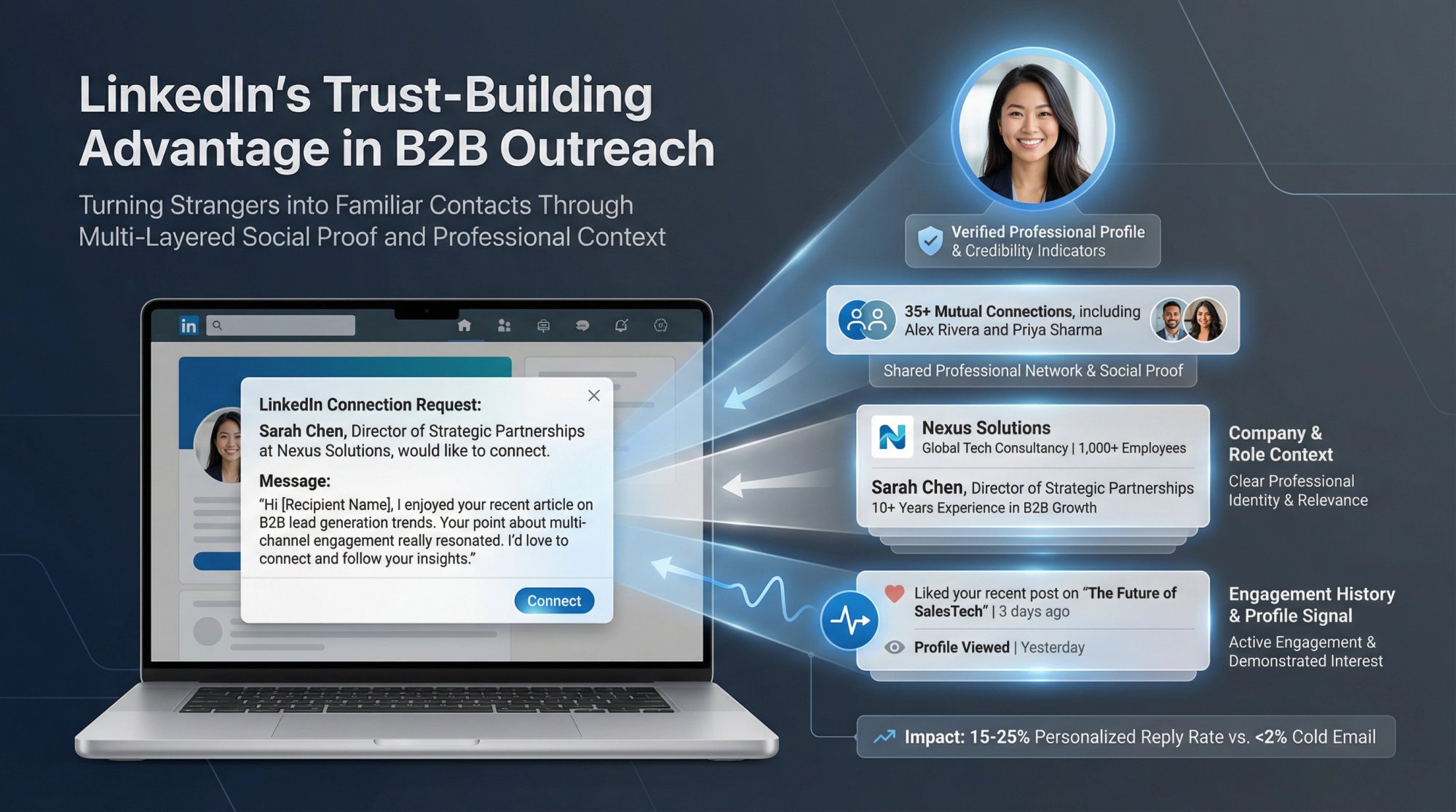
Note: An authentic LinkedIn feed interface screenshot would appear here, showing the professional context and trust-building UI elements discussed in this section. Due to authentication requirements, this screenshot requires manual capture.
How to Target B2B Prospects on LinkedIn Sales Navigator
LinkedIn effectively doubles as a massive, self-updating database of professionals. With Sales Navigator, you can filter prospects by industry, title, company size, location, and seniority with precision.
The profiles themselves give rich context: role, work history, mutual connections. You can find "CFOs at tech companies 50-200 employees in California" and reach out directly.
LinkedIn provides both the lead list and the channel in one. You don't need to source emails from third parties when prospects are reachable on the platform.
Why LinkedIn Messages Get Higher Response Rates Than Email
When a prospect sees a connection request or DM, it's viewed through a professional lens. Your LinkedIn profile is attached to every message, so recipients can immediately see who you are, your role, your company, and any mutual contacts.
This built-in social proof makes outreach feel warmer and more trustworthy. Recipients are generally more receptive to business discussions on LinkedIn.
How to Personalize LinkedIn Outreach at Scale
You can see a prospect's profile details, recent posts or activity, and shared connections. This makes it much easier to personalize outreach.
A LinkedIn DM can reference a post the prospect made ("Loved your recent article on supply chain trends"), a mutual acquaintance, or something about their background. These specific touchpoints capture attention.
LinkedIn outreach that feels genuinely tailored can achieve reply rates in the 15-25% range when done well.
LinkedIn Warm-Up Campaigns That Improve Response Rates
LinkedIn isn't just a direct messaging platform. You can engage prospects in multiple ways even before sending a message:
• View their profile (they'll see it in notifications)
• Comment or like their posts
• Endorse a skill
• Share content they might find valuable
These "soft touches" warm up the prospect. By the time you send a connection request or message, you're already on their radar.
Research shows that running LinkedIn "warm-up" campaigns (profile views and post likes prior to outreach) yielded a 7.2% reply rate vs much lower without warming. Even outperforming typical cold email metrics.
LinkedIn Outreach Limitations Every Sales Team Should Know
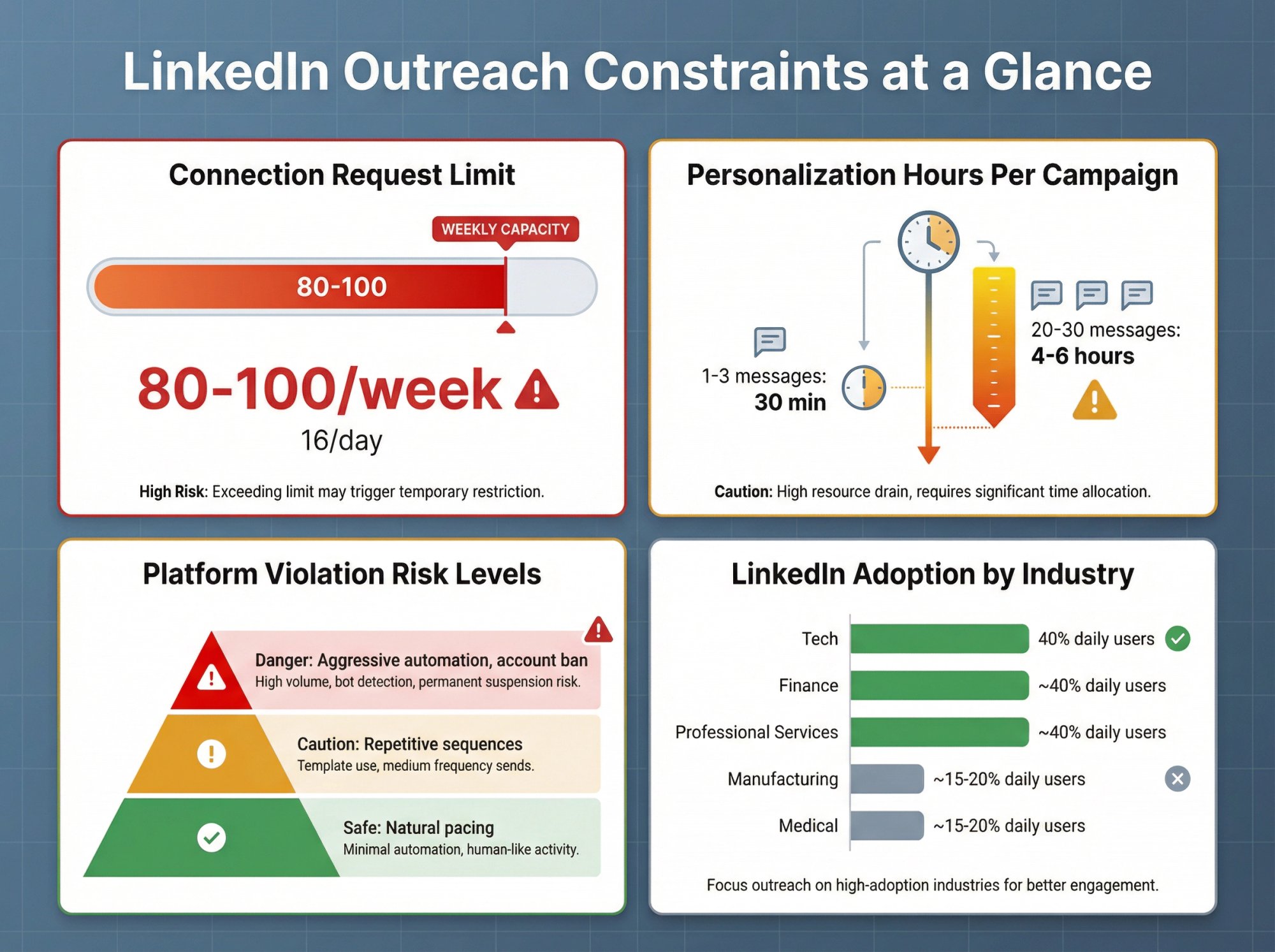
LinkedIn Connection Request Limits in 2026
LinkedIn strictly limits how many people you can reach to prevent spam on the platform. Typical users are capped to around 80-100 connection requests per week (roughly 16 per day).
Even with premium Sales Navigator, you can't blast 1,000 connection requests without hitting a wall. InMails are also limited. You get a certain number of credits per month (50 with a Sales Nav plan) and they exhaust quickly.
Scalability is inherently constrained on LinkedIn by design.
Why LinkedIn Personalization Takes Longer Than Cold Email
Crafting individual, personalized messages on LinkedIn takes significant effort. Researching each prospect's profile, finding a clever icebreaker or commonality, and writing a tailored note consumes hours if done manually.
Even sending just 20-30 highly personalized LinkedIn messages can consume hours of work. Compared to cold email where you might mail-merge custom fields into a template for 500 contacts, LinkedIn outreach is a slower, more hands-on process.
It's the trade-off for those higher reply rates.
How to Avoid Getting Your LinkedIn Account Banned
LinkedIn's User Agreement prohibits unauthorized automation and spammy behavior. The platform actively monitors for too many connection attempts, repetitive messages, or use of unapproved automation tools.
Offenders can get warnings, account restrictions, or permanent bans in severe cases.
Losing a LinkedIn account (especially a personal profile with your network) is painful. Outreach on LinkedIn must be done within safe limits. You can't set a sequence to bombard someone with 5 messages in a week without raising flags.
Which Industries Don't Use LinkedIn for Business
Not every target lives on LinkedIn. Many professionals have profiles but log in rarely. If your target persona isn't active, sending them a message might yield crickets simply because they didn't see it.
Certain traditional industries (manufacturing, medical, local small businesses) have lower LinkedIn engagement compared to tech or marketing sectors.
It's often said that LinkedIn works best for people who use LinkedIn. If your audience isn't among the ~40% of users who log in daily or weekly, your outreach could hit a dead end.
When to Use Cold Email vs LinkedIn Outreach
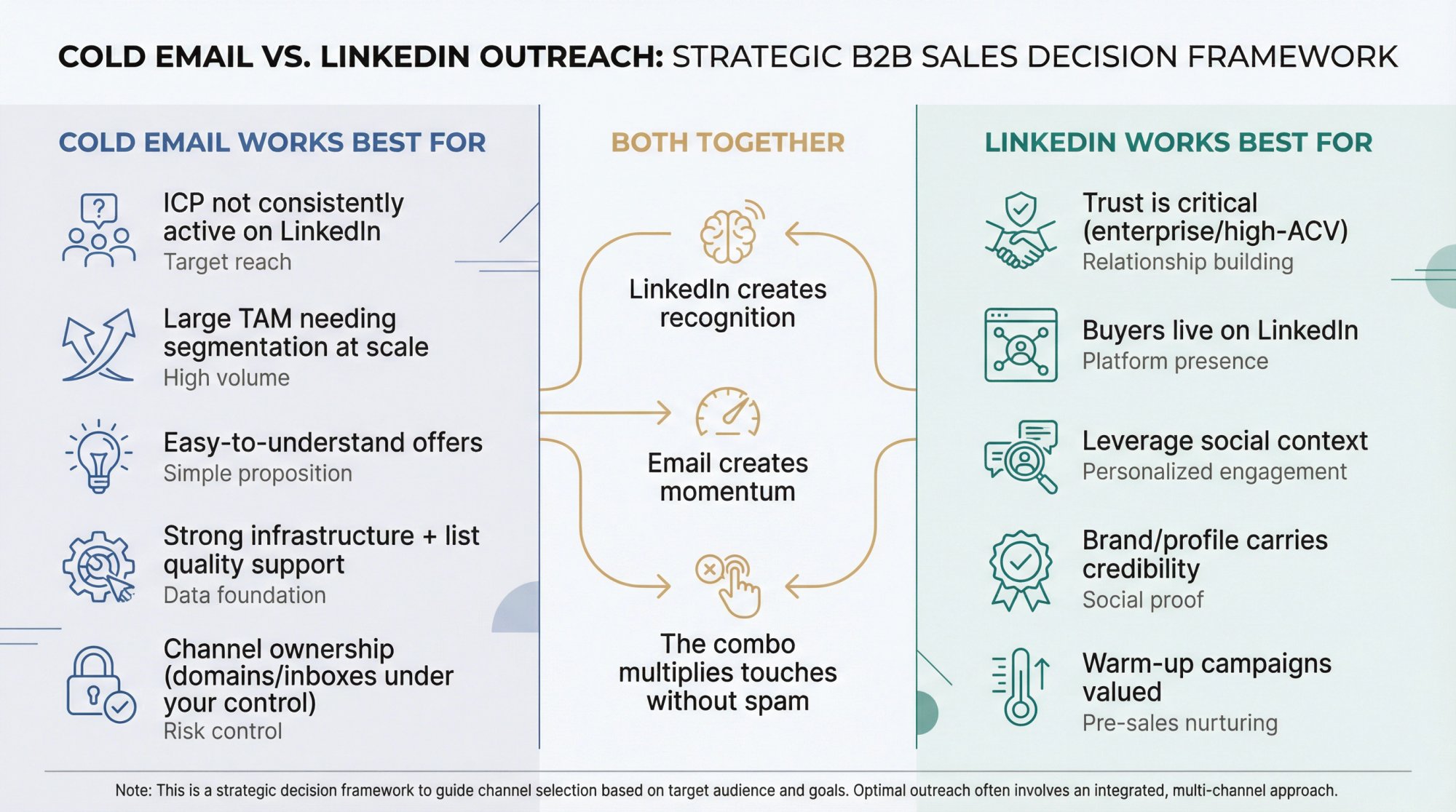
Use Cold Email When...
1. Your ICP isn't consistently active on LinkedIn
Traditional industries, ops-heavy roles, non-tech sectors. If they're not logging in, they won't see your messages.
2. Your TAM is big and you need segmentation at scale
Testing multiple segments fast or covering thousands of contacts. Email is your workhorse.
3. Your offer is easy to understand quickly
Clear pain, clear outcome, clear next step. Email's conciseness works.
4. You can support infrastructure and list quality
Or partner with someone who does. Deliverability isn't optional.
5. You want a channel you can "own"
Domains and inboxes are under your control. LinkedIn isn't.
Use LinkedIn Outreach When...
1. Trust is everything
Enterprise, high ACV, sensitive categories. Social context matters.
2. Your buyers live on LinkedIn
Tech, finance, recruiting-adjacent, modern professional services.
3. You can leverage social context
Shared connections, posts, recent announcements. Profile credibility carries weight.
4. Your brand/profile can carry credibility
Positioning matters. Your LinkedIn presence does heavy lifting.
5. You need warm starts
Commenting/engagement → DM conversion. Multi-touch trust building.
Use Both When...
You want the highest probability path to meetings.
LinkedIn creates recognition. Your name and profile stop being "random."
Email creates momentum. Clear ask, easy scheduling.
The combo multiplies touches without feeling like spam when sequenced correctly.
How to Combine Cold Email and LinkedIn for Maximum Results
Here's a practical blueprint we run for clients at Outbound System.
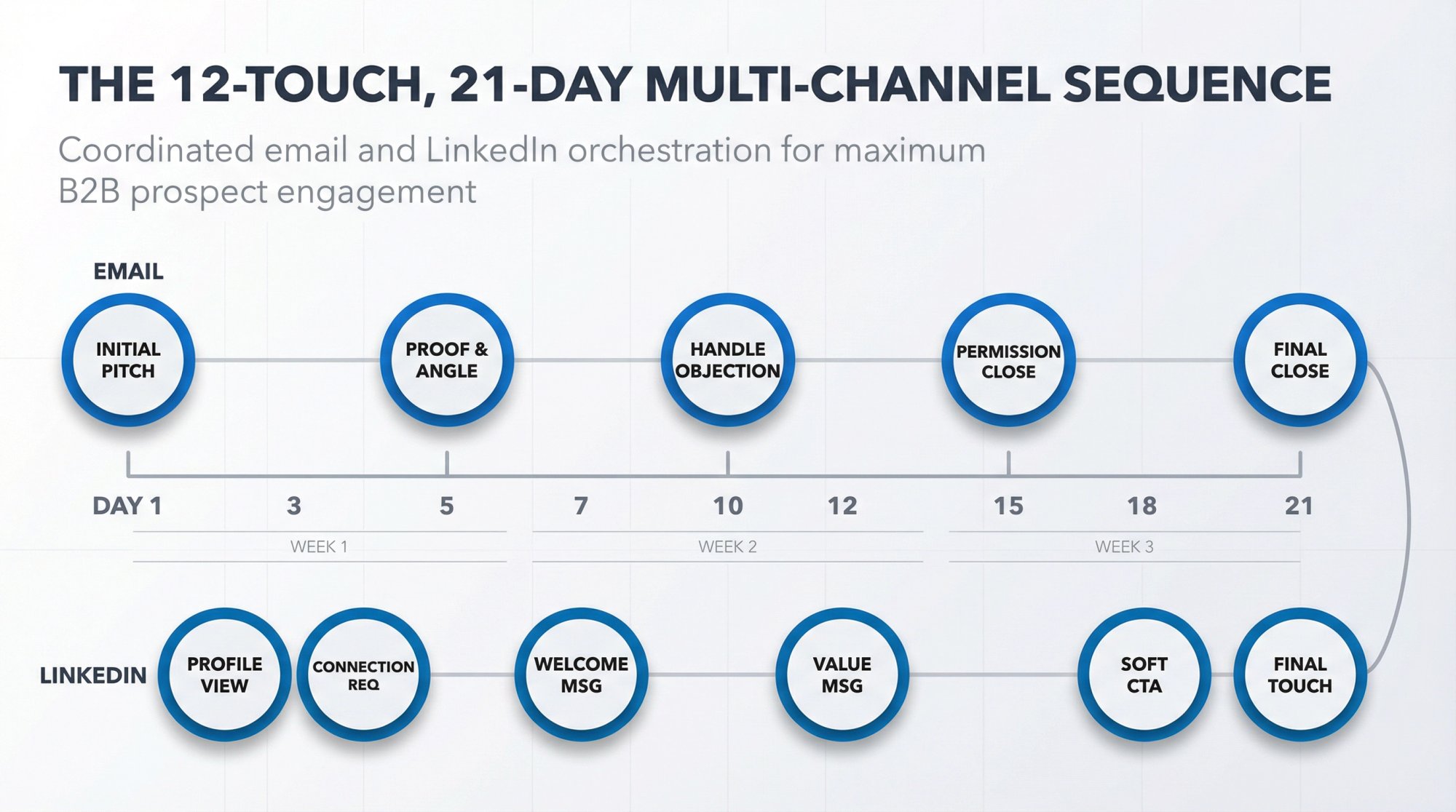
The 12-Touch, 21-Day Multi-Channel Sequence
Day | Channel | Action |
|---|---|---|
Day 1 | Initial outreach (relevance + outcome) | |
Day 2 | Profile view + light engagement (optional) | |
Day 3 | Connection request (short/no pitch) | |
Day 5 | Different angle + proof | |
Day 7 | Message after accept (no CTA yet) | |
Day 10 | Objection handler | |
Day 12 | Value message (quick win) | |
Day 15 | Breakup / permission close | |
Day 18 | Soft CTA | |
Day 21 | Email/LinkedIn | Final close-out (whichever channel they engaged with) |
Why this works:
• Email carries the clear ask
• LinkedIn reduces the "who is this?" friction
• You spread touches across channels instead of hammering one
• Each channel references the other to demonstrate consistency
Research suggests LinkedIn reply rates can be meaningfully higher than cold email in many datasets. Using LinkedIn as a trust layer increases overall conversion.
7 Cold Email Best Practices to Improve Deliverability in 2026
Most cold email advice is theoretical garbage. Here's what works in production.
1. How to Build Cold Email Lists That Get Replies
Cold email fails more from list problems than copy.
A serious list includes:
• ICP fit (firmographics + technographics + buying triggers)
• Role clarity (who owns the pain?)
• Contact accuracy (verified email)
• Company-level strategy (how many contacts per account?)
Research data suggests that blasting too many people in one company correlates with lower reply rates. In most datasets, 1-2 contacts per company outperformed 10+.
Actionable rule: Start with 1-3 contacts/account, expand only after signal.
2. Cold Email Deliverability Requirements for 2026
In 2026, sustainable cold email requires:
• SPF/DKIM/DMARC correctness
• Complaint minimization (under 0.3%)
• Fast unsubscribe handling
Know the difference between "delivered" and "inboxed." Industry reports highlight widespread confusion and emphasize inbox placement testing as the real visibility layer.
Actionable rule: If you can't measure inbox placement, you're flying blind.
3. How to Write Cold Emails That Generate Meetings
Email is a no-context channel compared to LinkedIn. Your message must generate context instantly.
Use this structure:
Relevant trigger (why them, why now)
Problem framing (what this costs them)
Credible mechanism (how you solve it)
Low-friction CTA (simple next step)
Avoid:
• Long company intros
• Generic "hope you're well"
• "Just checking in" follow-ups
Learn more about cold email copywriting and high-converting templates.
4. How Many Cold Email Follow-Ups Actually Work
Most replies come on the 2nd or 3rd email, not the first. People are busy. A polite follow-up or two can bump your email back to the top of their inbox.
But here's the catch: Research found that after the third email, reply rates plummet and unsubscribe rates triple.
The optimal cadence:
• Email 1: Relevance + clear offer
• Email 2: Different angle (case proof or quantified pain)
• Email 3: Objection handler (timing, fit, priority)
• Email 4: Breakup (permission-based close)
After that? You risk hurting your brand more than helping. Get detailed follow-up tactics here.
5 LinkedIn Outreach Best Practices That Avoid Platform Bans
LinkedIn outreach is relationship-building, not advertising. Here's how to do it right.
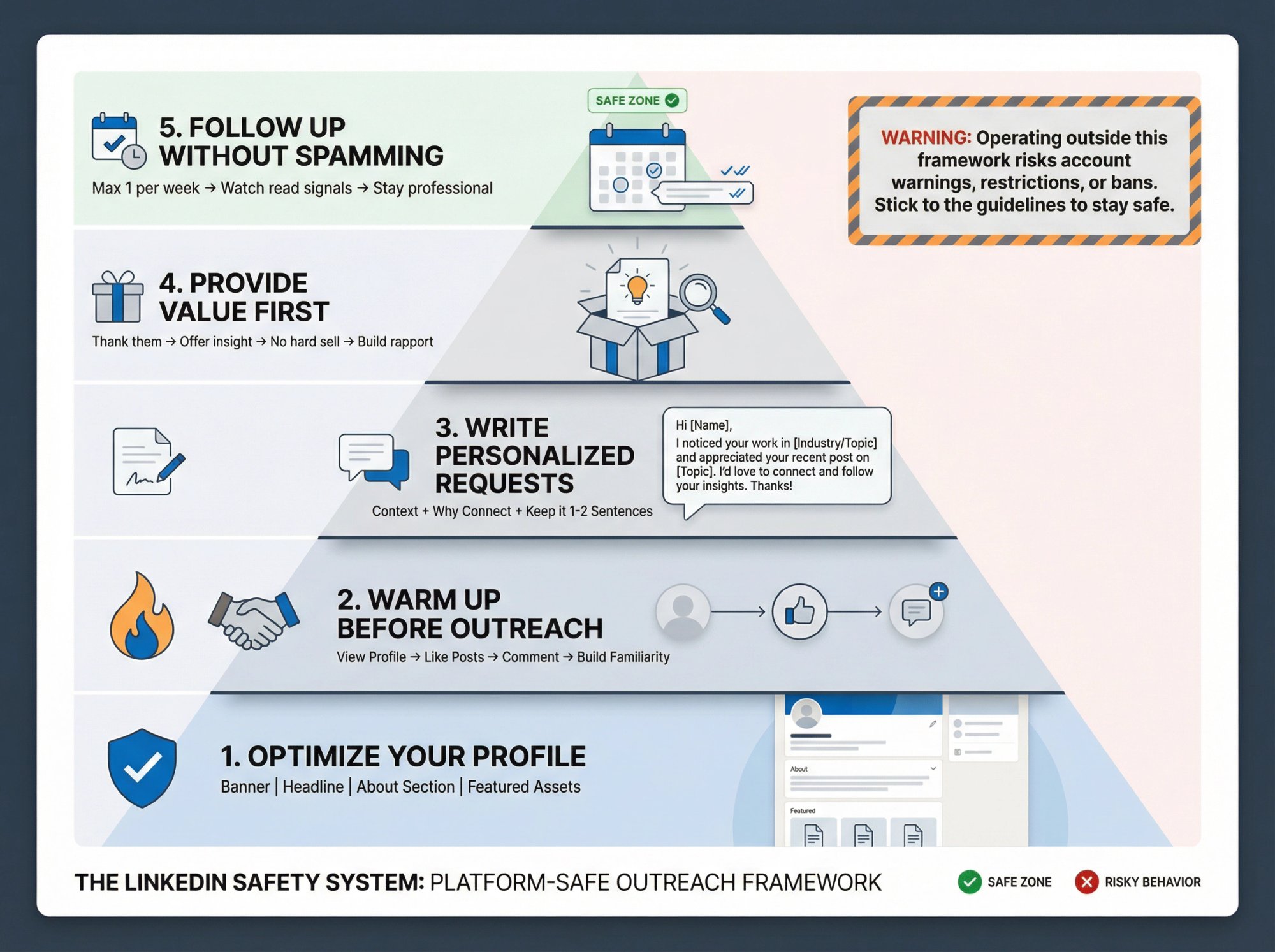
1. How to Optimize Your LinkedIn Profile Before Outreach
Your LinkedIn outreach is only as strong as your credibility layer.
Minimum viable profile:
• Banner that states ICP + outcome
• Headline that states who you help + how
• About section with proof + specificity
• Featured section with 1-3 strong assets (case study, insight post, guide)
Prospects will check your profile when you contact them. A thoughtful profile with mutual connections and valuable content drives acceptance and replies. Learn how to generate B2B leads on LinkedIn.
2. LinkedIn Profile Warming Strategy Before Sending Messages
Instead of connecting or pitching out of the blue, consider engaging with the prospect's content first.
The warm-up sequence:
• View their profile (they'll get a notification)
• React to or comment on their posts
• This puts you on their radar in a positive way
Analysis shows that sellers who liked a prospect's post before messaging saw significantly higher connection approvals and replies. It takes a bit more time, but it's an effective trust-building step. Get more proven LinkedIn strategies here.
3. How to Write LinkedIn Connection Requests That Get Accepted
When you send a connection request, always add a note (unless you have a strong reason not to). A blank invite from a stranger gets ignored.
Your note should briefly explain why you want to connect, and it should be about the prospect, not you.
"Hi Jane, I saw we're both members of the SaaS Product Leaders group and enjoyed your recent post on UX design. I'd love to connect and keep up with your insights."
Keep it to 1-2 sentences, friendly and professional. Learn how to connect on LinkedIn effectively.
4. What to Say After Someone Accepts Your LinkedIn Request
One of the biggest mistakes? Connecting and immediately sending a sales pitch. This turns people off.
Instead, send a thank you message that continues the conversation naturally without a hard sell.
"Thanks for connecting, John. I noticed you're expanding into APAC markets this year. How has that experience been so far?"
Or offer value: "Appreciate the connect! I have a great case study on reducing churn in fintech. Happy to send it if you're interested."
Provide value first. Only after rapport should you segue into your solution. Think of LinkedIn as a coffee chat, not a sales call.
5. LinkedIn Follow-Up Frequency That Doesn't Annoy Prospects
You can send one follow-up a week or so later, but avoid spamming multiple unanswered messages. That can prompt disconnection or even reports.
LinkedIn shows if someone has read your message. If they read but didn't reply twice, it might be a sign to back off or try a different approach (like email).
Remember: Your behavior is somewhat public on LinkedIn. Professionalism is key.
How Outbound System Combines Cold Email and LinkedIn
We exist because doing this well isn't a tool problem. It's a system problem.
Our Cold Email Infrastructure
We use 350-700 Microsoft U.S. IP inboxes (depending on plan tier) with distributed sending:
• Low per-inbox send volumes that mimic natural human patterns
• 9-step waterfall enrichment combining multiple data vendors
• Triple-verified email data to minimize bounces
• AI personalization with human copywriting for relevance
• 98% primary inbox placement maintained through proper infrastructure
This isn't something you cobble together with DIY tools. It's production-grade infrastructure that took years to build. See why we're the best cold email agency in 2025.
Our LinkedIn Approach
We manage 600+ LinkedIn profiles for clients with:
• Profile optimization for credibility
• Targeting via Sales Navigator
• Human-written message sequences
• Careful pacing to keep accounts safe
• 5-second reply notifications for fast response
• Multi-channel coordination with email campaigns
We've generated 127,000+ leads and $26 million in closed revenue from LinkedIn outreach across our client base.
Multi-Channel Orchestration
The highest-performing outbound programs coordinate channels instead of running them as separate silos.
We design sequences where:
• LinkedIn creates initial awareness and familiarity
• Email delivers detailed value propositions and clear CTAs
• The combination multiplies touchpoints without feeling spammy
• Reply handling is unified across channels
Our cold email plans start at $1,499/month. No long-term contracts. Month-to-month.
Want to see how this works for your business? Book a free 15-minute consultation and we'll walk through your specific situation.
Frequently Asked Questions
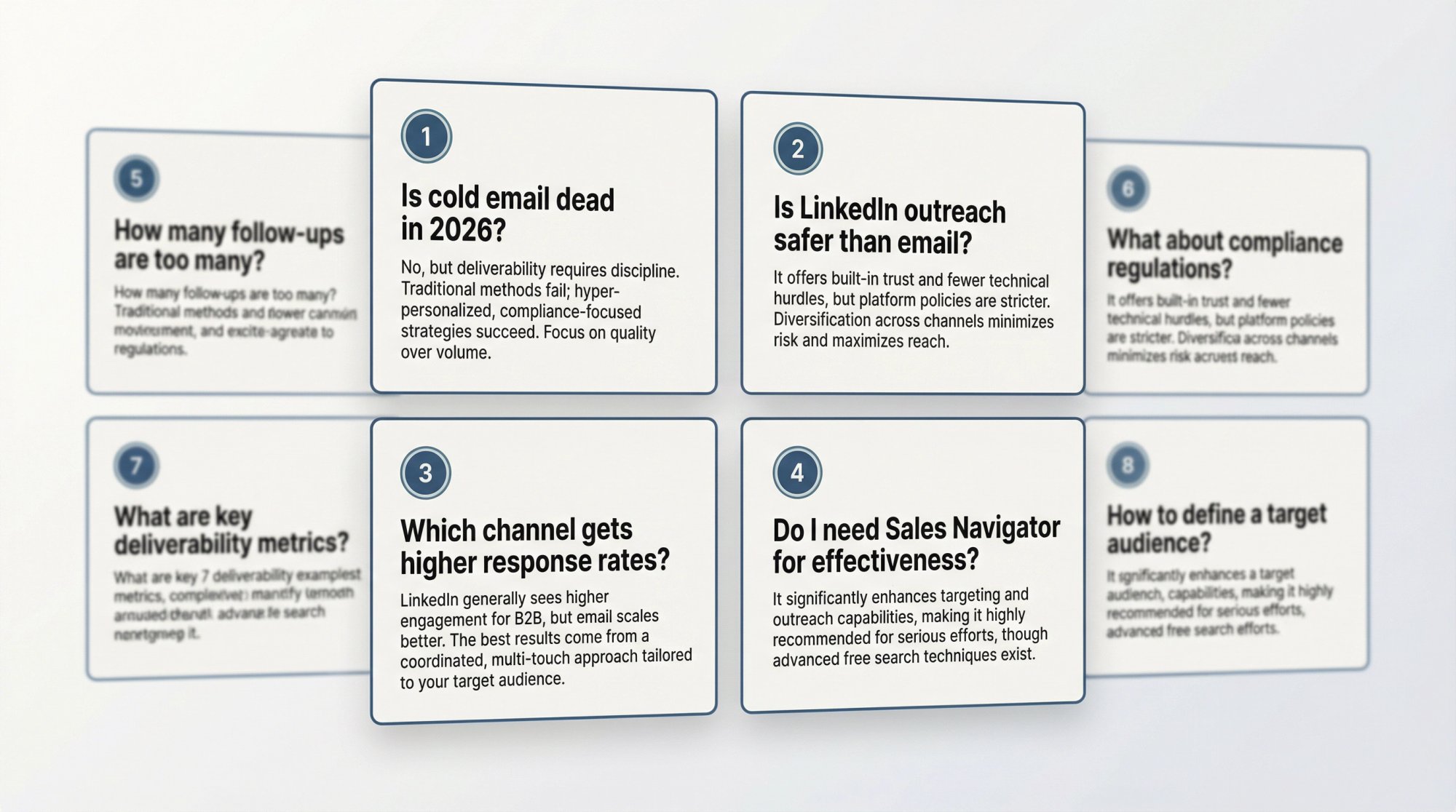
Is cold email dead in 2026?
No, but it's less forgiving. Inbox providers are stricter, and inbox placement isn't automatic. Teams that treat it as an engineering + relevance discipline still win.
Google's requirements around authentication and complaint rates aren't optional. But when executed properly, cold email remains one of the highest-ROI channels for B2B lead generation.
Is LinkedIn outreach safer than cold email?
It's safer from deliverability issues, but risk shifts to platform enforcement, invitation limits, and automation policy.
LinkedIn explicitly states that when you hit the weekly invitation limit, you generally can't send invites for a week. And their User Agreement restricts scraping and bot usage.
The key is staying within safe limits and treating LinkedIn as relationship-building, not mass outreach.
Which channel gets higher reply rates?
Many datasets show LinkedIn can outperform email on reply rate (often meaningfully). But email can win on total conversations due to reach and scale.
Industry data shows 10.3% average LinkedIn reply rates vs 5.1% for cold email. But you can send 10x more emails than LinkedIn messages in the same timeframe. Compare LinkedIn lead gen vs cold email in detail.
Do I need Sales Navigator for LinkedIn outreach?
If you're serious about B2B prospecting volume and targeting quality, it's usually worth it.
LinkedIn publishes plan pricing publicly (Core ~$119.99/month, Advanced ~$159.99/month). Sales Navigator also allocates 50 InMail credits per month, which are essential for reaching people outside your network. Learn about Sales Navigator features.
How many follow-ups should I send?
For cold email: 2-3 follow-ups maximum. Research shows that after the third email, reply rates plummet and unsubscribe rates triple.
For LinkedIn: 1-2 gentle follow-ups at most. The platform is more sensitive to perceived spam, and your reputation is more visible.
The key is adding value with each follow-up rather than just "checking in again."
Can I automate LinkedIn outreach?
Carefully, and within limits. LinkedIn's policies restrict bots and automation tools.
Safe automation mimics human-like actions with random delays and limited volume. We recommend augmenting human outreach with minimal automation rather than fully automating, which risks account restrictions.
What's the cost difference between DIY and using an agency?
DIY cold email costs:
• Domains, inboxes, DNS/authentication setup
• Warmup + monitoring tools
• Lead sourcing + enrichment + verification
• Sending/sequence platforms
• Copywriting + iteration time
• Deliverability expertise (often learned through mistakes)
DIY LinkedIn costs:
• Sales Navigator (~$120-160/month)
• InMail credits (50/month included, limited)
• Significant time investment for personalization
At Outbound System:
• Starter: $1,499/month (up to 15,000 emails)
• Growth: $2,499/month (up to 30,000 emails)
• Scale: $3,999/month (up to 60,000 emails)
All plans include AI personalization, 9-step enrichment, unified inbox, real-time metrics, CRM integrations, A/B testing, and dedicated account strategist.
The real cost of DIY is time + mistakes. Deliverability mistakes create future drag that takes months to unwind. Compare cold email agency vs in-house SDR or check how much a cold email agency costs.
Should I use both channels for every prospect?
Not necessarily. Strategic segmentation works better.
Use both for:
• High-value target accounts
• Enterprise prospects where trust matters
• Decision-makers who are active on both channels
Use primarily email for:
• Large volume segments
• Industries less active on LinkedIn
• Contacts where you have verified email but limited LinkedIn presence
Use primarily LinkedIn for:
• Executives and senior decision-makers
• Prospects in tech/SaaS/professional services
• Situations where social proof significantly impacts trust
The best approach? Start with one channel, then layer in the other for non-responders or high-priority targets.
The Bottom Line
Cold email and LinkedIn outreach aren't competitors. They're complementary weapons in your outbound arsenal.
Email scales. It reaches people regardless of platform activity, delivers detailed information, and costs virtually nothing per additional contact. But it requires technical expertise in deliverability and careful list management.
LinkedIn builds trust. It leverages social proof, enables deep personalization, and achieves higher engagement rates. But it's time-intensive and constrained by platform limits.
The winning strategy in 2026? Use both deliberately.
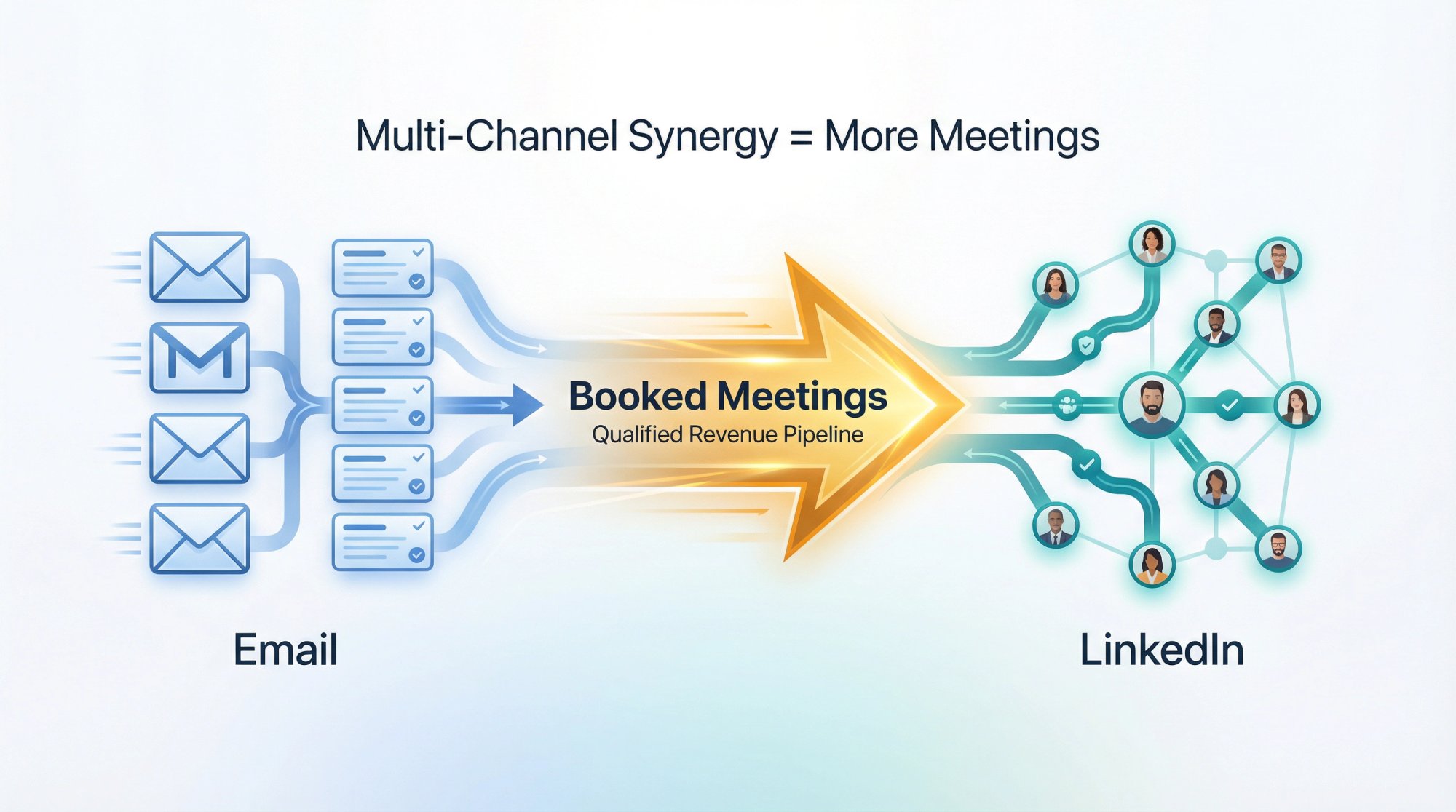
LinkedIn creates familiarity and warm recognition. Email creates momentum and clear next steps. Together, they multiply your chances of booking qualified meetings.
At Outbound System, we've built infrastructure and processes to run both channels at scale for 1,000+ B2B clients. Our multi-channel sequences consistently outperform single-channel approaches.
Ready to stop choosing between email and LinkedIn and start using both strategically?
Book a 15-minute consultation and we'll show you exactly how this works for your ICP, market, and growth goals.
No long-term contracts. No setup fees. Month-to-month pricing starting at $1,499.
Because the real question isn't "email or LinkedIn?"
It's "how fast can you start booking meetings from both?"