If you're running a B2B sales team, you've probably noticed the same thing we have: every other LinkedIn post is about AI SDRs replacing human reps, or AI SDRs being complete garbage. The debate is loud, messy, and honestly, missing the point entirely.
Because here's what we've learned after managing cold email and LinkedIn outreach for 1,000+ B2B clients at Outbound System: it's not about AI or humans. It's about building a system that actually works.
The teams booking 20+ qualified meetings monthly? They're not picking sides. They're using AI where it makes sense (research, enrichment, initial touches) and humans where judgment matters (qualification, relationship-building, complex conversations).
This guide breaks down what AI SDRs and human SDRs actually do well, what they struggle with, and how to combine them without wasting money or irritating prospects. No fluff, no vendor pitches. Just what works in 2026.
What Has Changed in AI Sales Prospecting (and What Hasn't)
Let's start with the uncomfortable truth: AI adoption in sales prospecting is accelerating, but most of what you're hearing is either hype or panic.
Here's the real data:
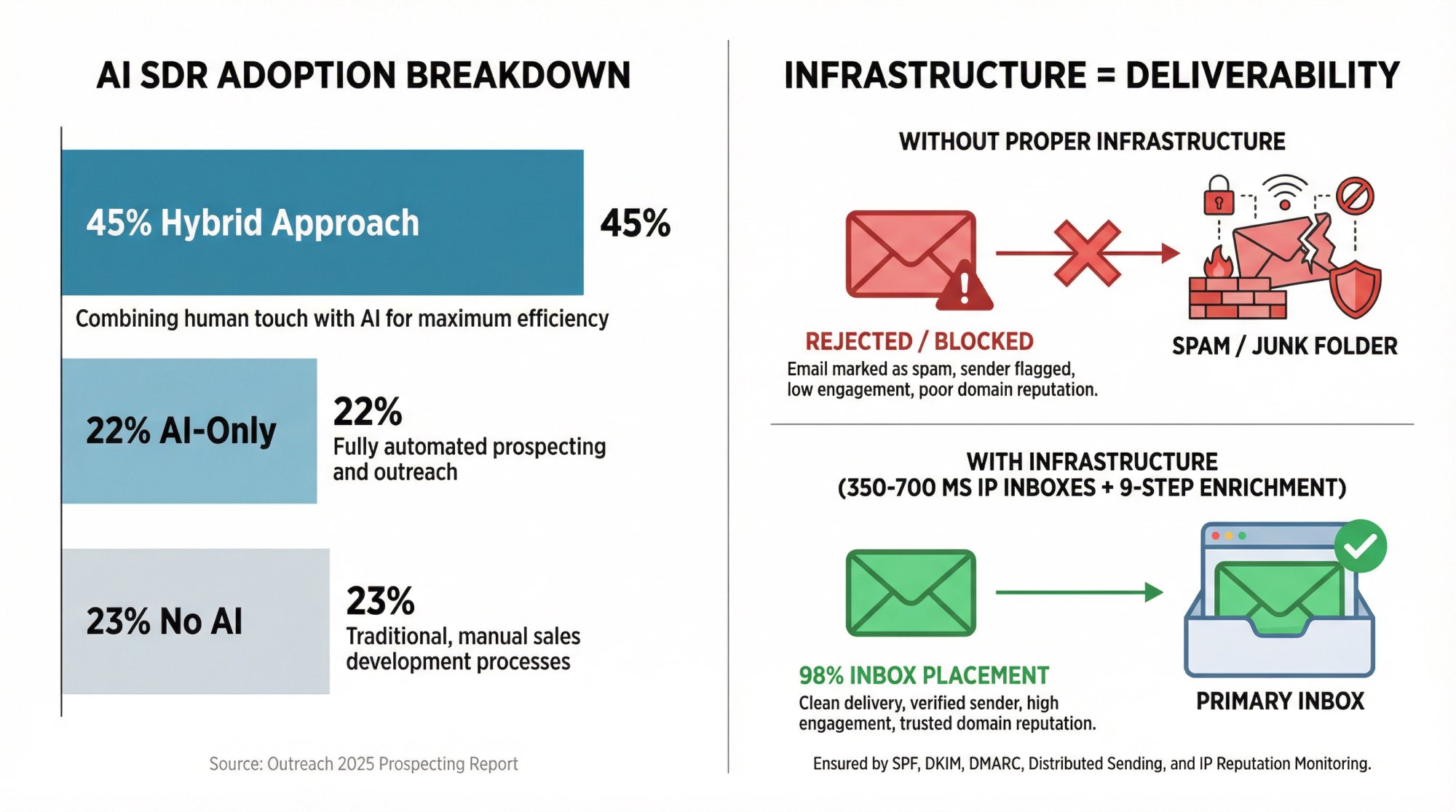
According to Outreach's 2025 Prospecting Report, 45% of sales teams use a hybrid approach for prospecting. Only 22% went fully AI. Another 23% don't use AI at all.
Translation? The majority of teams are still figuring this out, and smart operators are blending both approaches instead of betting everything on one side.
But AI is saving time
The same report found that 100% of respondents using AI saved more than an hour per week, with 38% saving 4-7 hours weekly. That's real leverage when your SDRs are drowning in research, data entry, and follow-up sequences.
What hasn't changed: deliverability still matters more than your emails
You can have the world's best AI writing your cold emails, but if they land in spam, none of it matters. Google and Microsoft both tightened bulk sender requirements in 2024-2025, raising the bar for anyone doing high-volume cold email outreach.
Google's sender guidelines now require proper authentication (SPF, DKIM, DMARC) and one-click unsubscribe for senders over 5,000 emails/day. Microsoft's doing the same thing with Outlook's high-volume sender changes.
That's why at Outbound System, we built our infrastructure on 350-700 Microsoft U.S. IP inboxes with 9-step waterfall enrichment. It's not sexy, but it's the difference between 98% inbox placement and wasting money on emails nobody sees.
Critical insight: Apple's Mail Privacy Protection downloads remote content in the background now, which means "open rates" tell you almost nothing about whether someone actually read your email.
Focus on replies and meetings booked instead. Those still mean something. Here's why you shouldn't always track cold email open rates.
What Is an AI SDR and What Does It Actually Do?
Let's cut through the noise. An AI SDR is software that automates parts of the SDR workflow. But which parts depends entirely on the vendor and how you configure it.
Most AI SDRs fall into one of three categories:
1. Assistive AI (Copilot Mode)
The AI helps your human SDRs by doing research, suggesting personalization lines, drafting emails, and summarizing calls. Humans still drive the process.
2. Semi-Autonomous AI
The AI runs sequences and suggests next actions, but humans approve major steps and handle replies. It's automation with guardrails.
3. Autonomous Agents
The AI sources leads, enriches data, sends outreach, follows up, handles basic conversations, and books meetings with minimal human involvement. This is the "fully automated" dream, and also where most disappointment happens when expectations don't match reality.
What AI SDRs do well:
→ 24/7 immediate response: An AI can reply to an inbound inquiry within seconds, any time of day. No waiting for someone to come online. In our experience with 1,000+ clients, speed matters enormously. Early contact and rapid response times consistently drive higher qualification rates.
→ Multi-channel outreach at scale: A single AI platform can orchestrate email, LinkedIn, and SMS follow-ups across thousands of contacts simultaneously. No human could juggle that volume without losing track. Learn more about multi-channel cold outreach strategies.
→ Data enrichment and prospect research: Quality AI SDR tools compile profiles from hundreds of sources: firmographics, tech stack, funding news, LinkedIn activity, job changes. What takes a human hours happens in seconds. Learn how to use AI for sales prospecting.
→ Personalization at volume: Modern AI uses natural language processing to reference specific details about each prospect (recent funding, LinkedIn posts, company news) and make messages feel hand-crafted instead of blasted. See our cold email personalization best practices.
→ CRM updates and admin tasks: Logging activities, updating contact records, sending calendar invites. The AI handles this without forgetting or taking shortcuts.
What AI SDRs struggle with:
• Handling unexpected objections: If a prospect asks something outside the script, AI can stumble. It lacks the judgment to know when to push, when to back off, or when the conversation's direction needs changing.
• Building genuine trust: Prospects can tell when they're talking to automation. AI can be efficient, but it can't genuinely care about solving someone's problem or building a long-term relationship.
• Navigating complex sales dynamics: Multiple stakeholders? Internal politics? Budget freezes? These require human intuition and strategic thinking that AI doesn't have.
• Quality control at scale: AI will do exactly what you program it to do. If your messaging is off or your targeting is wrong, it'll happily send 10,000 bad emails unless you catch it.
What Do Human SDRs Do (and Why Does It Still Matter)?
A human SDR is a sales rep who handles outbound and inbound lead engagement, usually the first point of human contact for prospects.
Core responsibilities:
① Prospecting and outreach: Finding potential leads through list building, LinkedIn, networking, and initiating conversations via cold emails, calls, or social media.
② Lead follow-up and nurture: Persistently following up with prospects who haven't responded, trying to turn cold or lukewarm leads into warm opportunities. Learn effective follow-up tactics.
③ Qualification and discovery: Asking the right questions to determine if a prospect is a good fit. Exploring needs, budget, decision process, and other criteria through live interaction.
④ Objection handling: When a prospect raises concerns or says "not interested," a human can engage, handle objections, and pivot the conversation in real time.
⑤ Appointment setting: Securing the next step when a lead is qualified, usually scheduling a meeting or demo with an Account Executive. Explore our B2B appointment setting services.
Where humans crush it:
Empathy and relationship-building
People buy from people they trust. Human SDRs excel at making genuine connections, bonding over shared experiences, demonstrating real understanding of pain points.
Complex problem-solving
If a prospect has unique needs or uncertainties, a human can brainstorm solutions on the fly, drawing from experience and intuition.
Reading between the lines
Sensing a prospect's mood and adjusting approach. Recognizing when a joke might lighten the mood, or when to tread carefully if someone seems busy or skeptical.
Navigating nuance
In enterprise deals with multiple stakeholders, humans can sense and adapt to internal dynamics. They can tailor follow-up materials or involve their own exec to address higher-up concerns.
Where humans struggle:
Challenge | Reality |
|---|---|
Limited capacity | A typical SDR might manage 250-300 leads per month, make about 40 calls a day, and have perhaps 3-4 quality conversations in that time. |
Inconsistent execution | Humans have variations. One rep might skip steps because they're busy. Another might forget to follow up because they got distracted. |
Repetitive task burnout | Most SDRs spend the majority of their time on non-selling tasks (research, admin, chasing unresponsive leads) instead of actual selling. That grind leads to burnout and turnover. |
High cost and scalability | Hiring and training SDRs takes months. Ramping a new rep to full productivity often takes 3-6 months. And then you deal with turnover costs when they leave. |
AI SDR Speed and Availability: 24/7 Response Times
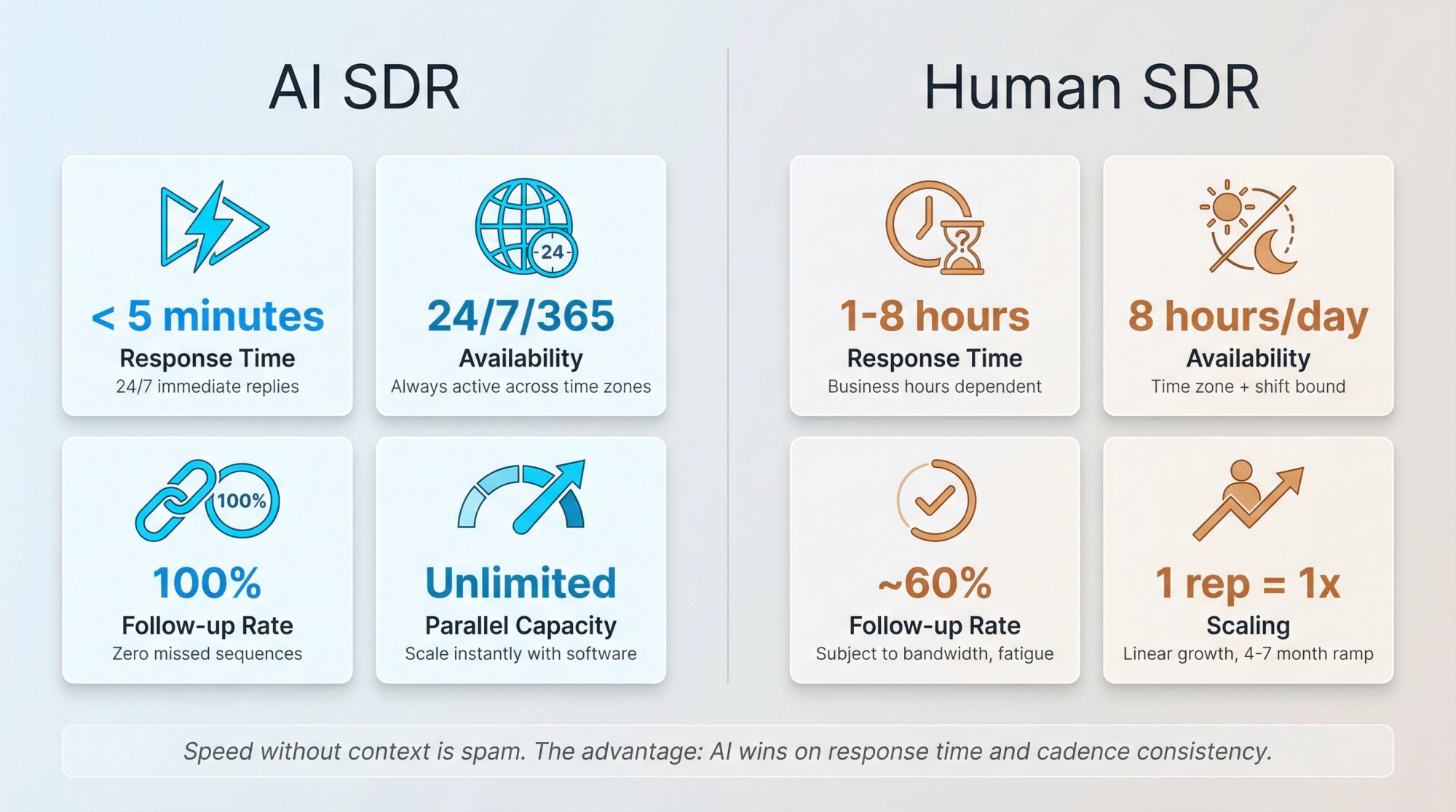
AI SDRs operate in real-time, 24/7. The moment a lead engages (fills a form, clicks an email, etc.), an AI can fire off a personalized response within seconds. Humans are constrained by working hours, workload, and the need for sleep.
The speed gap is massive:
Industry consensus shows that responding quickly (within minutes rather than hours) dramatically improves qualification rates. Even a well-oiled human SDR team might take hours (or more) to respond to every new lead.
AI SDRs consistently achieve sub-5-minute response times for inquiries around the clock. Humans simply can't guarantee that.
After-hours and global coverage:
Because AI doesn't sleep, it eliminates time-zone barriers. If a prospect from another continent submits a request at 3am your time, an AI can engage them immediately and maybe even book a meeting by the time your team comes online.
Human SDRs wouldn't even see that lead until the next work day. Rotating shifts or on-call schedules are expensive and still not as instantaneous as an AI agent that's always on.
Consistent follow-up cadence:
AI SDRs will never procrastinate or forget to send that next email on day 3 of a sequence. They execute the cadence with machine precision, ensuring every prospect gets pinged at the right intervals.
Many leads never get proper follow-up after initial contact, often due to human bandwidth issues. AI SDRs have a 100% follow-up rate when programmed with a sequence. Every lead gets every touch you've planned, on time, without fail.
The catch? Speed without context is just spam. If those rapid responses are low-quality or mis-targeted, being fast doesn't help. So speed is an advantage when combined with good targeting and messaging, not in isolation.
How to Scale AI SDRs vs Human SDRs: Instant vs Linear Growth
Scaling human SDRs = linear growth with delays
To double the output of an SDR team, you have to hire and train more SDRs. Each additional rep adds capacity, but this growth is roughly linear and comes with significant lag time.
Hiring a new SDR can take a month or more, then a rookie often needs 3-6 months of ramp-up to reach full productivity. If you decide today that you need to engage twice as many leads, you might be 4-7 months out from seeing that increased output.
Each SDR can only handle so many leads effectively. Typical capacity is around 250-300 leads per month, about 40 calls a day, ending up with maybe 3-4 quality conversations in that time.
Scaling AI SDRs = instant (with a caveat)
Increasing an AI SDR's output is usually as simple as adjusting your software subscription or toggling settings. There's virtually no hiring lag. You can turn on more capacity overnight.
Need to triple the number of prospects you contact this week? An AI can immediately handle that surge, as long as you have the data and infrastructure. Many AI SDR platforms can engage 1,000+ leads per month per instance because the AI isn't limited by working hours.
Instead of recruiting new reps, you essentially "upgrade your plan" or deploy additional AI agents, and the work is done in parallel by the software. Scaling is near-instant and exponential.
The caveat: maintaining quality at scale
While AI can scale outreach effortlessly, scaling too much without checks can lead to quality issues. Blasting thousands of messages increases the risk of mistakes or impersonal communication if not carefully monitored.
The AI will do exactly what it's programmed to do, which could mean persistently sending messages that don't make sense if a prospect's situation changes or if the messaging isn't resonating.
Aspect | Human SDR Scaling | AI SDR Scaling |
|---|---|---|
Growth pattern | Linear, 1 rep = 1× capacity | Exponential, instant capacity |
Time to scale | 4-7 months (hiring + ramp) | Days or hours (subscription) |
Typical capacity | 250-300 leads/month per rep | 1,000+ leads/month per instance |
Quality control | Individual attention per lead | Requires monitoring at scale |
The solution many teams adopt is a hybrid approach to quality control: use AI for heavy lifting, but have humans monitor the AI's outputs and intervene as needed.
AI SDR vs Human SDR Cost: What You're Actually Paying
One of the most important considerations is cost. Let's break down the economics of each without the marketing spin.
What Does a Human SDR Really Cost? (Full Picture)
Hiring a full-time SDR in the United States typically runs $50,000-$70,000/year base salary, depending on experience and location.
But that's just the beginning.
Add these costs:
• Benefits and employer overhead: Health insurance, payroll taxes, 401k matches add roughly 20-30% on top of base pay. A $60k salary easily becomes $80k-$90k in actual cash outlay.
• Commissions and bonuses: A strong SDR who hits targets might have on-target earnings of $75k-$90k including commission. Total compensation: $80k-$100k per year.
• Tools and software: CRM seat, sales engagement platform, data subscriptions (ZoomInfo for contacts), LinkedIn Sales Navigator. These collectively cost tens of thousands per year. ZoomInfo alone can be ~$20k/year for a team license.
• Training and onboarding: You pay salary during ramp-up months when they aren't fully productive, and invest manager time in coaching.
• Turnover costs: SDR roles typically have high churn rates. Replacing an SDR can cost between 50% to 200% of the departing rep's salary in combined recruiting, interviewing, training expenses, and lost productivity.
All in, some analyses find that a fully ramped in-house SDR can cost $125,000 to $150,000+ per year once you tally salary, benefits, tools, training, and management support.
How Much Does an AI SDR Cost? (Actual Market Pricing)
AI SDR solutions are sold as SaaS subscriptions. Pricing varies wildly based on sophistication, volume, and features.
Typical pricing ranges:
Basic automation tools: $100-$500/month (often just glorified sequence senders, limited AI capability)
Mid-market AI SDR platforms: $1,000-$5,000/month (roughly $12k-$60k per year) for typical use cases
Enterprise-grade systems: $2,000-$7,000+/month (advanced conversational AI, large contact databases, reply handling)
Examples (published pricing where available):
AiSDR: Tiers at $900/month, $2,500/month, and $4,500/month with volume limits and feature differences
Regie.ai: AI Agents starting at $35K (package pricing, not self-serve)
Artisan: Request pricing, priced based on outreach volume
11x: No public pricing (third-party estimates commonly cite ~$5,000/month starting range)
For the cost of one fully loaded human SDR (~$100k+), you could afford 2-4 AI SDR licenses (or more), depending on the vendor.
The cost advantage:
AI SDR cost includes its "labor" and infrastructure. You're not paying extra for benefits, and the vendor handles maintenance, updates, and often data to some extent.
No recruiting cost, no onboarding time, no benefits, no turnover.
If you want to scale up, you increase your plan or add another module, but you won't face the proportional increase in overhead that hiring a new rep entails.
Cost Per Qualified Meeting: The Only Honest Comparison
Formula: (Monthly program cost) ÷ (Qualified meetings booked per month)
Scenario | Monthly Cost | Qualified Meetings/Month | Cost Per Meeting |
|---|---|---|---|
AiSDR at $900/mo | $900 | 10 meetings | $90 |
AiSDR at $900/mo | $900 | 3 meetings | $300 |
Human SDR at $115k/yr all-in | $9,583 | 20 meetings | $479 |
Human SDR at $115k/yr all-in | $9,583 | 40 meetings | $240 |
Those numbers are only useful if you define what "qualified" means, show rates, pipeline conversion rate, and whether meetings are genuinely ICP-fit.
The hidden trap:
AI can produce more meetings that look good until AEs start no-showing or disqualifying them. Human SDRs can produce fewer meetings with higher conversion.
Hybrid aims to maximize both.
What Does Outbound System Cost?
At Outbound System, we offer a different model entirely. Our plans start at $1,499/month (up to 15,000 emails per month) and include:
• Dedicated Microsoft U.S. IP inboxes
• AI personalization + human copywriting
• Dedicated account strategist
For comparison: agencies often spread tech and labor costs across clients, meaning you pay a fraction of what it would cost to replicate the same infrastructure yourself.
That's why teams working with Outbound System often see better ROI than hiring in-house or buying AI tools standalone. See how much a cold email agency costs.
AI SDR vs Human SDR Lead Quality: Quantity vs Quality
AI SDRs can contact far more leads in the same amount of time. This typically results in a larger volume of initial meetings or responses at the top-of-funnel.
Companies using AI for prospecting often see substantially more sales-qualified leads coming in. However, pure volume can mask engagement depth.
Where AI Excels at Lead Generation
Surface-level personalization and prompt-based replies:
AI is excellent at initial engagement. It can reference specific details about each prospect (recent funding, LinkedIn posts, company news) to make messages feel relevant. This dramatically improves initial engagement rates compared to generic spam.
AI-driven emails can sometimes achieve higher engagement compared to generic human outreach (though remember, open rates matter less now with Apple's Mail Privacy Protection).
Meeting booking rates:
AI can achieve higher meeting booking rates overall due to relentless follow-ups and optimized timing. AI can out-persist and optimize scheduling, so more prospects eventually say "okay, fine, I'll take a meeting."
Where AI SDRs Struggle with Lead Quality
Complex objections and unexpected questions:
When a prospect steps outside the script with an unexpected question or unique use case, AI can stumble. It lacks true judgment and flexibility.
Consider this: a prospect says, "We might consider this next fiscal year, but we have concerns about integration with our legacy system."
A human SDR would recognize this as a buying signal with a concern, and could respond strategically (perhaps by providing relevant info or scheduling a call with a technical consultant).
An AI SDR, unless specifically trained on that exact prompt, might give an irrelevant answer or just repeat a standard value proposition.
Tone-deaf to subtle cues:
If a prospect goes radio-silent due to an internal issue, the AI might keep bombarding them with follow-ups without understanding why they went quiet. A human might guess "maybe their budget got frozen, I'll pause or try a different angle."
Where Human SDRs Excel at Qualification
Consultative qualification:
Human SDRs bring human judgment into play. While they engage fewer leads overall, the leads they do engage often get a more tailored, consultative experience.
A skilled human SDR can read between the lines: if a prospect's emails become shorter, they sense frustration or loss of interest and can adjust strategy. If a call reveals an unspoken need, they can pivot the conversation to explore it.
For high-value B2B sales, human SDRs tend to convert leads to opportunities at a higher rate than AI would on those same leads.
Deeper personalization:
Personalization is more than just inserting a factoid. It's about making the prospect feel understood. Humans do this by empathetic communication: tying personalization to a meaningful business problem, using humor or warmth appropriately, and showing genuine interest.
Most customers prefer companies that offer personalized experiences. AI helps scale the data side of that personalization (finding tidbits at scale), while human SDRs deliver the emotional side.
Higher qualification depth:
Humans might book fewer meetings, but those tend to be better qualified because the SDR likely had a phone chat or detailed email exchange to vet the prospect. That consultative qualification leads to higher close rates on opportunities that come through human SDRs.
The hybrid advantage: AI can front-load the funnel with volume and information, and humans can increase their conversion rates because they're focusing on the most promising leads with full attention. It's not zero-sum.
Teams using both often see significantly more leads and maintain (or even improve) conversion rates by using each resource where it excels.
Why Human SDRs Win at Empathy and Relationship-Building
Sales development isn't just a numbers game. It's also a human relations game. This is where the most significant difference emerges: the ability to connect on a human level, build trust, and navigate emotional nuances.

Emotional Intelligence in Sales
Human SDRs come equipped with emotional intelligence: the ability to read tone of voice, interpret the subtext of what someone is saying (or not saying), and respond with appropriate tact or enthusiasm.
An experienced SDR can tell when a prospect sounds hesitant on a call and will gently probe, "I sense this might not be a priority for you right now. Is there a concern I haven't addressed yet?"
Such responsiveness can salvage a deal by bringing issues to the surface.
AI has a fixed repertoire. Even advanced AI that processes sentiment (positive/negative wording) doesn't truly feel the conversation. It might detect frustration in a reply and choose a canned sympathetic response, but it doesn't genuinely empathize or adjust strategy dynamically like a person would.
Salespeople who demonstrate high empathy tend to outperform others. Effective listening and adaptability (tied to empathy) account for a large part of the performance gap between top and average reps.
Emotional connection drives customer loyalty more than any other factor. Humans create emotional connection. AI currently does not.
How to Build Trust with Prospects
People buy from people they trust.
Human SDRs excel at making genuine connections: bonding over attending the same college, sharing a laugh about challenges in the prospect's industry, or simply demonstrating real understanding of pain points.
This rapport-building is inherently personal. An AI can be programmed to use a friendly tone and even insert personal trivia (gleaned from LinkedIn), but savvy prospects often recognize these as automated touches. They don't build real trust because the prospect knows the AI doesn't truly care.
A human SDR, on a call, can share a personal anecdote or actively listen and respond in a way that makes the prospect feel heard. Over multiple interactions, an SDR can establish themselves as a go-to resource, so the prospect feels comfortable opening up about internal challenges or confiding their timeline.
This kind of relationship-building pays dividends, especially in longer sales cycles. Prospects may appreciate the efficient answers from a chatbot, but they won't trust a chatbot with their worries or strategic questions.
Navigating Complex B2B Sales Dynamics
In B2B sales, especially enterprise deals, there are often multiple stakeholders and internal politics at play. Human SDRs can sense and adapt to these dynamics.
If an SDR learns that a prospect champion likes the solution but their VP is skeptical, the SDR can tailor follow-up materials or even involve their own exec to address the higher-up's concerns. That's a strategic move beyond the scope of any AI's default programming.
Humans also navigate cultural nuances better. Something as subtle as humor can build a bridge or burn it, depending on the context. Seasoned SDRs learn to gauge what's appropriate with each prospect. AI's attempts at humor or familiarity can misfire.
Where AI Supports (But Doesn't Replace) Human Connection
AI can analyze conversations (call transcripts or email threads) and provide a human SDR with insights, like "Prospect seemed concerned about pricing when they mentioned ROI" or even coach SDRs on better responses.
But ultimately, it hands those insights to a human to act on.
Another supportive role: AI can remind human reps of key personal details ("It's prospect's birthday" or "They mentioned their daughter's graduation last call") so the human can follow up warmly.
These are examples of AI acting as a copilot to the human's empathy, rather than being the one interacting.
For now, the "human element" remains irreplaceable in sales development, especially as the complexity or value of the sale increases.
AI SDR Consistency and Compliance: Where Automation Has the Edge
Sales development is one part art and one part science. There are certain best practices and steps that should be followed consistently for best results.
Consistency of Execution
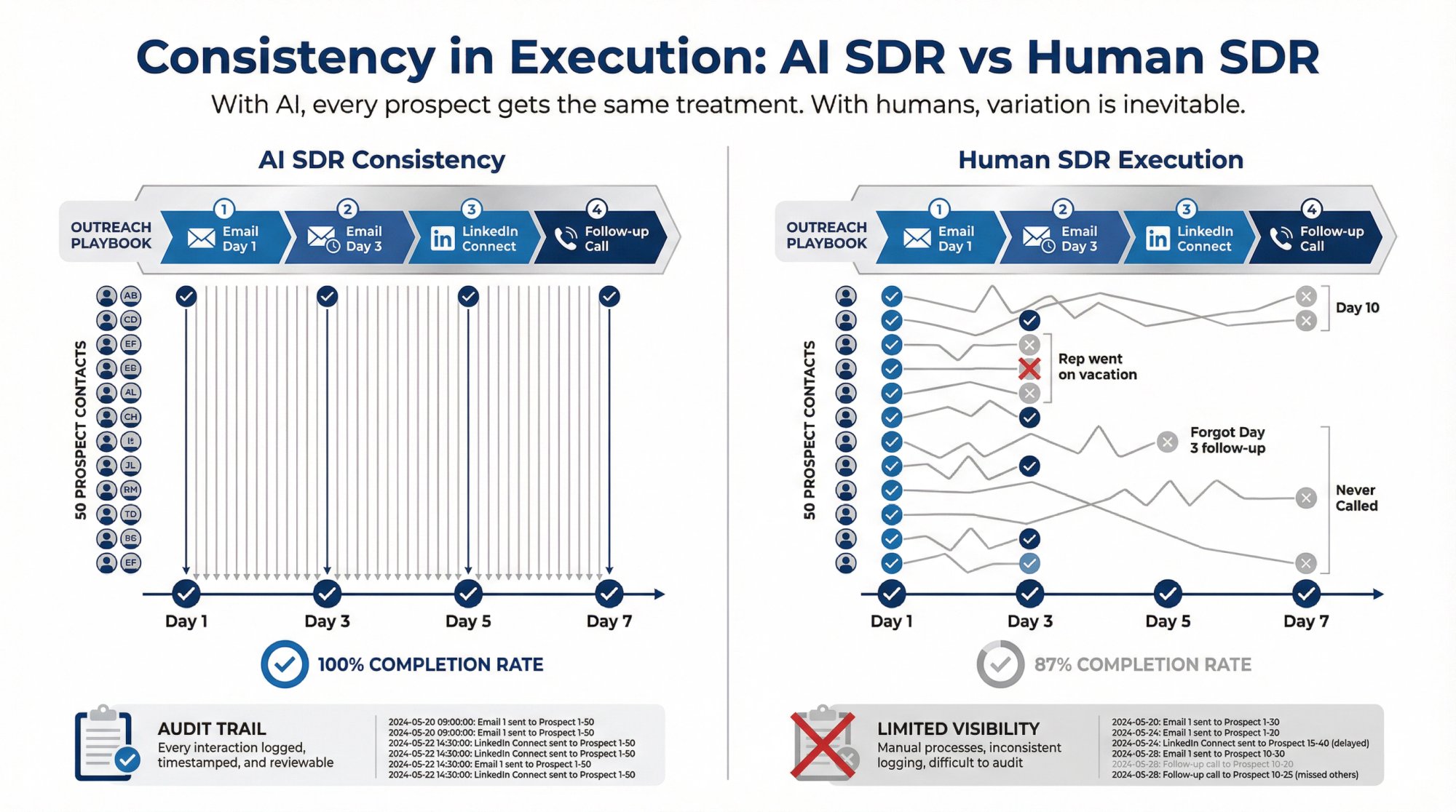
AI SDRs are nothing if not consistent. They will follow the outreach sequence and script exactly as instructed, every single time.
If your process is "two emails, then a call, then connect on LinkedIn," an AI will do that for every lead without fail.
Human SDRs, being human, often have variations. One rep might skip the LinkedIn step because they don't like using it. Another might forget to make the Day 3 call because they were swamped with a hot lead.
With AI, once you set the playbook, every prospect gets the same treatment (until a human intervenes or the prospect replies). This uniformity is great for A/B testing and optimization. You can be sure results aren't skewed by one rep doing something wildly different.
Also, AI doesn't get tired or bored of doing task #50. Human reps might start taking shortcuts by the time they reach the 50th call of the day. AI will deliver the 50th call with the same thoroughness as the first.
No Missed Follow-Ups or Leads
Because AI systems diligently log and pursue every lead, you won't have situations where a hot lead slipped through because someone forgot to follow up. It's programmed not to forget.
Humans can and do lose track at times. Maybe a CRM sync error means a lead wasn't assigned properly, or an SDR left for vacation and nobody covered their tasks.
AI has the edge in ensuring no lead is left behind.
Compliance and Messaging Control
AI SDRs will stick to the script and approved messaging. They won't ad-lib a claim they aren't supposed to make, or use wording that Legal hasn't vetted.
This is huge for compliance in regulated industries or simply for brand voice control. If you've trained your AI on a compliant, on-brand script, it won't stray from it.
Human SDRs, even with training, might occasionally improvise or make an offhand remark that could be off-message or even legally risky (e.g., accidentally promising something product can't do, or sending a text to a prospect without proper consent).
AI always stays on-message and on-policy. It's essentially incapable of going rogue as long as the inputs are controlled. Every interaction by an AI can be logged and reviewed easily, whereas a human might have phone calls that aren't recorded or emails sent off-system.
Error Rates
AI is not infallible. It can certainly make mistakes (like pulling in the wrong data field and calling someone by the wrong name, or misinterpreting a response).
But many of these errors are systematic and can be caught and corrected in the logic.
Human errors are often random and harder to eliminate entirely: typos, forgetting to attach a PDF, dialing the wrong number.
The double-edged sword:
If AI is programmed correctly, it will never deviate (great for compliance). But if programmed incorrectly, it will uniformly apply a bad practice across many leads.
For instance, if someone set it up without accounting for GDPR and it emails a bunch of EU leads without opt-out language, that mistake is widespread.
A human SDR might make that mistake once, get corrected, and not do it again. An AI will do it to every contact until fixed.
This reinforces that even with AI, you need human oversight, especially early on, to ensure compliance settings and content are correct. Once they are, you gain confidence that every outreach is compliant by design.
How to Build a Hybrid AI + Human SDR System That Actually Works
After weighing all these factors, the ideal strategy is clear: AI SDRs and human SDRs each have distinct strengths. Rather than choosing one over the other, the winning move is a hybrid model where AI and humans complement each other.
Here's how to combine them effectively:
1. How to Divide Tasks Between AI and Human SDRs
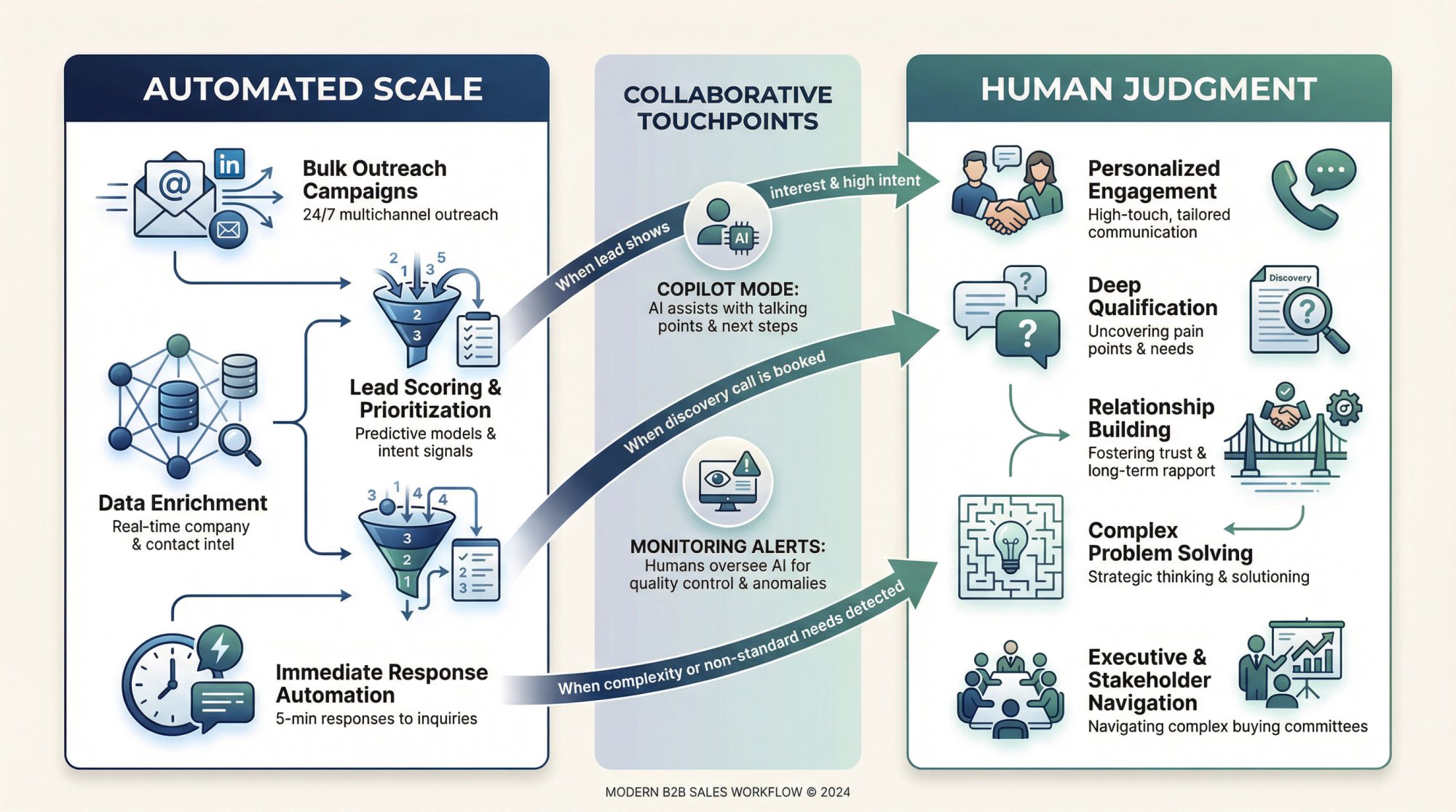
AI SDR responsibilities:
→ Bulk outreach campaigns (email sequences, LinkedIn connection requests, follow-up automation)
→ Initial lead qualification (using rule-based Q&A or lead scoring models)
→ Data enrichment and CRM data entry
→ Immediate response handling for simple cases
Human SDR responsibilities:
→ Personalized engagement with interested leads (e.g., calling a lead who clicked the email)
→ Deep qualification and needs discovery (asking nuanced questions, understanding the prospect's situation)
→ Building rapport and trust over time (multiple calls or personalized videos)
→ Handling edge cases and complex scenarios that AI can't parse (unique objections, technical hurdles)
→ Guiding prospects through later stages of pre-sale (coordinating demos, meetings with multiple stakeholders)
Collaborative touchpoints:
• AI drafts a personalized email, human reviews and tweaks before sending (copilot mode)
• AI nurtures a cold lead for months and alerts a human when that lead shows buying signals (like visiting the pricing page), then the human takes over
This division ensures each part of the process is handled by the entity best suited for it.
2. When to Hand Off Leads from AI to Human SDRs
Decide when to transition a lead from AI to human. You don't want leads to slip through cracks or bounce back and forth awkwardly.
Typical handoff triggers:
• When a lead responds with interest or a complex question (AI sets a meeting or flags the lead for a call)
• When an account reaches a certain score or threshold (AI nurtures until lead score = X, then human engages)
• When the prospect requests to speak to someone
Make sure the human SDR gets all the context. The AI should log the conversation so far and any data collected, so the human stepping in is fully informed.
A well-orchestrated handoff means the prospect experiences it as one continuous flow, not "I talked to a bot and now I have to repeat myself to this SDR."
3. How to Use Human SDRs to Train and Improve AI
Think of your human SDRs not only as salespeople but also as AI trainers and overseers.
In the initial deployment of an AI SDR, have your experienced SDRs help configure the messaging and rules. Their frontline knowledge is invaluable to setting the right tone and content for the AI.
Then, continuously loop back insights: if the AI is sending an email that isn't getting responses, let your SDRs refine that template. If the AI keeps failing to answer a particular question, have SDRs create a better response for the AI to use next time.
This is the essence of "human in the loop."
At Outbound System, our approach blends human creativity with AI scalability. Our strategists craft the core messaging, and then the AI personalizes it at scale for each prospect. The result is messaging that carries authentic human insight but is delivered by the AI efficiently across thousands of contacts.
4. How to Monitor and Optimize Your Hybrid SDR System
Treat the AI + human system as an evolving process. Track key metrics for both:
• Response rates to AI outreach
• Conversion rates of AI-set meetings versus human-set meetings
• Show rates for different types of meetings
• Pipeline quality from each source
This can reveal strengths and weaknesses. Perhaps you find the AI emails get lots of opens but few replies (tweak the personalization or targeting). Or you find that prospects handled entirely by AI to meeting stage have lower show-up rates (incorporate a human touch call to firm up commitment after booking).
Regular team meetings between the SDRs and whoever manages the AI can surface qualitative feedback.
5. How to Segment Industries and Accounts for AI vs Human
In some cases, you might use AI more heavily for certain segments and humans for others.
For simpler, high-volume segments (say, small businesses in a broad industry):
Let the AI run largely autonomously, with humans only handling the hottest responses.
For your top enterprise accounts or most valuable segments:
Have human SDRs do more custom outreach, using AI only for research assistance and minor personalization.
This tiered approach ensures you're investing human effort where it pays off most, and leveraging AI efficiency where the personal touch matters less.
By combining AI and human SDRs effectively, companies can see substantial improvements in overall SDR team efficiency without sacrificing the quality of engagement.
The AI drives more pipeline, the humans convert more of it, and together they produce results neither could alone.
When to Use AI SDR vs Human SDR: Decision Framework
Still not sure which approach fits your situation? Use this decision tree:
Choose AI-First When:
• You have high inbound volume and leads fall into predictable buckets
• Your offer is low-to-mid ACV and qualification is structured
• You can tolerate some "automation feel" because the volume economics make sense
• Your brand risk is moderate and you have strong guardrails
Choose Human-First When:
• Your ACV is high, sales cycles are complex, and buyer committees are real
• You must control brand voice tightly (exec targeting, regulated space, PR-sensitive positioning)
• Your outbound requires multithreading + creativity, not just sequences
• Your motion is LinkedIn-heavy and you want to minimize automated activity risk
Choose Hybrid When:
• You want scale without sacrificing quality
• You're doing outbound and inbound simultaneously
• You want AI leverage but human oversight for messaging, qualification, and compliance
The hybrid approach is already the most common choice among sales teams implementing AI.
AI SDR Risk and Compliance: What You Must Get Right
This section isn't legal advice. Treat it as a risk checklist to discuss with counsel.
Cold Email Compliance (US + Canada)
CAN-SPAM (US) sets rules like truthful headers/subject lines, clear identification, a physical address, and honoring opt-out requests. FTC guidance is the best starting point. Learn more about email outreach compliance rules.
CASL (Canada) is stricter and generally requires consent frameworks and clear unsubscribe mechanisms. Check CRTC guidance.
LinkedIn Automation Risk
LinkedIn warns against automated activity and third-party tools that scrape or automate behavior. This can lead to restrictions.
If LinkedIn is core to your motion, you want a model that prioritizes:
• Conservative daily limits
• Human-like pacing
• Careful follow-up behavior
• Rapid response handling (to avoid "automation smell")
Learn about LinkedIn outreach strategies for B2B sales.
AI Voice and Cold Calling Regulations
The FCC's February 2024 ruling clarified that AI-generated voices fall under TCPA restrictions for "artificial or prerecorded voice."
In plain terms: consent rules matter if you use AI-generated voice calls. Explore our cold calling services.
EU AI Act and Governance
If you sell into or operate in the EU, the EU AI Act rollout and associated obligations are relevant for how AI is deployed and governed (especially around transparency and risk classification).
How to Evaluate an AI SDR Tool: Buying Checklist
If you're considering an AI SDR vendor, use this like an RFP.
1. Deliverability and Infrastructure
• Do emails send from your domains or shared domains?
• Who owns DNS/authentication setup?
• Do they support SPF/DKIM/DMARC alignment and enforcement?
• How do they implement unsubscribe and suppression?
• Can they throttle per inbox/domain to avoid spikes?
These matter more post-2024 given Google and Microsoft sender rules.
2. Data Quality
• Where does lead data come from?
• Do they verify emails (and how)?
• Do they dedupe across sources?
• Can you bring your own data?
Learn about our waterfall enrichment approach.
3. Reply Handling
• Who handles replies: AI, humans, or you?
• Can the AI reliably distinguish "not now" vs "unsubscribe" vs "wrong person"?
• Is there a human escalation workflow?
4. Messaging Control
• Can you enforce brand voice and claims?
• Can you lock what the AI is allowed to say?
• Is there approval workflow for strategic accounts?
5. Channel Risk
• Does it include LinkedIn automation? If yes, what's the safety model, and how do they interpret LinkedIn's restrictions on automated activity?
• Does it include voice calling? If yes, what's the TCPA consent model given the FCC's interpretation around AI voice?
6. Pricing Reality
• Is pricing based on contacts, messages, seats, or outcomes?
• Are there onboarding/services fees?
• Is there a long-term commitment?
• What happens when you exceed volume limits?
Use published pricing where available (AiSDR, Regie) and treat estimates as estimates (e.g., 11x).
How to Make a Human SDR Hire Succeed: Hiring Checklist
Human SDRs fail when companies think the role is "send more emails."
To win with humans, you need:
1. Clear ICP + offer + disqualification rules
Not "write something good," but repeatable frameworks.
2. A repeatable messaging framework
Good inputs from the start. Check out our cold email copywriting tips.
3. List-building and data operations
Automation and infrastructure. Learn how to build a prospect list.
4. A sequencing system + QA + coaching cadence
Regular feedback and iteration.
5. Fast iteration loop
Weekly testing and adjustments, not quarterly reviews.
If you're choosing between in-house and outsourced, Outbound System's own analysis of agency vs in-house SDR highlights common tradeoffs like speed, hidden costs, and ramp time.
Where Does Outbound System Fit in AI vs Human SDR?
Outbound System's point of view is that outbound success is not a tool decision. It's a systems decision:
• Deliverability infrastructure
• Human-written positioning and messaging
• AI-assisted personalization where it's appropriate
• Continuous testing and optimization
That's why Outbound System publishes both:
• AI prospecting execution guidance (how to use AI without losing the human touch)
• Deliverability and measurement guidance (why open rates aren't the KPI they used to be)
Our infrastructure:
We built Outbound System on 350-700 Microsoft U.S. IP inboxes with 9-step waterfall enrichment and triple-verified data. We achieve 98% inbox placement and 6-7% response rates because deliverability is the foundation.
Our pricing:
• Starter: $1,499/month (up to 15,000 emails per month)
• Growth: $2,499/month (up to 30,000 emails per month)
• Scale: $3,999/month (up to 60,000 emails per month)
Every plan includes:
• Dedicated Microsoft U.S. IP inboxes
• AI personalization + human copywriting
• Dedicated account strategist
• Real-time metrics and CRM integrations
• A/B testing and optimization
If your goal is: "We want qualified meetings, without building and managing a full SDR operation," then an outsourced, hybrid system can be a better fit than either hiring a full team or betting everything on an AI agent.
We've helped 1,000+ B2B clients book qualified meetings, generate pipeline, and close revenue with our hybrid approach.
Check out our case studies to see what's possible.
AI SDR vs Human SDR: Final Recommendation for 2026
If you're deciding today:
If you're inbound-heavy:
Start with AI for responsiveness + qualification, but keep humans for edge cases and high-value conversations.
If you're outbound-heavy:
Don't start by asking "AI or human?" Start by asking "What's our deliverability + data + messaging system?" Then use AI where it increases throughput without increasing risk.
If you're enterprise / high ACV / brand sensitive:
Human-led with AI assist is still the safest high-performance model.
If you want the highest probability of success:
Build a hybrid system. Because that's where many teams are landing operationally. Research confirms it.
The teams winning in 2026 aren't picking sides. They're building systems that use AI for leverage and humans for judgment.
That's the real competitive edge.
Frequently Asked Questions
Can AI SDRs Completely Replace Human SDRs?
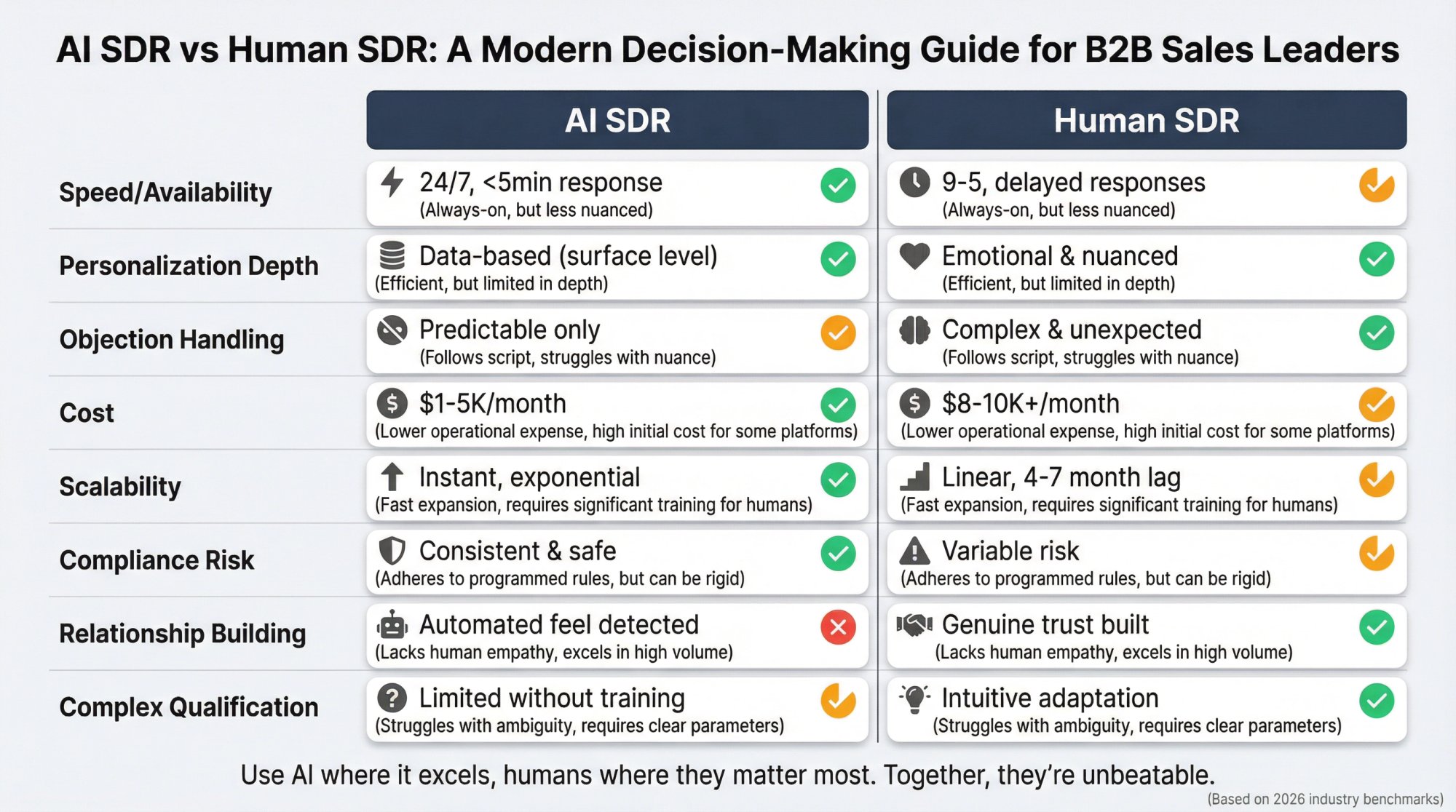
Not yet, and probably not ever for complex B2B sales. AI SDRs excel at volume, speed, and consistency, but they lack the empathy, creative problem-solving, and relationship-building skills that humans bring to high-value conversations. The most successful teams use AI to handle repetitive tasks and initial outreach, while humans focus on qualification, objection handling, and building relationships.
What's the ROI Timeline for AI SDR Implementation?
Most teams see initial results within 30-60 days of implementing AI SDRs, but the full ROI becomes clear at the 90-day mark. The key is proper setup: deliverability infrastructure, messaging testing, and handoff workflows all need to be configured correctly. Teams that rush implementation often see poor results, while those that invest in proper setup typically see 40-60% improvement in SDR team efficiency.
How to Prevent AI SDRs from Damaging Your Brand?
Three critical safeguards:
(1) Start with conservative messaging that human SDRs review and approve
(2) Set up clear escalation workflows so complex conversations always involve humans
(3) Monitor response quality closely in the first 30 days and adjust based on prospect feedback
Also ensure your AI SDR platform has proper compliance controls for unsubscribe handling and data privacy.
What Metrics Should You Track for AI SDR Performance?
Focus on these metrics instead of vanity metrics like open rates:
(1) Positive reply rate (not total reply rate)
(2) Meeting booked rate
(3) Show rate for booked meetings
(4) Meeting-to-pipeline conversion
(5) Pipeline per 1,000 sends
These tell you if the AI is actually generating qualified opportunities, not just activity.
How Much Human Oversight Does an AI SDR Need?
Initially, significant oversight. In the first 30 days, plan for daily monitoring of AI interactions, weekly messaging reviews, and continuous tuning of qualification logic. After 60-90 days of optimization, most teams settle into a weekly review cadence where they check performance metrics, review edge cases, and refine messaging based on what's working. The goal is to reduce oversight over time while maintaining quality.
What's the Biggest Mistake When Implementing AI SDRs?
Treating AI SDRs like a "set it and forget it" solution. The biggest failures happen when teams deploy an AI SDR without proper deliverability infrastructure, clear handoff workflows, or human oversight. They expect the AI to work magic without doing the strategic work of messaging, targeting, and system design. AI amplifies your system; if your system is broken, AI just breaks it faster at scale.
How Does AI SDR Pricing Work?
AI SDR pricing varies widely based on:
(1) Active contacts or messages sent
(2) Channels included (email only vs omnichannel)
(3) Data included or not
(4) Reply handling capability
(5) Onboarding and services
Basic automation tools start around $100-500/month (limited AI), mid-market platforms run $1,000-5,000/month, and enterprise-grade systems with advanced conversational AI can cost $2,000-7,000+/month. Always ask about volume limits, overage fees, and what happens when you scale.
Can AI SDRs Handle Objections as Well as Humans?
No. AI SDRs can handle simple, predictable objections that you've programmed responses for (like "send me more info" or "not the right time"). But when prospects raise complex or unexpected objections, nuanced concerns, or questions that require strategic thinking, humans still outperform AI significantly. The best approach is to have AI escalate these conversations to human SDRs rather than trying to handle them autonomously.
What's the Difference Between AI SDR and Sales Automation Tools?
Traditional sales automation tools (like sales engagement platforms) are workflow engines that help humans sequence their outreach. AI SDR platforms go further by using AI to make decisions: personalizing messages based on prospect data, determining optimal send times, qualifying responses, and even conducting basic conversations. The key difference is autonomy: traditional automation executes what you tell it; AI SDRs make some decisions on their own based on rules and patterns.
Should You Build an In-House SDR Team or Outsource to an Agency?
It depends on your resources and timeline. Building in-house gives you control but requires significant investment: SDR salaries ($80k-100k+ fully loaded per rep), tools and data subscriptions ($20k-30k+ annually), management overhead, and 4-7 months to ramp. Outsourcing to an agency like Outbound System (starting at $1,499/month) gives you immediate access to proven infrastructure, messaging expertise, and deliverability systems without the overhead. Many teams start with an agency to prove the model, then decide whether to bring it in-house later. Learn more about agency vs in-house SDR.