Building a steady pipeline is every B2B company's lifeblood. But when it comes to outbound prospecting, you're facing a choice that will define your growth trajectory: hire an in-house Sales Development Representative (SDR) or partner with a cold email agency.
Both approaches can book meetings and generate leads. Yet the cost structures, speed to results, expertise available, and management overhead couldn't be more different.
Make the right call and you'll scale efficiently. Choose wrong and you'll watch months slip by while competitors surge ahead.
This guide breaks down the cold email agency vs in-house SDR decision from every angle that matters: true costs (visible and hidden), ramp-up speed, scalability, expertise depth, management burden, brand control, and ROI. You'll walk away knowing exactly which model fits your business right now.
What Is a Cold Email Agency vs In-House SDR?
Before diving into the details, let's clarify what each option actually delivers.
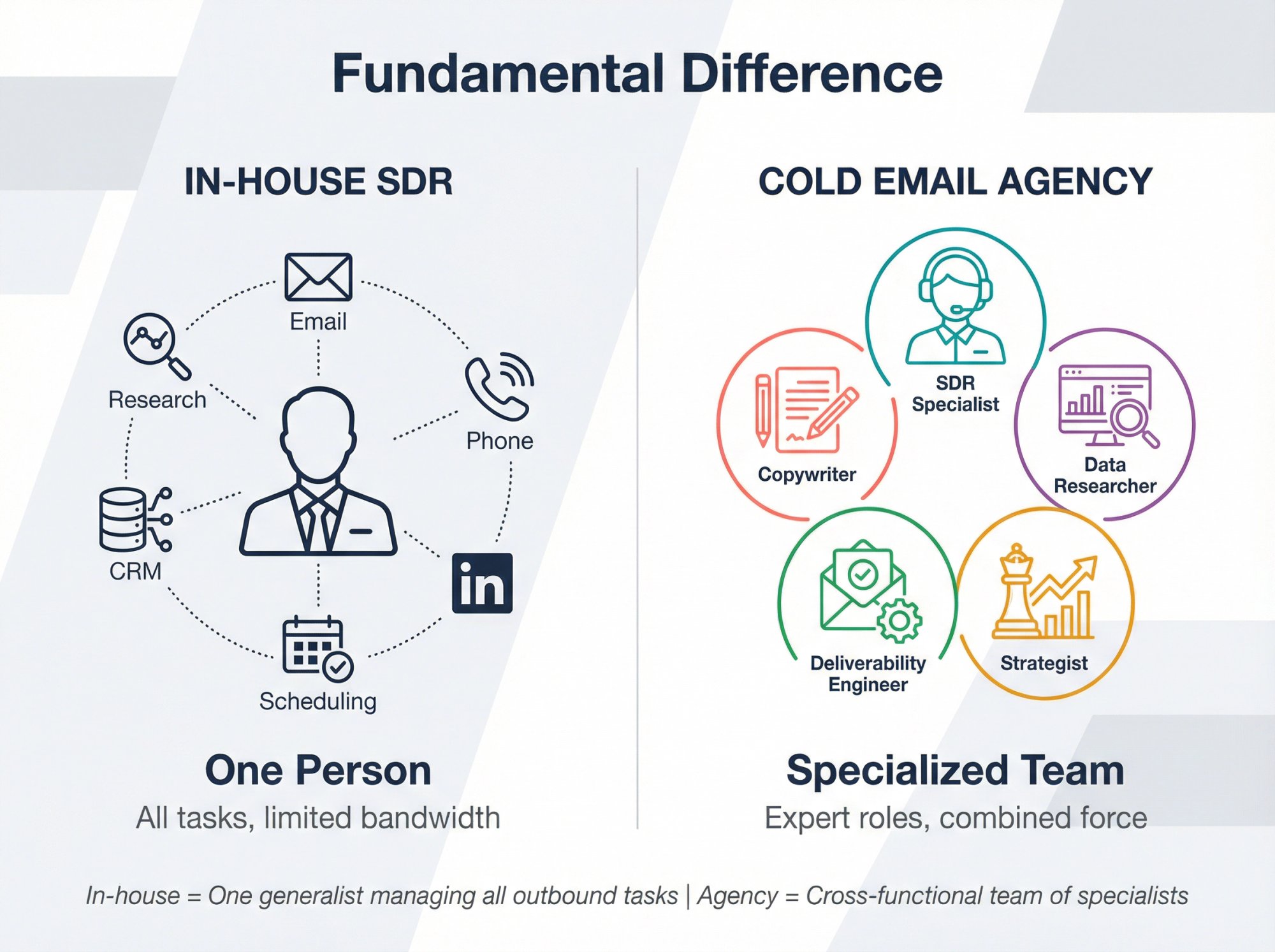
In-House SDR: A full-time employee dedicated to outbound prospecting. They research prospects, craft cold emails, send LinkedIn messages, make calls, and qualify leads. They work inside your company, report directly to your team, and become deeply familiar with your product and culture.
Cold Email Agency: An external service provider specializing in B2B appointment-setting through cold outreach. Think of it as hiring a fractional SDR team. A quality agency handles everything: building targeted prospect lists, setting up email infrastructure, writing personalized copy, and scheduling qualified meetings directly on your calendar.
You're not hiring one person with an agency. You're getting access to experienced SDRs, copywriters, data researchers, and deliverability engineers working together.
So what's the fundamental difference? In-house means recruiting and managing individual SDRs yourself. An agency means outsourcing the entire SDR function to specialists.
How Much Does a Cold Email Agency vs In-House SDR Cost?
Cost drives most business decisions. But comparing the two models requires looking past the obvious numbers.
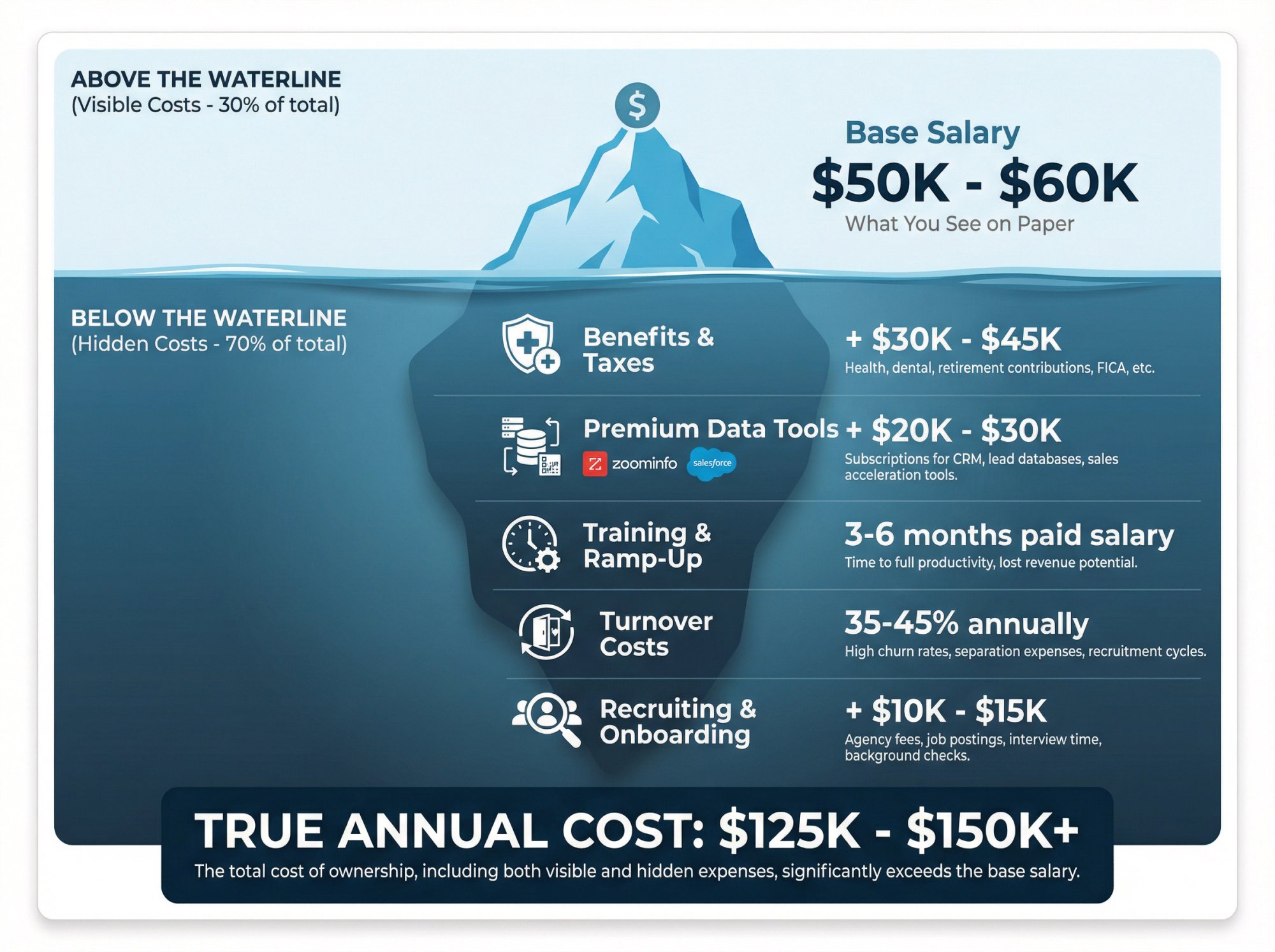
What Does an In-House SDR Really Cost?
An SDR's base salary in 2025 averages $50,000 to $60,000 annually. Strong performers earn $75,000 to $85,000 with commissions included.
That looks straightforward on paper.
Then reality hits.
Benefits and employer taxes add roughly 20-30% on top of base salary. Health insurance, retirement contributions, payroll taxes, and paid time off can easily push $30,000 to $45,000 more onto your annual cost. A $60,000 SDR actually costs your company $80,000 to $100,000 after the full accounting.
But we're still not done.
Tools and technology for effective outbound prospecting aren't cheap:
• Premium data platform like ZoomInfo: ~$20,000/year
• CRM seat (Salesforce): ~$900/year
• Sales engagement platform: ~$3,600/year
• Email sequencing tools: ~$1,200/year
• LinkedIn Sales Navigator: ~$1,500/year
Without quality data and automation, your SDR's effectiveness plummets. Most companies underestimate these software costs until the bills arrive. When you add training expenses, recruiting costs, and the salary paid during ramp-up (when the SDR isn't yet productive), the total cost of an entry-level SDR easily reaches $125,000 to $150,000+ per year.
Turnover makes it worse. SDR roles experience 35-45% annual turnover. High performers get promoted or poached. Mediocre ones move on. Each departure means you restart the recruiting cycle, pay onboarding costs again, and lose pipeline momentum during the gap.
How Much Do Cold Email Agencies Charge?
Reputable B2B outbound agencies typically charge $2,000 to $10,000+ per month depending on scope. Many quality providers fall around $6,000 to $7,000 monthly for comprehensive outreach programs, totaling $75,000 to $80,000 annually.
At first glance, that looks similar to (or higher than) one SDR's base pay. But here's what changes the math:
The agency fee covers everything. No benefits. No recruiting expenses. No software subscriptions. No training costs. No dealing with turnover. The agency handles all personnel costs, provides enterprise-grade tools, and delivers ready-to-go infrastructure.
For example, Outbound System's Starter plan is $1,499/month for up to 15,000 emails per month, including AI personalization and complete deliverability management. Growth ($2,499/month) and Scale ($3,999/month) raise volume to 30,000 and 60,000 emails.
Compare that to building the same infrastructure yourself.
Agencies achieve economies of scale by spreading technology costs across multiple clients. Their advanced sales platforms, data enrichment services, and analytics tools might cost them $50,000 to $100,000 annually, but you only pay a fraction.
Staff turnover becomes their problem, not yours. When an agency SDR leaves, they train a replacement behind the scenes. Your campaigns keep running. You don't experience the pipeline drop that kills an in-house program when someone quits.
Cost Factor | In-House SDR | Cold Email Agency |
|---|---|---|
Base compensation | $55K-$75K/year | N/A (included in fee) |
Benefits & taxes | +$30K-$45K/year | Included |
Tools & data | +$20K-$30K/year | Included |
Training & ramp | 3-6 months paid salary | 2-4 weeks to launch |
Turnover replacement | Restart full cycle | Handled internally |
Total annual cost | $125K-$150K+ | $60K-$100K |
When you calculate cost per qualified lead or meeting, outsourcing frequently delivers 20-30% lower costs than in-house teams. Some analyses suggest companies save 25-60% of outbound expenses by using agencies when all hidden costs factor in.
Which Gets Results Faster: Agency or In-House SDR?
Time kills deals.
How fast can you spin up an effective outbound engine?
How Long Does It Take to Hire and Ramp an In-House SDR?
First, recruit the right talent. Job postings, interviews, offer negotiations... this alone takes weeks or months. After hiring, the new SDR needs training on your product, market positioning, and tools.
Even talented SDRs require 90-120 days to reach basic productivity and about 6-9 months to hit full quota performance. You're paying full salary and tool costs during this ramp while getting minimal meetings booked.
Then there's the infrastructure work: creating email domains, warming them up (typically 4-6 weeks alone), setting up CRM workflows, sourcing prospect lists, writing email sequences.
Realistically, 8-12 weeks pass before an internal SDR fully plugs in and starts generating consistent meetings.
A quarter gone. Zero pipeline.
How Fast Can a Cold Email Agency Launch?
Specialized cold email agencies compress this timeline dramatically. They already have outreach systems ready. They mainly need to learn about your business specifics, then plug them into their existing machine.
Many agencies can launch campaigns in 14 days or less. Outbound System, for instance, handles domain setup, warming, email sequence writing, and prospect list loading in parallel. Within 7-14 days, campaigns are running and appointments start booking.
Compare that to the 2-3 months an in-house hire needs to produce consistent results.
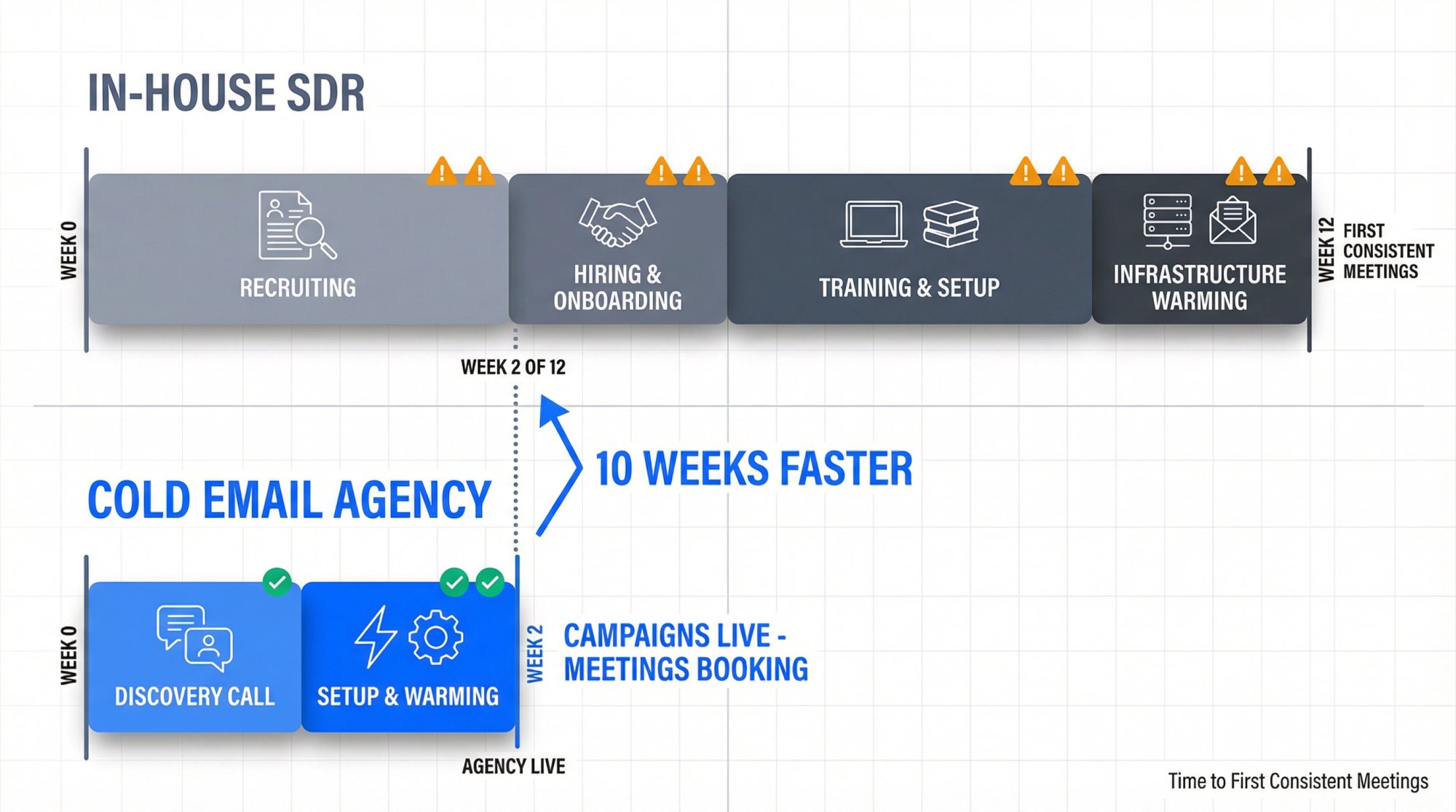
Speed advantage: If you're capitalizing on a seasonal opportunity or trying to sprint ahead of competitors, agencies deliver results in weeks instead of months. You're not building from scratch. You're tapping into an already-built engine.
How Do Cold Email Agencies Scale Faster Than In-House Teams?
Need to 5× your outbound volume next quarter?
In-house: Hiring five additional SDRs could take most of a year. Each new hire requires recruitment, training, tooling, and managerial oversight. Even with unlimited budget, you can't just "toggle" up an in-house program overnight.
Agency: Ask them to increase campaign volume. They allocate more resources, deploy additional infrastructure, and scale within weeks. Instead of managing five separate hiring processes, you negotiate one scope adjustment.
Need to test a new vertical? An agency can spin up a parallel campaign targeting that market in days. Your internal team would need to learn the new market from scratch while still handling existing workload.
Want to pause for a month? Many agencies (like Outbound System) operate on month-to-month contracts. You can dial down without layoffs or HR complications.
Try doing that with salaried employees.
Scalability winner: Agencies, by a wide margin. They're built for on-demand flexibility.
Cold Email Agency vs In-House SDR: Who Has Better Expertise?
Effective outbound isn't just about sending emails. It requires skills across multiple domains: persuasive copywriting, accurate data sourcing, automation expertise, deliverability engineering, and performance analytics.
What Skills Does One In-House SDR Bring?
When you hire an SDR, you get one person with whatever mix of skills they bring. Even great SDRs have limitations. Your hire might excel at phone calls but struggle with email copy. They might personalize well but lack technical knowledge about email deliverability.
Finding top-performing SDRs is hard. They're expensive and highly sought after. If you're a smaller company without Silicon Valley salaries or rapid promotion paths, you'll likely hire mid-level talent who needs substantial guidance.
One SDR also means one brain. They have to split time between prospect research, email writing, calling, activity logging, and everything else.
There's no team to bounce ideas off. No specialized expertise to tap when campaigns underperform.
What Expertise Does a Cold Email Agency Team Provide?
A cold email agency brings a cross-functional team:
• Experienced SDRs handling day-to-day outreach
• Professional copywriters crafting and refining messaging
• Deliverability engineers managing technical infrastructure
• Data researchers building and cleansing prospect lists
• Strategists and account managers analyzing performance and optimizing campaigns
You're not hiring one person. You're renting an outbound department.
This matters because outbound success is multi-dimensional. Quality data. Deliverable emails. Persuasive copy. Smart cadencing. Performance analysis. It's extremely hard to find all those talents in one individual.
Critical insight: Agencies assemble these specialists and let you access their combined expertise without managing separate hires.
Benchmark knowledge gives agencies another edge. In-house SDRs only see your company's results. Agencies run campaigns across multiple clients, industries, and regions. They develop cross-industry benchmarks: what subject lines work, which call scripts resonate, effective personalization tactics.
When you test a new approach in-house, you're experimenting in isolation. When agencies test, they're gathering data across dozens of campaigns simultaneously. They spot patterns faster. They innovate quicker.
Agencies reported clients seeing 2-3× higher conversion rates simply by applying frameworks proven with other clients. Your internal team might take months (or never) to discover those same tactics.
What Technology Infrastructure Do Agencies Provide?
In-house tech stack: Budget constraints often mean limited tools. Maybe one email automation platform, one data provider, and basic tracking. Many small internal teams send cold emails from one or two company addresses, which quickly triggers spam filters.
Without specialized deliverability knowledge, internal teams struggle with sender reputation, domain warming, and inbox placement optimization.
Agency infrastructure: Outbound agencies invest heavily in enterprise-grade technology that individual companies can't justify.
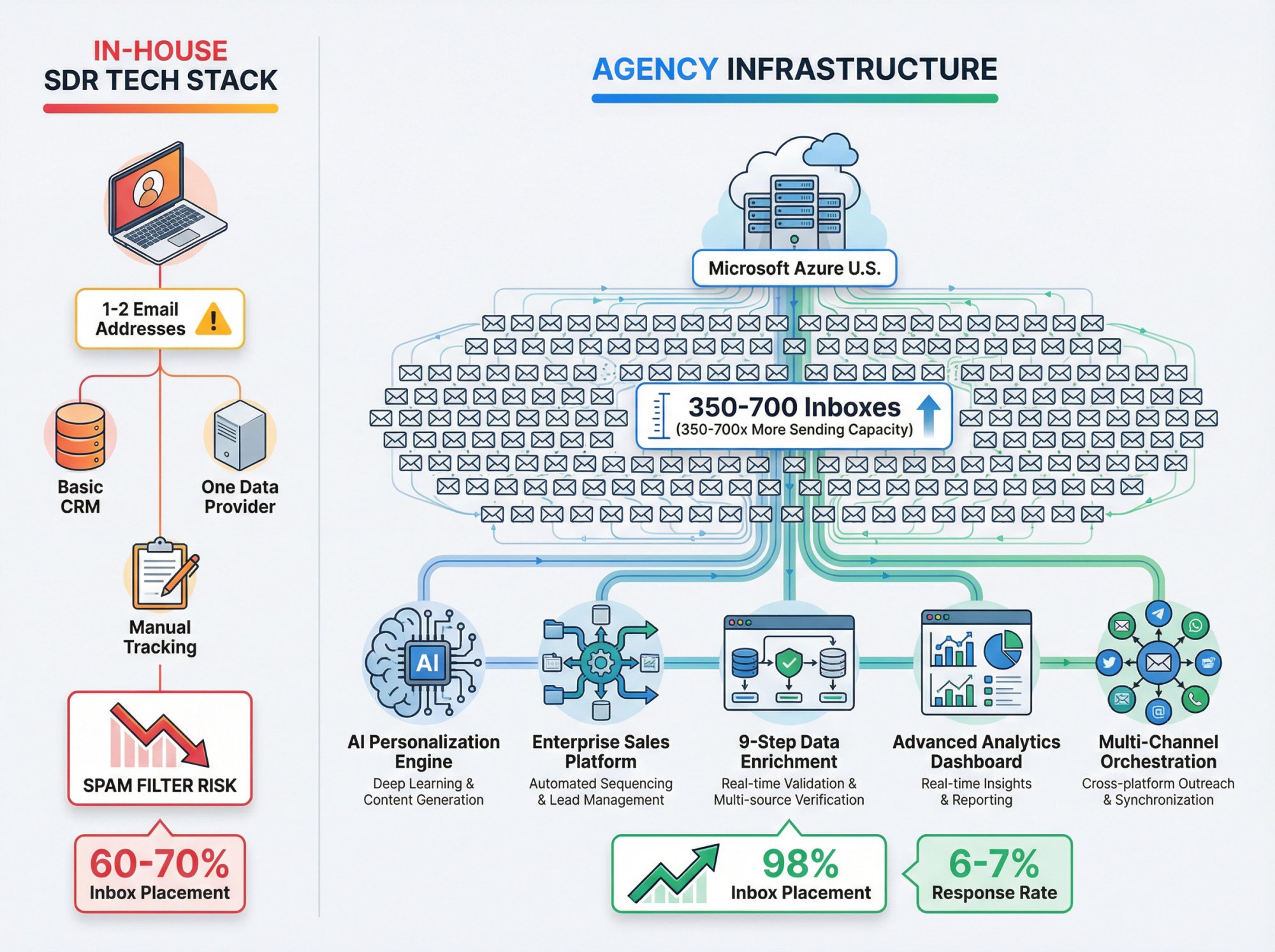
Outbound System maintains 350-700 warmed email inboxes on private Microsoft infrastructure, sending through each at low volume to mimic human patterns. This approach achieves 98% inbox placement and 6-7% response rates. A single SDR using one domain could never match that deliverability.
Agencies use:
→ Advanced sales engagement platforms coordinating multi-channel touches
→ AI personalization tools inserting custom sentences at scale
→ Auto phone dialers bypassing spam filters
→ Custom dashboards tracking detailed funnel metrics
→ Professional data enrichment and verification pipelines
For instance, Outbound System's 9-step waterfall enrichment combines syntax validation, SMTP pings, bounce data analysis, and engagement signals to triple-verify contacts. This minimizes bounces and maximizes reply probability.
You basically rent a world-class outbound machine that would cost hundreds of thousands to build alone.
How Much Management Time Does Each Model Require?
Running an outbound program requires effort.
The question is whose effort and how much.
How Much Time Does Managing In-House SDRs Take?
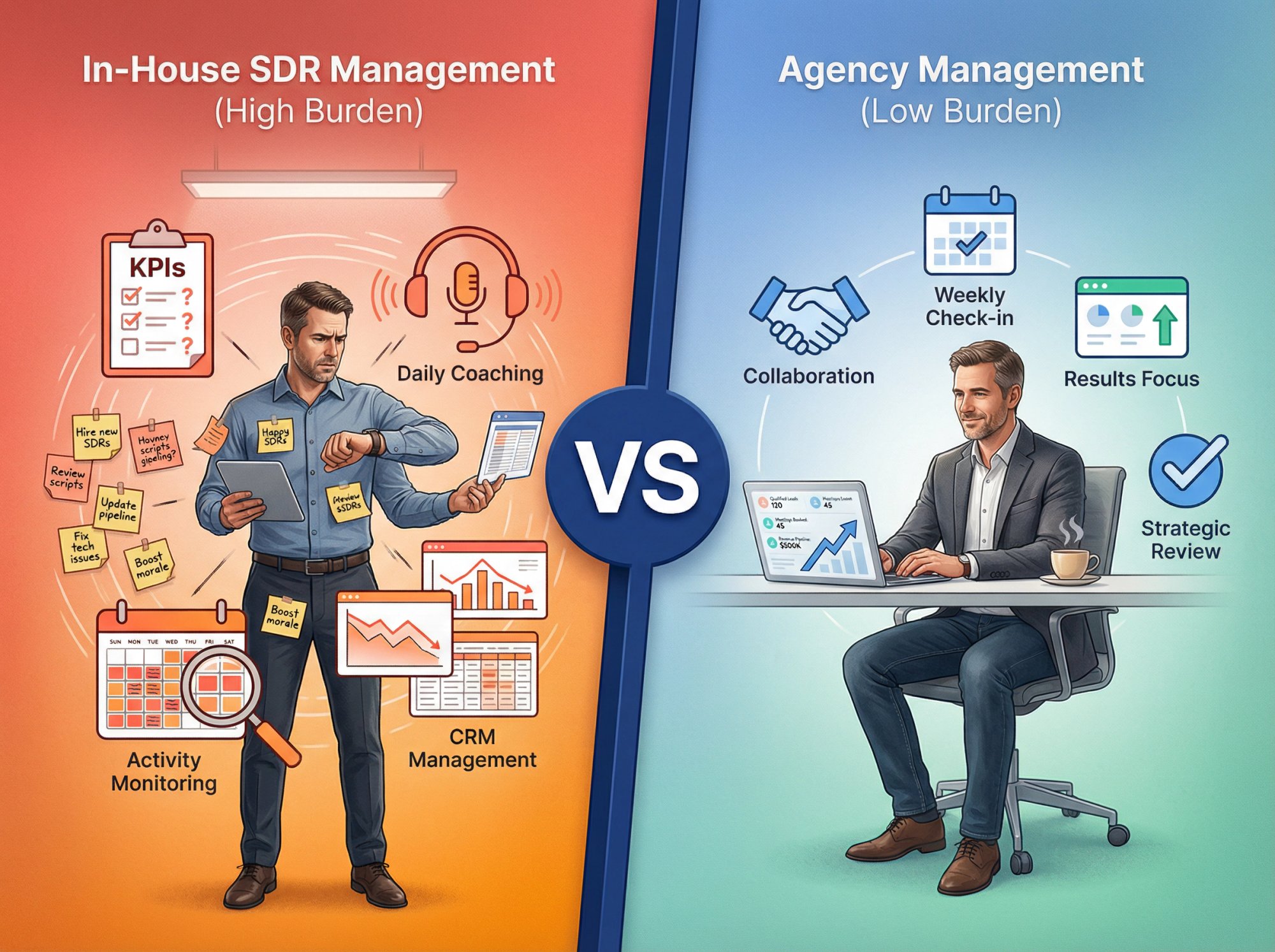
Hiring SDRs internally means taking on all management duties:
Setting goals and KPIs
Monitoring daily activity
Coaching on technique
Reviewing call recordings and email drafts
Keeping them motivated (SDR work is repetitive)
If you have just one SDR, they often report directly to the founder or sales lead. That's a substantial time investment for leadership. Multiple SDRs require an SDR manager (another hire earning as much or more than the SDRs themselves).
There are administrative tasks too: uploading lead lists, managing sequences in tools, ensuring CRM hygiene, handling qualified lead hand-offs to AEs.
Someone has to do this meticulously.
Many CEOs find themselves basically acting as part-time SDR managers when they go in-house too early. That's time not spent closing deals, improving product, or handling higher-level strategy.
How Much Management Do Cold Email Agencies Need?
Outsourcing eliminates day-to-day management of the prospecting process. You don't manage individual SDRs or copywriters at the agency. That's their job.
Your role shifts to collaboration: working with the agency on strategy and reviewing progress. A good agency provides an account manager who serves as your point of contact. You'll have regular check-ins (weekly or biweekly) to discuss results and adjustments.
You don't teach the agency how to do outbound. You teach them about your business specifics (target personas, value proposition) at the start. Then they execute.
This saves massive managerial time and mental bandwidth. One often-cited agency advantage: "management-free pipeline generation." You get the meetings without managing the minutiae of how they were booked.
For small companies with limited leadership bandwidth, this is huge. It lets you focus on closing sales or other priorities while experts handle top-of-funnel work.
Who Handles Risk When SDRs Underperform?
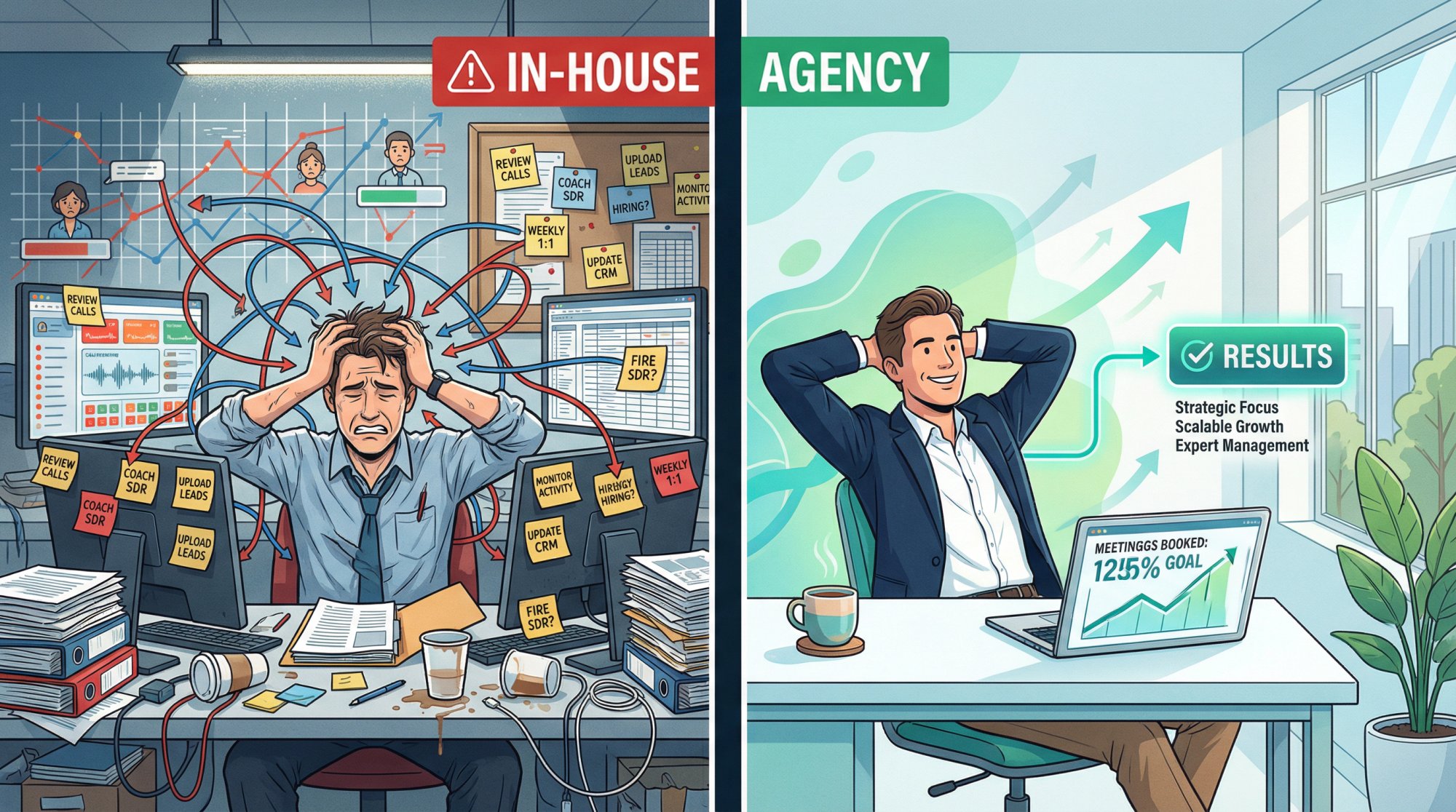
In-house risks: If your SDR gets sick, goes on vacation, or quits unexpectedly, outbound outreach might stop. Small teams are fragile. Seasonal holidays or one departure severely impacts results.
If the SDR underperforms, you need to diagnose problems, coach them, and possibly replace them (restarting the expensive hiring cycle). Meanwhile, pipeline suffers.
Agency commitments: Agencies are highly results-driven. They know poor performance means you'll cancel. Some even offer performance guarantees (Outbound System's cold calling service, for instance, guarantees 10-30 qualified meetings in 30 days or full refund).
If one person on the agency team underperforms, they handle it internally. You never know about their personnel issues. Your campaigns keep running.
The risk dynamic favors clients: agencies must deliver or lose your business quickly. Internal employees get paid regardless of short-term outcomes.
Will a Cold Email Agency Represent Your Brand Correctly?
This is where companies hesitate most about outsourcing.
"Will they represent our brand correctly? Can an external team really speak for us?"
Why In-House SDRs Know Your Product Best
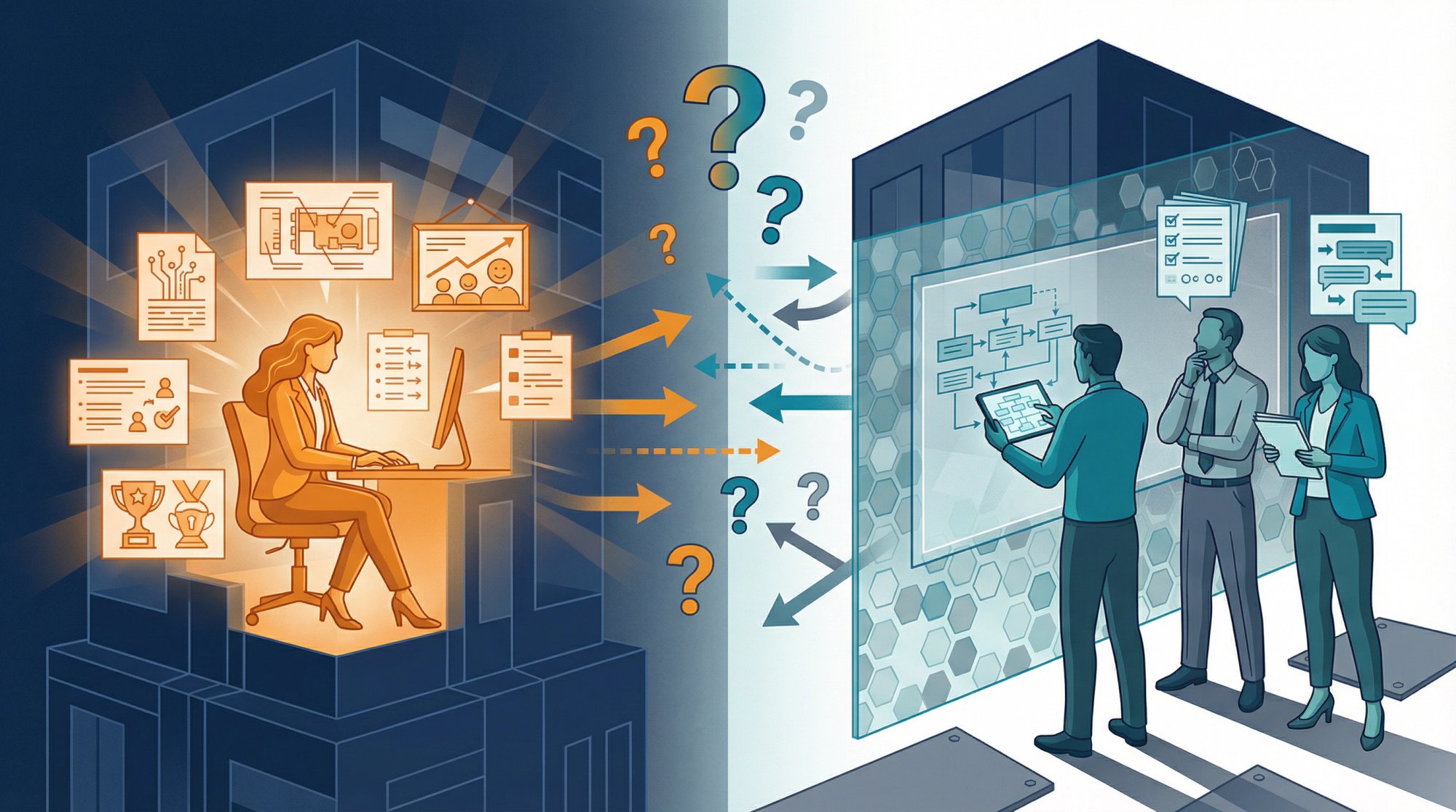
An in-house SDR naturally absorbs deep product knowledge. They attend internal trainings, sit in product meetings, hear customer success stories. Over time, good internal reps speak about your solution almost as fluently as founders.
They're fully dedicated to your offering. All their time is spent in your context. For highly technical or complex products, this depth might be necessary for credible executive conversations.
In-house team members also live your company culture and tone. They know exactly how you present the brand. They can nurture prospects for months or years, gradually building relationships with genuine passion for the mission.
If cultivating internal expertise and cultural alignment matters deeply, in-house has advantages.
How Do Cold Email Agencies Learn Your Product?
Most agencies might never match quite the same native product knowledge as an internal employee. They're working with multiple clients and remain external.
Effective onboarding is crucial. Good agencies invest time upfront learning your value proposition, differentiators, target profiles, and common objections. Many start with detailed discovery calls and questionnaires.
The goal: get as close as possible to internal team understanding. Agencies develop messaging frameworks and scripts for your approval, ensuring accuracy.
Some companies involve agencies in weekly sales meetings or Slack channels, treating them as extended team members. This keeps agencies up-to-date on product changes and market shifts.
Remember: in most cold outreach, the SDR's role (agency or not) is piquing interest and securing meetings, not delivering full demos. As long as messaging is correct and convincing, deep technical knowledge rarely gets tested in top-of-funnel interactions.
Who Controls the Messaging: You or the Agency?
Direct oversight in-house: You can listen to call recordings, read email drafts, give immediate feedback. You have complete control over external communications (assuming you exercise it through coaching).
If compliance or legal approval is needed for messaging (relevant in finance or healthcare), managing it internally might feel easier.
Shared control with agencies: You'll approve general messaging and campaign approaches, but you won't see every single email before it sends. You trust the agency's execution within approved parameters.
Reputable agencies stick to scripts and templates you've signed off on. Many share exact email copy, sequences, and targeting criteria at the start. Once campaigns run, they inform you of major changes or optimize copy based on learnings.
Some agencies provide live dashboard access so you can spot-check emails anytime. But you likely won't review each message, especially at scale (hundreds or thousands of contacts).
The key: choose an agency you trust and establish clear guidelines. Good agencies maintain regular communication and transparency.
How Do Agencies Protect Your Brand Reputation?
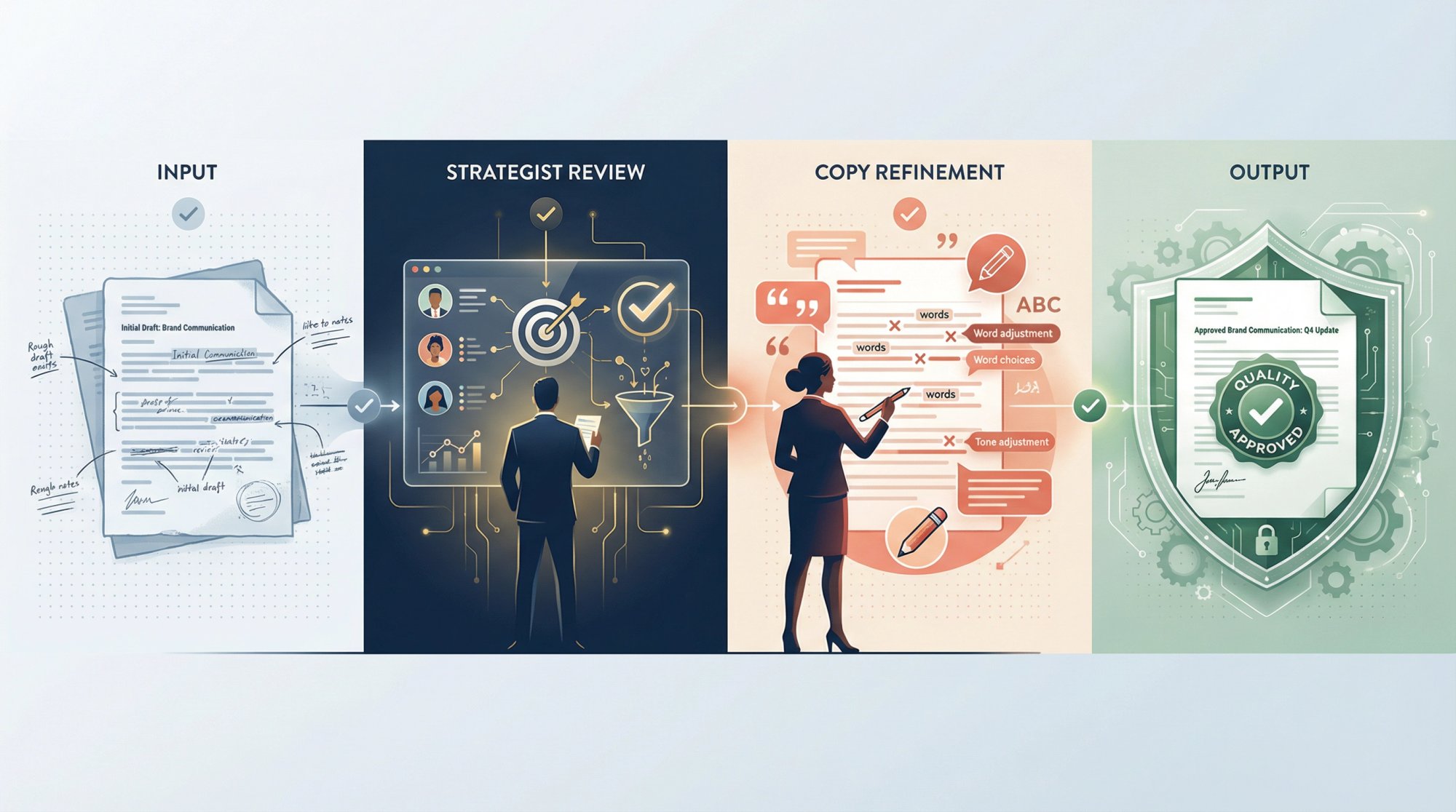
Agency QA: Agencies live by results and client satisfaction. They typically have rigorous quality processes:
Multiple people review campaigns before launch
Strategists sign off on targeting criteria
Copywriters check SDR personalization for errors
High-quality data verification steps (bad lists hurt their sending reputation too)
In many cases, agencies improve outreach quality compared to what a rushed in-house rep might produce.
Top agencies train their teams to act as extensions of your brand. Some even have SDRs use your company email domain and titles ("YourCompany Business Development") so prospects see what appears to be an internal employee reaching out.
When done right, brand voice and professionalism remain intact.
Which Delivers Better ROI: Cold Email Agency or In-House SDR?
Results determine everything.
How many meetings? How much pipeline? What's the return on investment?
How Long Until You See Positive ROI?
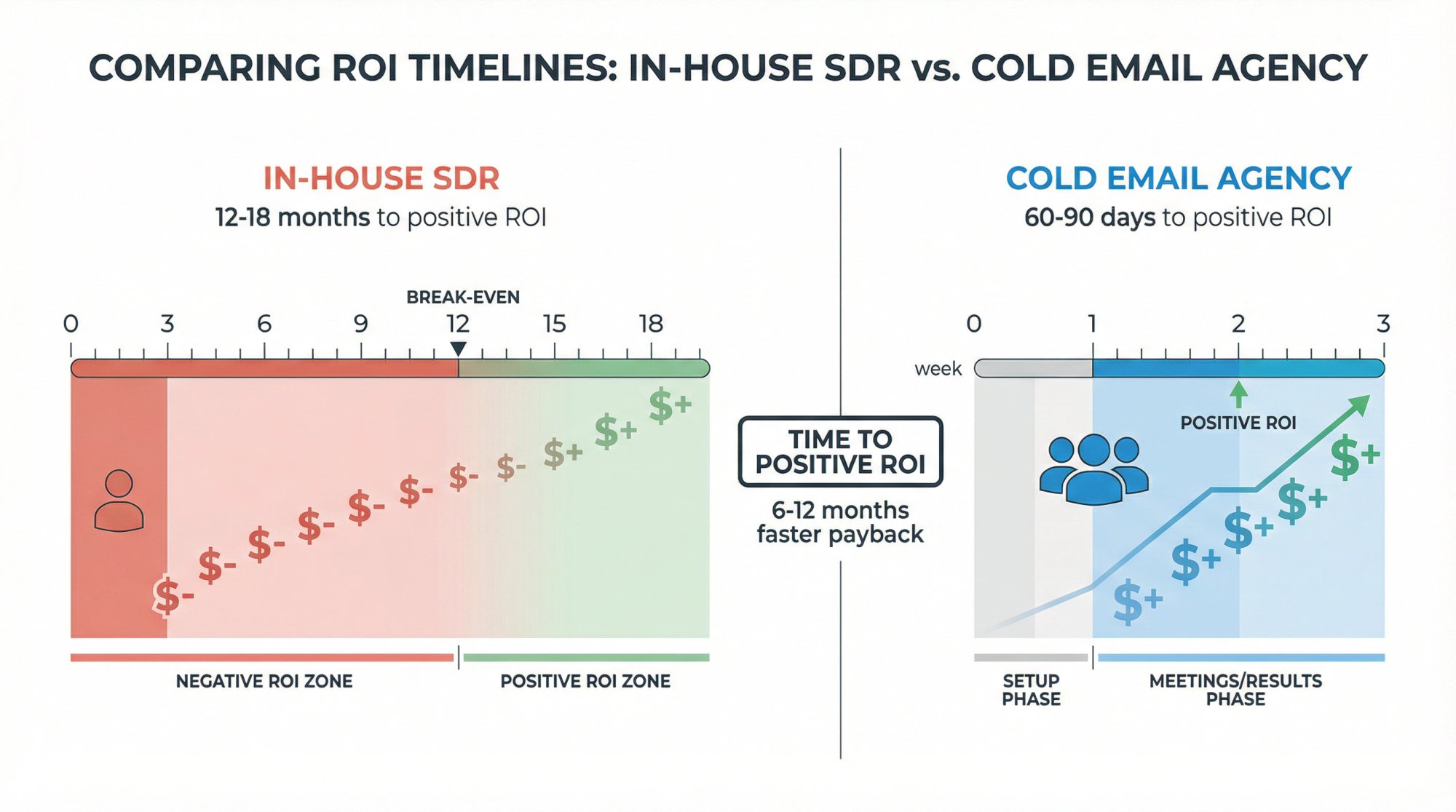
In-house: Expect negative ROI in the initial months. You're investing ahead of results. Building a fully productive internal SDR function can take 12-18 months to really pay off.
Agency: Start delivering qualified meetings faster, often within 60-90 days showing positive ROI. One analysis found companies typically see returns from outsourced SDR programs within this timeframe, compared to potentially a year for in-house to reach the same point.
In terms of payback period, agencies win. (Assuming the agency is competent. Bad agencies waste time too.)
Which Model Generates More Meetings?
A single in-house SDR has finite output: maybe 50 emails and 20 calls daily.
An agency with team and automation might send hundreds of targeted emails daily on your behalf (distributed across many inboxes for deliverability). For example, Outbound System's Starter plan sends up to 15,000 emails monthly across a large pool of warmed inboxes. No single human could match that volume safely.
Higher activity volume, when quality is maintained, generates more opportunities.
But volume isn't everything. Lead quality matters enormously. Choose agencies known for qualified meetings where prospects meet agreed criteria and have genuine interest.
Good agencies focus on quality because low-quality meetings waste everyone's time and won't convert to revenue. They set clear qualification criteria with you upfront (budget, authority, need, timeline) and train teams to only pass meetings that meet those filters.
Data suggests conversion rates from initial outreach to qualified opportunity can be similar whether in-house or outsourced (best teams achieving 15-20% conversion of engaged contacts). The difference: agencies reach more contacts to begin with.
What's the Real Cost Per Meeting?
From an ROI perspective, what matters is how much you spend to get a qualified meeting or customer.
Once you account for fully loaded costs, outsourced SDR teams often deliver lower cost per lead. Industry analyses quantify this as roughly 20-30% lower CPL versus in-house. Some estimates suggest companies cut outbound costs up to 60% by outsourcing when all factors are included.
Example math:
Model | Monthly Cost | Meetings Booked | Cost Per Meeting |
|---|---|---|---|
Agency | $6,000 | 15 qualified | $400 |
In-house SDR | $10,000 (all-in) | 10 qualified | $1,000 |
Your numbers will vary, but it's illustrative.
Some agencies even offer pay-per-lead pricing, which can virtually guarantee ROI if structured correctly.
Who Optimizes Performance Better Over Time?
Agency incentive structure: Agencies must continuously improve your results to keep your business. They're proactive about optimization. They'll surface ideas to improve reply rates or target new segments, sometimes before you ask.
They run A/B tests constantly and share learnings across clients. Cross-pollination of ideas means faster innovation.
In-house risk: Internal teams can become complacent or run out of new ideas. An underperforming SDR might "hide" bad weeks by looking busy. You may not realize there's a problem until pipeline dries up.
Agencies make everything visible through reporting, which highlights issues faster.
When Should You Choose a Cold Email Agency vs In-House SDR?
The right choice depends on your stage, goals, and resources.
Best Choice for Early-Stage Startups (No SDRs Yet)
Recommendation: Start with an agency.
You likely don't have time for trial-and-error hiring. Your small team wears many hats. An agency brings immediate expertise and output.
Use the agency to validate your ICP, messaging, and channel mix. Once a repeatable playbook is proven (typically 30-45 days), you can consider building in-house if desired.
Early on, cash flow and learning speed are vital. Agencies help with both by delivering results quickly and showing you what works in the market.
Early startups often can't attract top SDR talent or afford full tech stacks. Renting the agency's "sales engine" makes sense. Plus, month-to-month contracts (like Outbound System offers) give you flexibility if priorities change.
Best Choice for Growth-Stage Companies (1-5 SDRs)
Recommendation: Consider a hybrid model.
Keep one or two SDRs in-house for strategic outreach (perhaps high-touch enterprise accounts or complex products). Use an agency to drive volume and test new markets in parallel.
This combines strengths: in-house folks handle delicate prospects with deep knowledge, while the agency generates broader market coverage and meetings.
If the agency performs better, channel more budget there. If in-house ramps up well, gradually expand internal. You're not locked into one approach.
Many companies follow: agency first to prove models, add in-house later once demand justifies it.
Best Choice for Large Companies (10+ SDRs)
Recommendation: Use agencies tactically for scale and innovation.
If you have a robust internal SDR department, agencies can supplement when:
Going after new regions or markets
Internal capacity is maxed
Handling lower-priority segments
Running short-term campaign surges
Even at scale, agencies provide flexible capacity and fresh ideas. Need 5 more SDRs for a 6-month campaign? Outsourcing that chunk beats hiring contract SDRs yourself.
Many enterprises maintain core in-house teams for culture and long-term engagement while augmenting with agencies for experimentation and extra capacity.
How Does Product Complexity Affect the Decision?
Highly technical offerings (enterprise cybersecurity to Fortune 500 CIOs) might tilt toward at least some in-house SDRs for nuanced conversations.
Straightforward B2B services to SMB owners? An agency can probably handle it end-to-end without issue.
Also consider channel needs. If outbound requires heavy phone calling, evaluate whether the agency has that component (Outbound System offers cold calling services with trained appointment setters).
Why Outbound System Built a Different Cold Email Agency
We've worked with hundreds of B2B companies facing this exact decision. Many come to us after struggling with:
Internal SDRs who couldn't get enough meetings
Agencies that generated low-quality appointments
Deliverability nightmares from shared IP pools
Lack of transparency into what's actually happening
That's why Outbound System focuses on what actually moves the needle:
Private infrastructure at scale. Every plan runs on hundreds of dedicated Microsoft inboxes. This isn't shared pool sending. It's private architecture designed for 98% inbox placement and 6-7% response rates.
Triple-verified data. Our 9-step waterfall enrichment pipeline ensures you're reaching real people at real companies. Syntax validation, SMTP verification, bounce data analysis, engagement signals. We minimize wasted touches.
Human copywriting + AI personalization. Professional copywriters craft your core messaging. AI adds prospect-specific personalization at scale. Each email feels hand-written without the manual effort.
Complete transparency. Unified inbox shows every reply in real-time. Detailed dashboards track all metrics. Dedicated account strategist provides ongoing optimization. You always know exactly what's happening.
Month-to-month flexibility. No long-term contracts. No setup penalties. Start at $1,499/month. Scale up, down, or pause as business needs change.
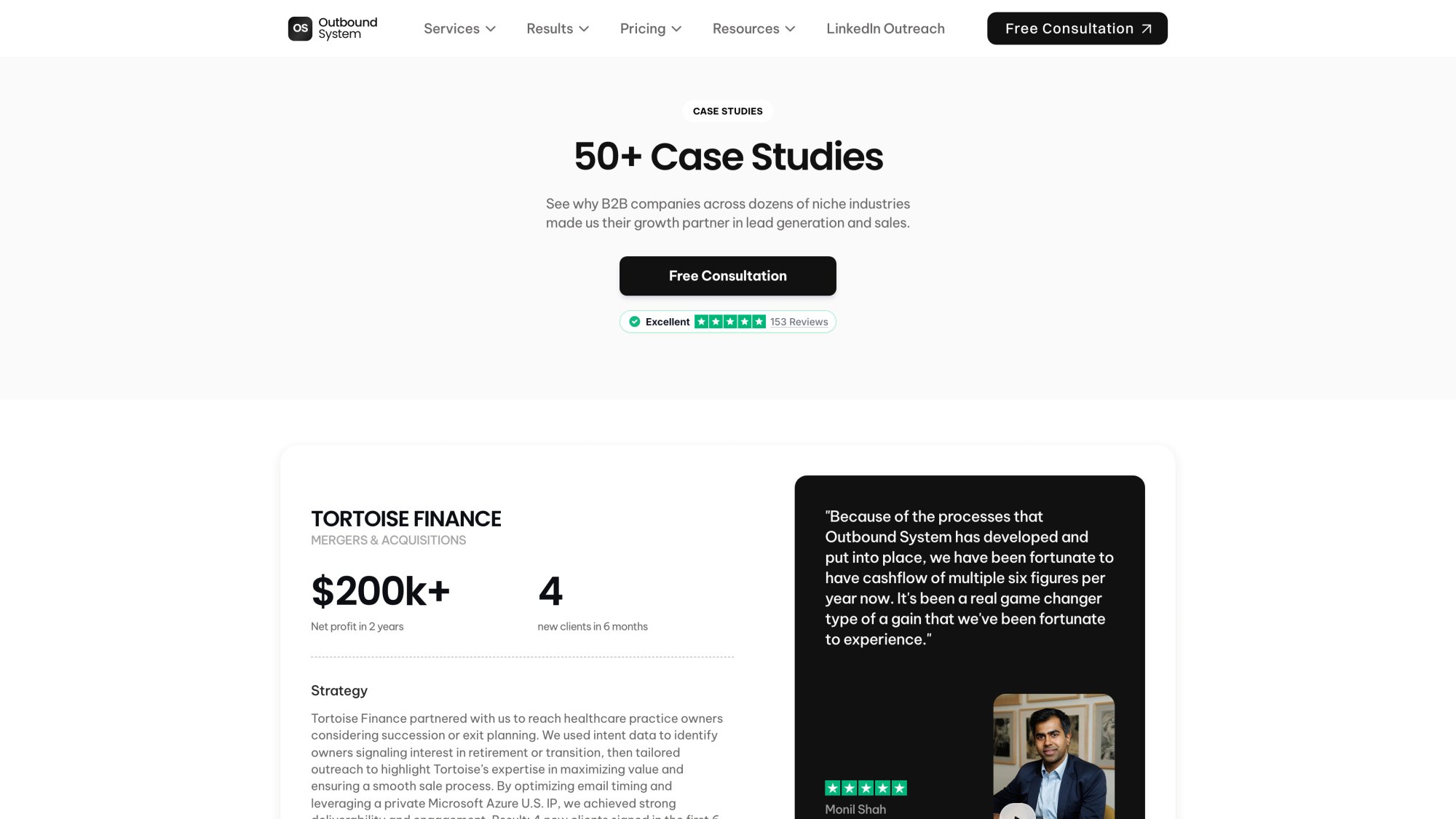
We've generated 52M+ cold emails, 127K+ leads, and $26M in closed revenue across 1,000+ B2B clients. From SaaS companies to financial services, manufacturing to professional services.
Want to see if we're a fit? Book a 15-minute consultation and we'll discuss your specific situation.
Should You Use Both a Cold Email Agency AND In-House SDRs?
Here's what many successful companies eventually realize: it's not either-or forever.
Start with an agency to validate and scale quickly. Get meetings flowing in weeks, not months. Learn what messaging resonates. Understand your ideal customer profile through real conversations.
Once you've proven a repeatable playbook and have sufficient volume to justify dedicated headcount, bring specific functions in-house. Maybe you hire an SDR to handle strategic accounts while the agency continues broader market coverage.
Or keep the agency running while you build internal SDR capacity for new products or markets. Use the agency as a laboratory for testing approaches before rolling them out to your internal team.
The companies winning in 2025 aren't dogmatic about build vs buy. They're pragmatic about what drives pipeline and revenue most efficiently at each stage of growth.
Cold Email Agency vs In-House SDR: Final Recommendation
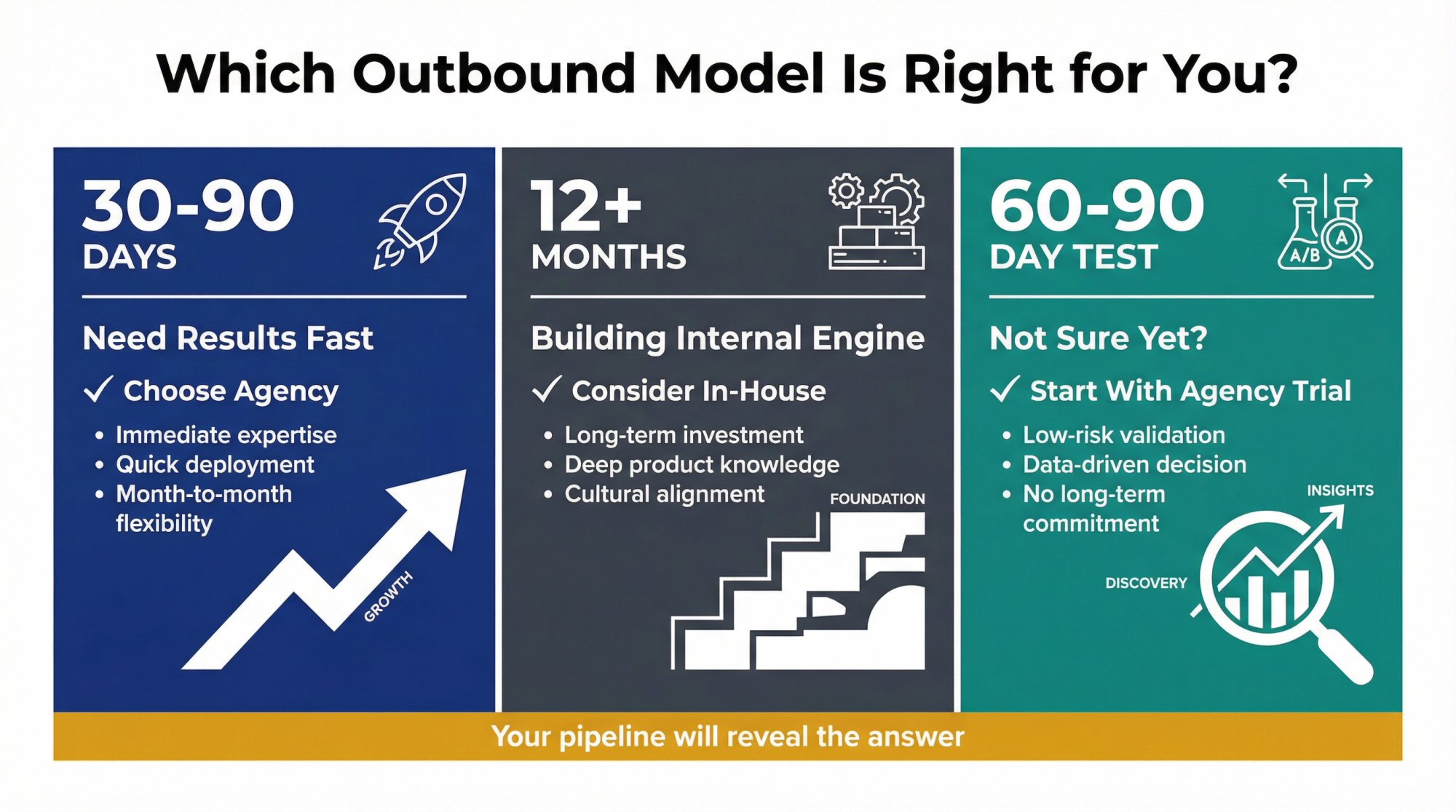
If you need results in the next 30-90 days: Choose an agency. Nothing else will move that fast.
If you have 12+ months to build an internal engine and can afford the investment: In-house can work, but expect the long ramp and be prepared for the hidden costs.
If you're not sure which is right: Start with an agency on month-to-month terms. Test it for 60-90 days. The data from that period will inform whether you should continue, transition in-house, or run a hybrid model.
The worst decision is choosing neither and hoping referrals alone will fuel growth. In 2025's competitive B2B landscape, systematic outbound isn't optional.
It's table stakes.
The only question is how you build that system. Will you invest months assembling it yourself? Or will you use specialists who've already built it?
Your pipeline will reveal the answer.
Frequently Asked Questions
Q: Can't I just use cold email software and do it myself instead of hiring SDRs or an agency?
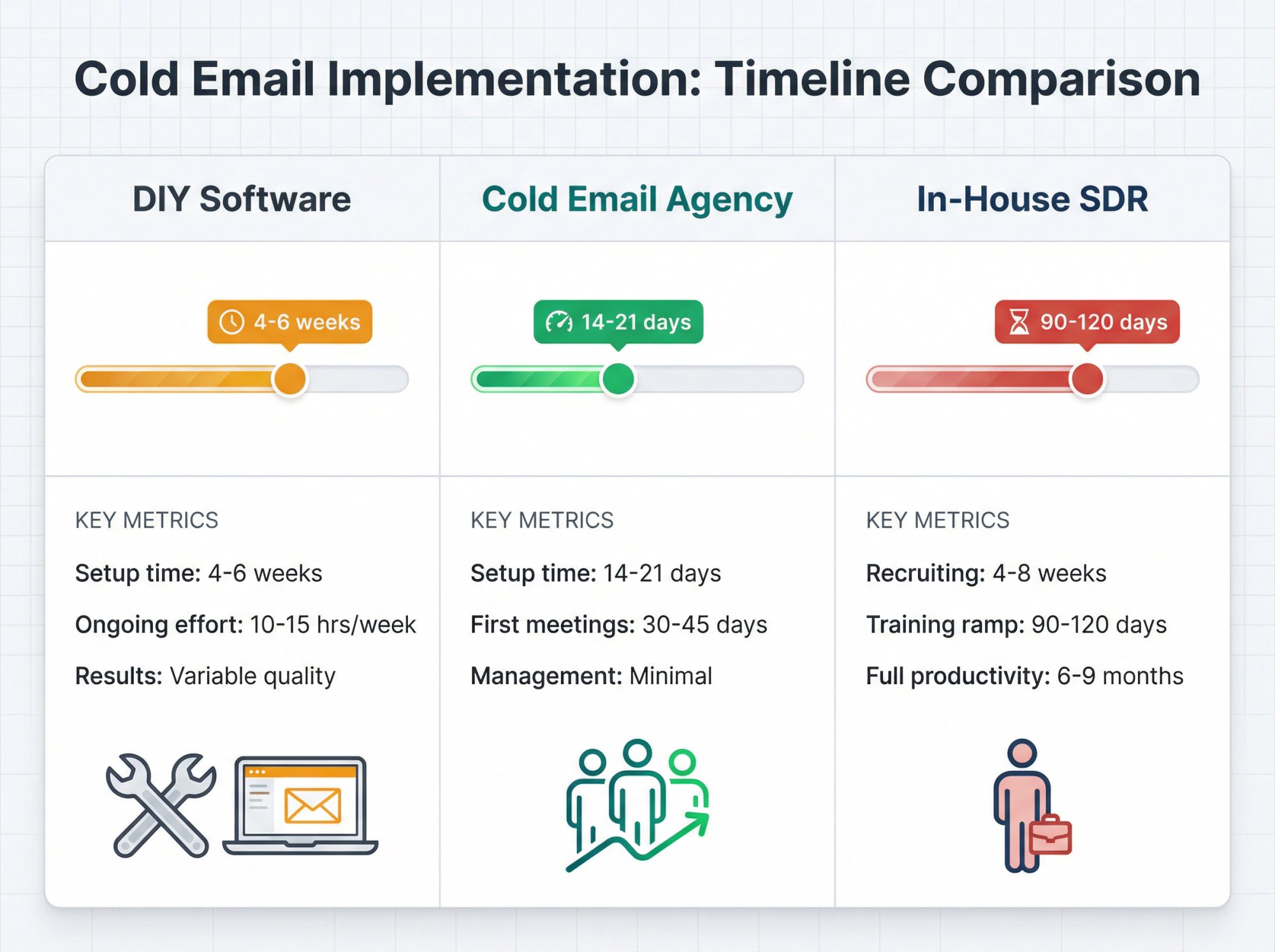
You can try DIY with software tools, but you'll face significant challenges. You still need to:
Build and verify prospect lists (hours of work)
Set up and warm multiple domains/inboxes (4-6 weeks)
Write effective copy that converts (skill-dependent)
Monitor deliverability constantly
Troubleshoot when things break
A/B test and optimize based on data
Most founders who try DIY cold email find they're spending 10-15 hours weekly on it, still getting mediocre results because they lack the specialized expertise.
Software is just a tool. It doesn't replace the know-how and infrastructure that agencies or trained SDRs bring.
Q: How long does it take to see results from each approach?
In-house SDR: Expect 90-120 days before basic productivity, 6-9 months to full performance. Add 4-8 weeks before that for recruiting.
Agency: Most quality agencies (like Outbound System) can launch campaigns within 14-21 days. First qualified meetings typically come within 30-45 days of starting.
Q: What if my product is too complex for an agency to understand?
This is a common concern, but often overstated. Most B2B products seem complex to outsiders initially, but the core value proposition usually isn't.
Agencies don't need to know every technical detail. They need to understand:
Who your ideal customer is
What problem you solve for them
How you're different from alternatives
What typically triggers buying decisions
For top-of-funnel outreach, that's sufficient. The detailed technical discussions happen later with your AEs or solutions engineers.
That said, if you're selling something truly specialized (like enterprise quantum computing infrastructure), you might need more in-house involvement. Consider a hybrid: agency books initial meetings, then a technical internal person joins early in the process.
Q: Won't prospects know they're talking to an outsourced team?
Not if the agency is good. Professional agencies train their teams to represent your brand seamlessly. Many use:
Your company email domain
Your brand voice and messaging
Titles like "[YourCompany] Business Development"
Deep knowledge of your offering and market
Prospects typically can't tell the difference between a well-trained agency SDR and an in-house one. What matters is whether the person sounds knowledgeable and helpful, not where they sit.
If brand representation is critical, ask agencies about their training process, QA procedures, and whether you can review sample outreach before launch.
Q: How do I measure ROI for each approach?
Track these metrics regardless of which model you choose:
Input metrics:
Total monthly cost (fully loaded for in-house, contract fee for agency)
Number of prospects contacted
Emails sent / calls made
Response rate / connection rate
Output metrics:
Qualified meetings booked
Opportunities created
Pipeline value generated
Revenue closed
Calculate cost per qualified meeting and cost per closed deal. That tells you which approach delivers better ROI.
Also track time-to-results. An in-house SDR who takes 6 months to ramp has an opportunity cost. An agency that delivers meetings in 30 days accelerates revenue realization.
Q: What happens if an agency isn't performing well?
Most agencies (including Outbound System) operate on month-to-month contracts. If results aren't meeting expectations after 60-90 days, you can:
Provide feedback and request strategy adjustments
Switch to a different agency
Cancel and try another approach
You're not locked in. Compare this to hiring: if an in-house SDR underperforms, you face difficult conversations, potential termination, and restarting the expensive recruiting process.
The agency risk is much lower because you haven't sunk recruiting costs, benefits, or long-term commitments.
Q: Can I run both an in-house team AND an agency at the same time?
Absolutely. Many successful companies use a hybrid model:
In-house SDRs for strategic accounts, complex products, or core markets
Agency for broader market coverage, new verticals, or overflow capacity
This combines benefits: in-house provides deep product knowledge and cultural alignment, while the agency brings scale, speed, and specialized expertise.
Start with what makes sense for your current stage, then add the other component as you grow.
Q: How do agencies maintain deliverability at high volumes?
Quality agencies invest heavily in deliverability infrastructure. Outbound System, for example:
Uses 350-700 dedicated Microsoft inboxes on private infrastructure
Sends low volume through each inbox to mimic human patterns
Properly warms all domains and inboxes before campaign launch
Triple-verifies all email addresses to minimize bounces
Monitors sender reputation constantly
Rotates inboxes and domains strategically
This achieves 98% inbox placement versus the 60-70% typical of DIY approaches using one or two domains.
Individual SDRs rarely have this level of infrastructure or expertise. Deliverability is one area where agencies show clear technical advantages.
Q: What's the minimum contract length for most agencies?
It varies by provider. Traditional agencies often require 3-6 month contracts.
But newer models (Outbound System is an example) offer month-to-month agreements with no long-term commitment. You can start, scale, or stop based on results.
When evaluating agencies, ask about contract terms upfront. Avoid long commitments until you've validated that the partnership works.
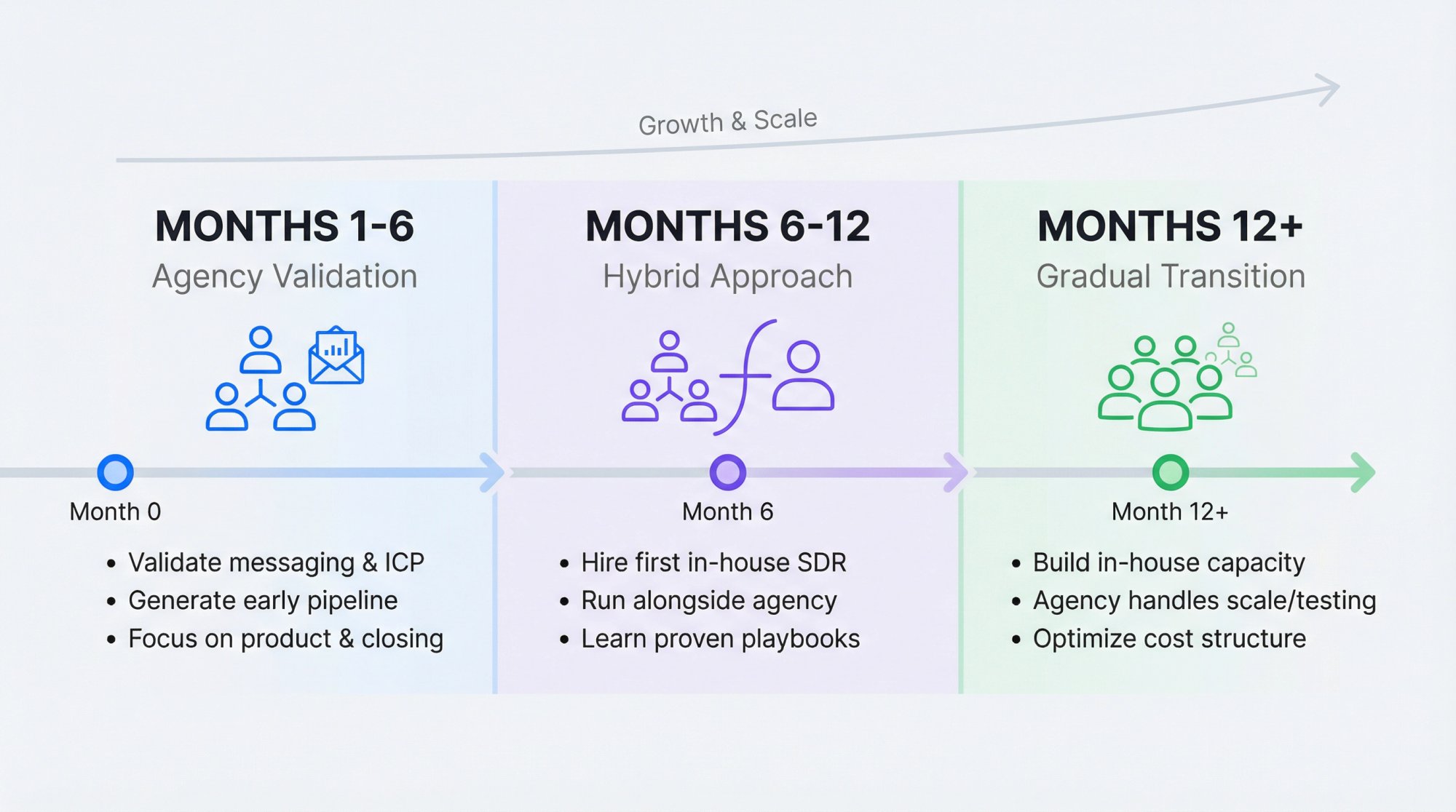
Q: What if I want to eventually bring SDRs in-house after using an agency?
That's a smart path many companies take:
1. Months 1-6: Use agency to validate messaging, ICP, and campaign structure. Generate early pipeline while you focus on product and closing deals.
2. Months 6-12: Once playbooks are proven and volume justifies it, hire your first in-house SDR. Have them work alongside the agency, learning what works.
3. Months 12+: Gradually transition some functions in-house while keeping the agency for scale, testing, or specific markets.
Agencies are often happy to support this transition because they'd rather see you succeed (and potentially expand the agency scope to new markets) than lose you to poorly executed in-house efforts.
The agency basically de-risks your in-house hiring by proving what works first.
Outbound System
We write the copy, build the lists and run the campaigns, month-to-month. Every decision is backed by data from 10,400+ campaigns.

Matthew Johnson is the founder and CEO of Outbound System, which runs cold email, LinkedIn outreach and AI calling for 1,000+ active B2B clients. He has personally sold over $12 million in B2B services, and his team has sent 52 million+ cold emails and helped clients close $26 million in revenue.
About Outbound System
Outbound System runs done-for-you cold email, LinkedIn outreach and AI calling for B2B companies. 1,000+ active clients and 10,400+ campaigns launched.