You send a thoughtful cold email. It lands. The prospect actually opens it, reads it, and replies.
But the reply says: "Not interested."
Most salespeople see this as rejection and move on. That's a mistake. Because what actually just happened: you broke through the noise. You earned a response in a world where average cold email reply rates sit around 4.1%. You got engagement. And engagement, even when it sounds negative, is an opportunity.
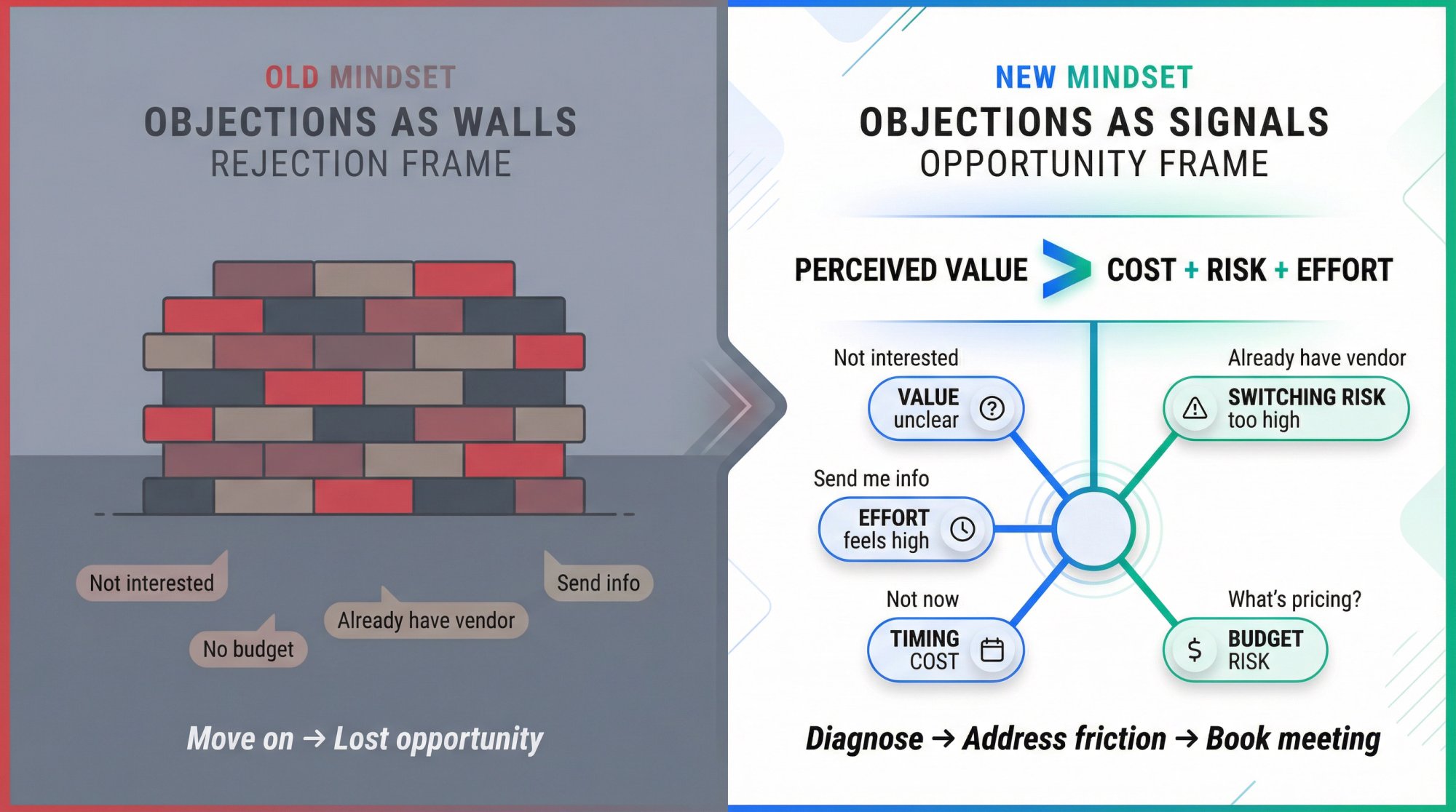
Objections aren't walls. They're doors that haven't been opened yet.
When someone replies with "no budget," "already have a vendor," or "send me info," they're not slamming the door. They're showing you exactly which concern you need to address. Research shows that 60% of customers say "no" several times before eventually saying yes, and 80% of sales require five or more touchpoints to close.
This guide gives you a system, not random tactics. You'll get:
• A first-principles model for why objections happen
• A framework to classify and respond to any objection in under 20 seconds
• Copy-paste templates for the most common cold email objections
• Prevention strategies that reduce objections before they happen
• Compliance guardrails so your objection handling doesn't backfire
And most importantly, you'll learn how to turn "not interested" replies into booked meetings without sounding pushy or damaging your deliverability.
Let's start with understanding what objections really mean.
Why Do Prospects Object to Cold Emails?
When a prospect objects, they're not being difficult. They're doing their job.
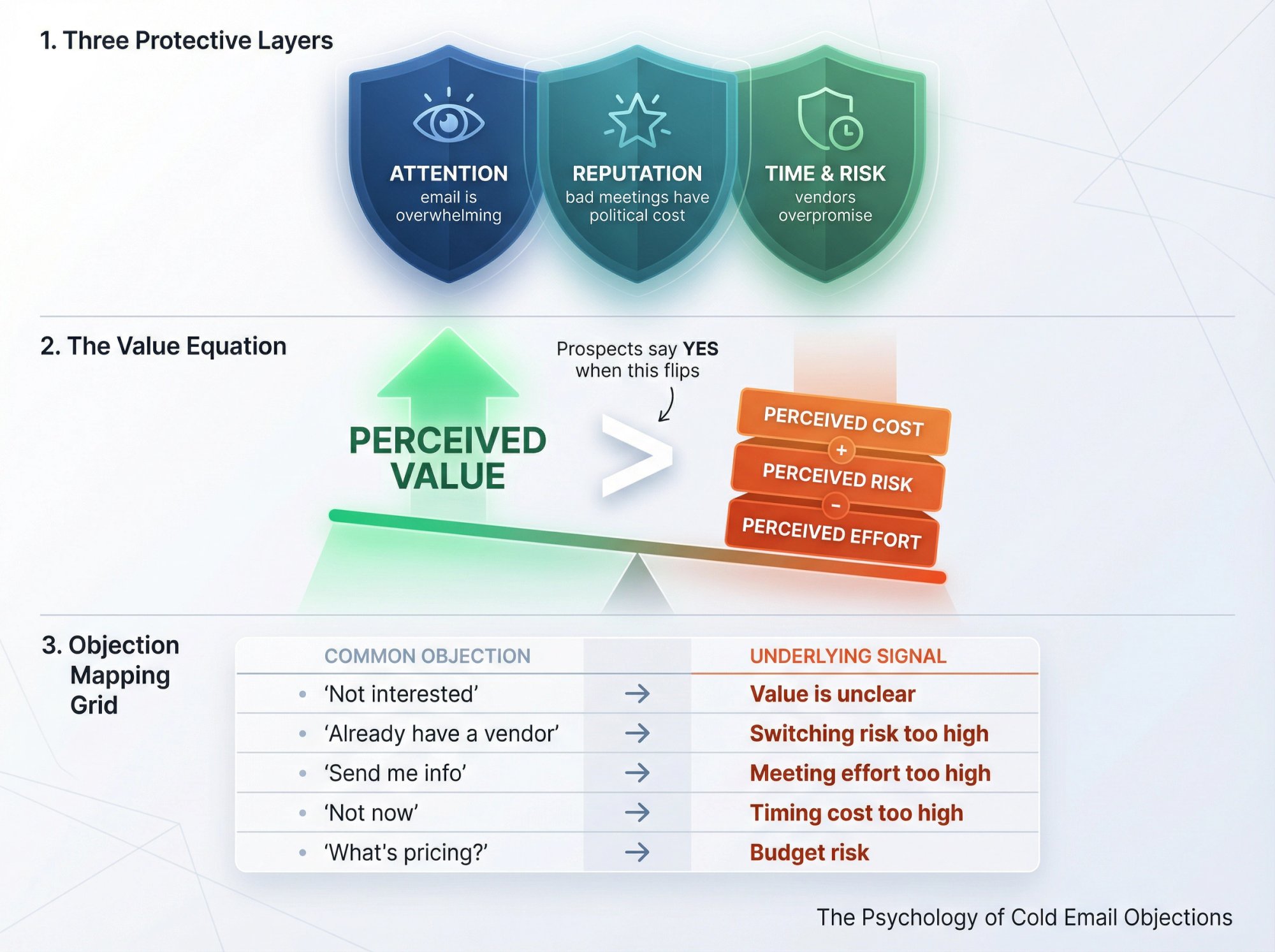
Every person who receives your cold email is unconsciously protecting three things:
1. Their attention (email is overwhelming, and most messages get deleted)
2. Their reputation (taking bad meetings has political cost internally)
3. Their time and risk (most vendors overpromise, and switching costs are real)
So the default state for any cold email is "no." That's not pessimism. It's how humans manage information overload.
The Value Equation That Explains 95% of Objections
A prospect agrees to a meeting when this inequality flips:
Perceived Value > Perceived Cost + Perceived Risk + Perceived Effort
Most objections are the prospect signaling which term is too high. When you understand this, you stop "overcoming" objections and start diagnosing uncertainty.
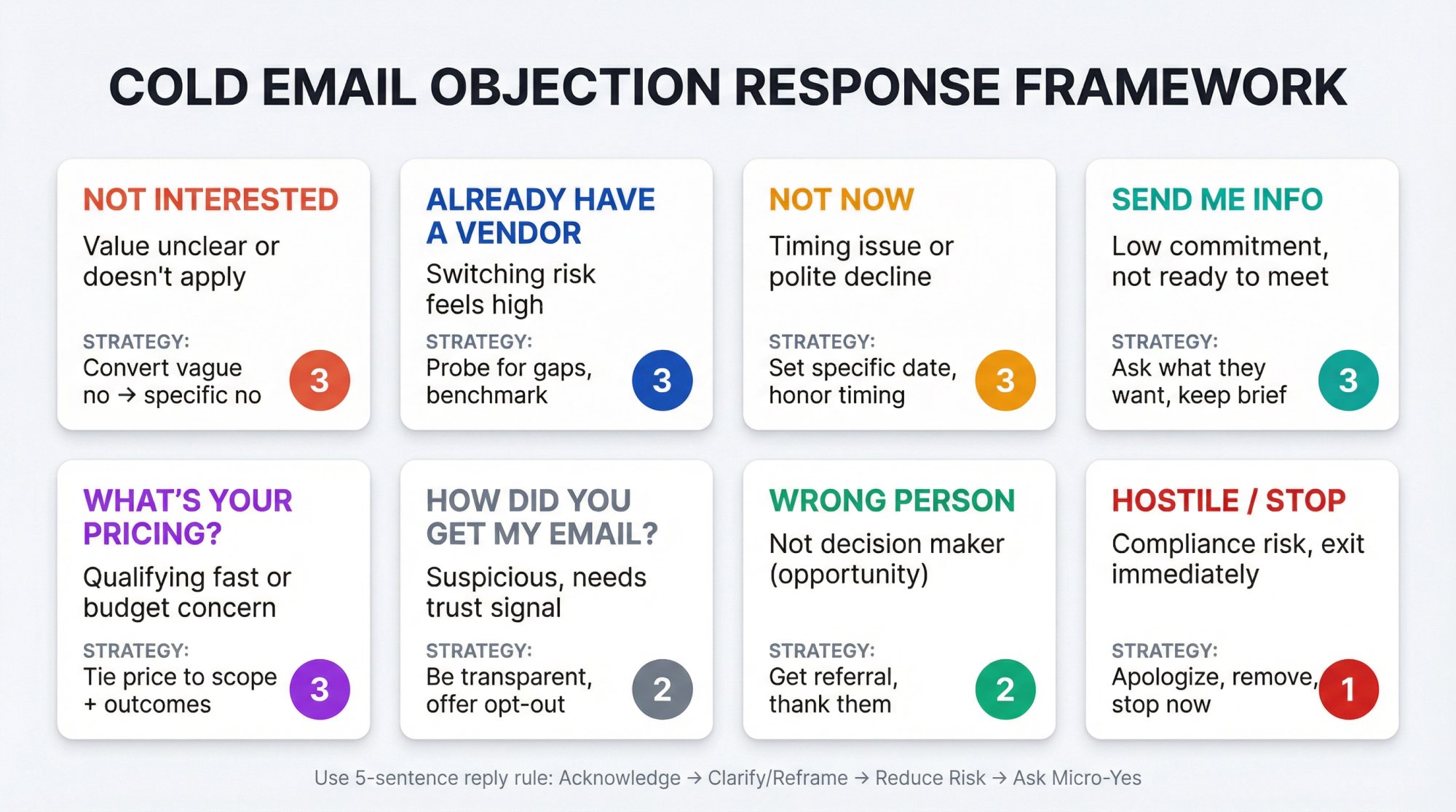
Here's how common objections map to the equation:
Objection | What It Usually Signals |
|---|---|
"Not interested" | Value is unclear or doesn't apply to them |
"Already have a vendor" | Switching risk feels too high |
"Send me info" | Effort of a meeting feels too high right now |
"Not now" | Timing cost is high (busy with other priorities) |
"What's your pricing?" | Budget risk or trying to qualify you quickly |
The key mindset shift: You're not arguing. You're reducing friction.
What the Data Says
Research analyzing 11 million cold emails found that decision-makers don't respond to cold outreach for three main reasons:
• 71% say lack of relevance (the offer doesn't apply to their situation)
• 43% cite impersonality (generic messaging that feels mass-produced)
• 36% mention lack of trust (unknown sender with no credibility signals)
This tells us something critical: objection handling isn't mainly a "words" problem. It's usually a relevance + trust problem that shows up in words. The best objection handling happens before you send the first email, by improving your targeting and positioning.
But when objections do come, you need a system to handle them efficiently.
How to Respond to Any Cold Email Objection in 5 Steps
You need a repeatable process you can run on every reply. Here's the framework.
Step 1: Classify the Reply in 5 Seconds
Put every objection into one of these buckets:
1. Compliance/Stop
"Unsubscribe," "remove me," "stop emailing," "spam"
2. Wrong Person
"Not me," "contact X," "I'm not responsible for that"
3. No Interest
"Not interested," "no thanks," "we don't need this"
4. Timing
"Not now," "check back Q3," "busy this quarter"
5. Status Quo/Competitor
"We already have a vendor," "we built something in-house"
6. Budget/Pricing
"No budget," "too expensive," "send pricing"
7. Info Request
"Send a deck," "send more info," "what's your website?"
8. Hostile
Insults, threats, or accusations
Why classify? Because each bucket has a different best move. If you respond with the wrong approach, you create friction and risk spam complaints.
Step 2: The 5-Sentence Reply Rule
Objection replies fail for one consistent reason: they're too long and too salesy.
Use this constraint: 5 sentences maximum. If you need more words, you should book a call, not write a novel.
The universal structure that works:
Sentence 1 (Acknowledge): Show you read what they said
Sentence 2-3 (Clarify or Reframe): Ask a clean question or offer new perspective
Sentence 4 (Reduce Risk): One proof point or context line, not a pitch
Sentence 5 (Ask): Propose a tiny next step
Research shows that keeping these replies under 125 words gets the best response rates. They're long enough to address concerns but short enough that a busy reader will actually read them.
The Power of the Micro-Yes
Instead of asking for a 30-minute meeting (which feels like commitment), ask for something smaller:
• "Is this even on your radar?"
• "Is this you or someone else?"
• "Is Q2 or Q3 more realistic?"
• "Would a 3-bullet summary help, or should I stop?"
These micro-yes questions reduce friction. They give prospects an easy way to engage without feeling pressured.
Curiosity Over Combativeness
The most effective approach when handling objections is genuine curiosity, not persuasion. When a prospect says "We're all set," respond with something like:
"That's great you have something working. Most teams I talk to in your space are struggling with [specific challenge]. Is that on your radar at all?"
This acknowledges their stance while gently probing for an unmet need. You're not contradicting them. You're inviting them to identify gaps on their own terms.
"Not Interested" Cold Email Replies: What to Say
What it really means:
"Not interested" rarely means "never." It usually means: "I don't see how this is relevant to me," or "Bad timing," or "Your message didn't stand out."
Bad move: Arguing, dumping features, sending a long case study
Good move: Convert a vague "no" into a specific "no," then either pivot or exit gracefully
Template A: The 3-Option Diagnosis
Template B: The "I Might Be Wrong" Relevance Check
Template C: Graceful Exit with Learning Question
If they don't respond after this, stop. Pushing harder doesn't increase meetings. It increases spam complaints.
"We Already Have a Vendor" - How to Respond
What it really means:
"Switching cost and risk feels high." Your goal isn't to replace their vendor in one email. Your goal is to earn a low-risk conversation where you learn if they're happy or if there are gaps.
Template A: The Benchmarking Angle
Template B: The "Only Reason to Talk" Pattern
Template C: If You're Truly Different
Important: Only use Template C if your differentiator is genuinely unique. If it's generic ("better service," "AI-powered"), this will backfire.
"Not Now" Cold Email Objection Responses
What it really means:
Either (a) real timing issue, or (b) polite way to say no. Your job: force clarity without being annoying.
Template A: Set an Actual Date
Template B: Permission-Based Micro-Call
Template C: The "One Question Then I'll Disappear"
If they answer with a specific month or quarter, honor it. That's how you build trust over time.
How to Handle "Send Me Info" Email Requests
What it really means:
"I'm not committing to a meeting, but I'm not fully shutting you down." Common mistake: attaching a PDF and writing a 400-word pitch. That screams "vendor."
Do this instead:
Template A: Ask What They Actually Want
Template B: Info + Micro-CTA
Template C: "Here's the Info" Without Attachments
Why avoid attachments? Many companies block them, and they can reduce trust. Keep it plain text.
"What's Your Pricing?" Objection Scripts
What it really means:
Either (a) they're qualifying you fast, or (b) they assume you're expensive. You want to avoid a pricing debate without context.
It's worth distinguishing: "no budget" often means the expense wasn't planned for (timing issue), while "too expensive" means the perceived value doesn't justify the cost.
The move is to tie price to scope and outcomes.
Template A: Scope-First
Template B: Budget Reality Check Without Pressure
Template C: If They Say "No Budget"
This works because it forces a real answer. You can't fix "no priority" with clever wording.
"How Did You Get My Email?" Response Templates
What it really means:
"I'm suspicious. I get spam. Prove you're legitimate." Don't be defensive. Be transparent and give them control.
Template A: Transparent and Simple
Template B: If They're Irritated
Critical: If you offer to remove them, actually remove them immediately. Compliance and trust depend on it.
"Wrong Person" - How to Get the Right Contact
This is one of the best replies you can get. It's a door, not a wall.
Template A: The Clean Referral Request
Template B: Confirm the Right Function
If they refer you, keep them out of future sequences. Don't keep emailing the wrong person.
Hostile Cold Email Replies: What to Do
Do not argue. Do not explain. Do not justify.
Template:
Then suppress immediately.
This isn't just "being nice." Spam complaints directly harm deliverability. Google's sender guidance emphasizes keeping spam rates low, and exceeding thresholds can lead to filtering or blocking.
Handling Silent Objections (No Reply)
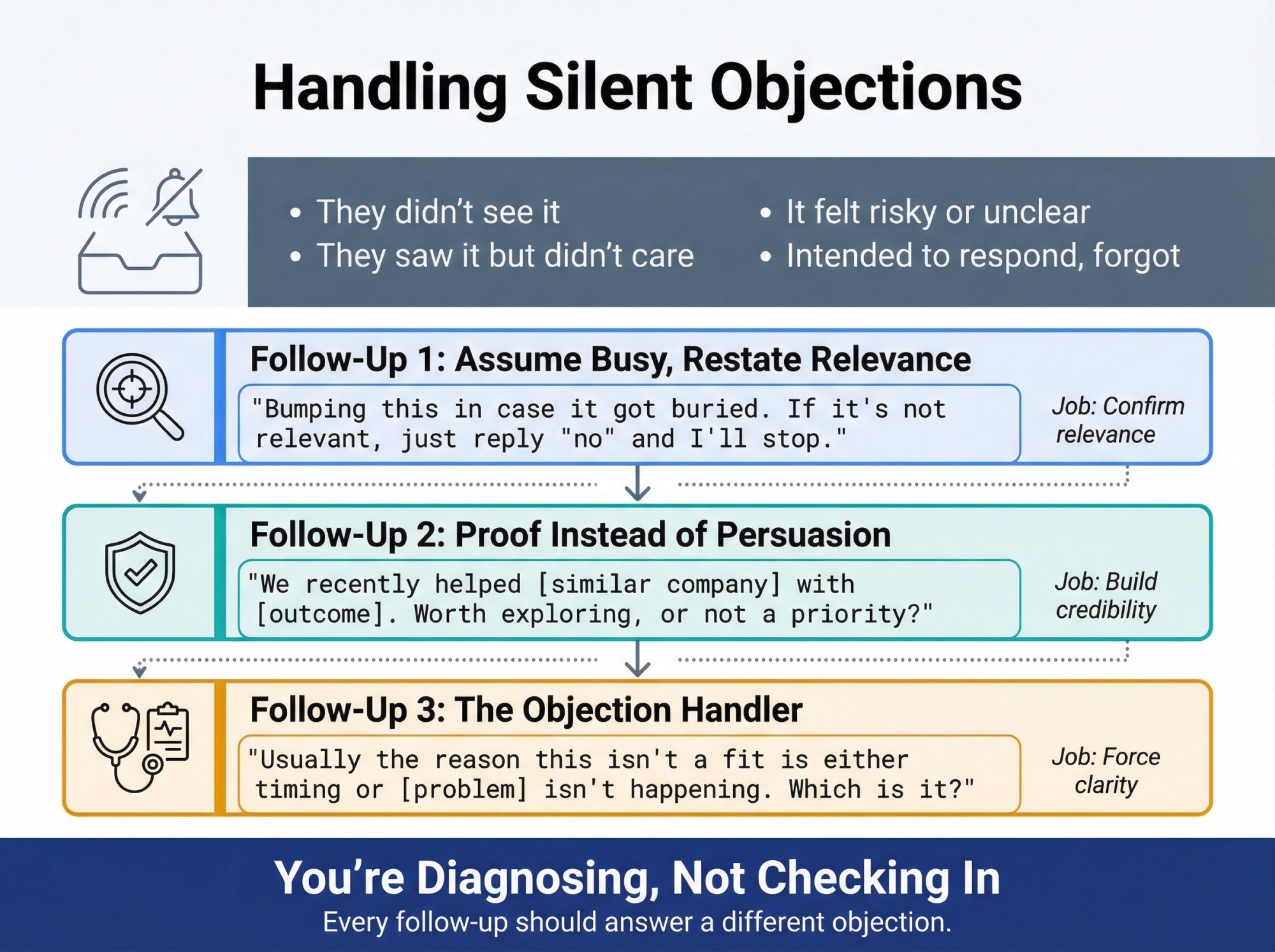
No reply is the most common objection. It usually means:
• They didn't see it
• They saw it but didn't care
• They saw it but it felt risky or unclear
• They intended to respond and forgot
Research shows campaigns with follow-ups have higher average reply rates, and many decision-makers either appreciate follow-ups or don't mind them. But excessive follow-ups increase annoyance, and unsubscribe rates grow after the third touch.
The Right Way to Follow Up: Answer a Different Objection Each Time
Effective cold email sequencing frames it well:
• Email 1: Relevance + clear offer
• Email 2: Different angle (proof or quantified pain)
• Email 3: Objection handler (timing, fit, priority)
Every follow-up should have a job.
Follow-Up Templates That Handle Objections Without Sounding Needy
Follow-Up 1: Assume Busy, Restate Relevance
Follow-Up 2: Proof Instead of Persuasion
Follow-Up 3: The Objection Handler
Notice: you're not "checking in." You're diagnosing.
Learn more about effective follow-up email strategies and proven follow-up tactics that increase conversions.
How to Prevent Cold Email Objections Before They Happen
The uncomfortable truth: if you get lots of objections, your biggest win isn't better rebuttals. It's fewer objections.
Data shows lack of relevance is the #1 reason people ignore cold outreach. So prevention is mostly about relevance and trust.
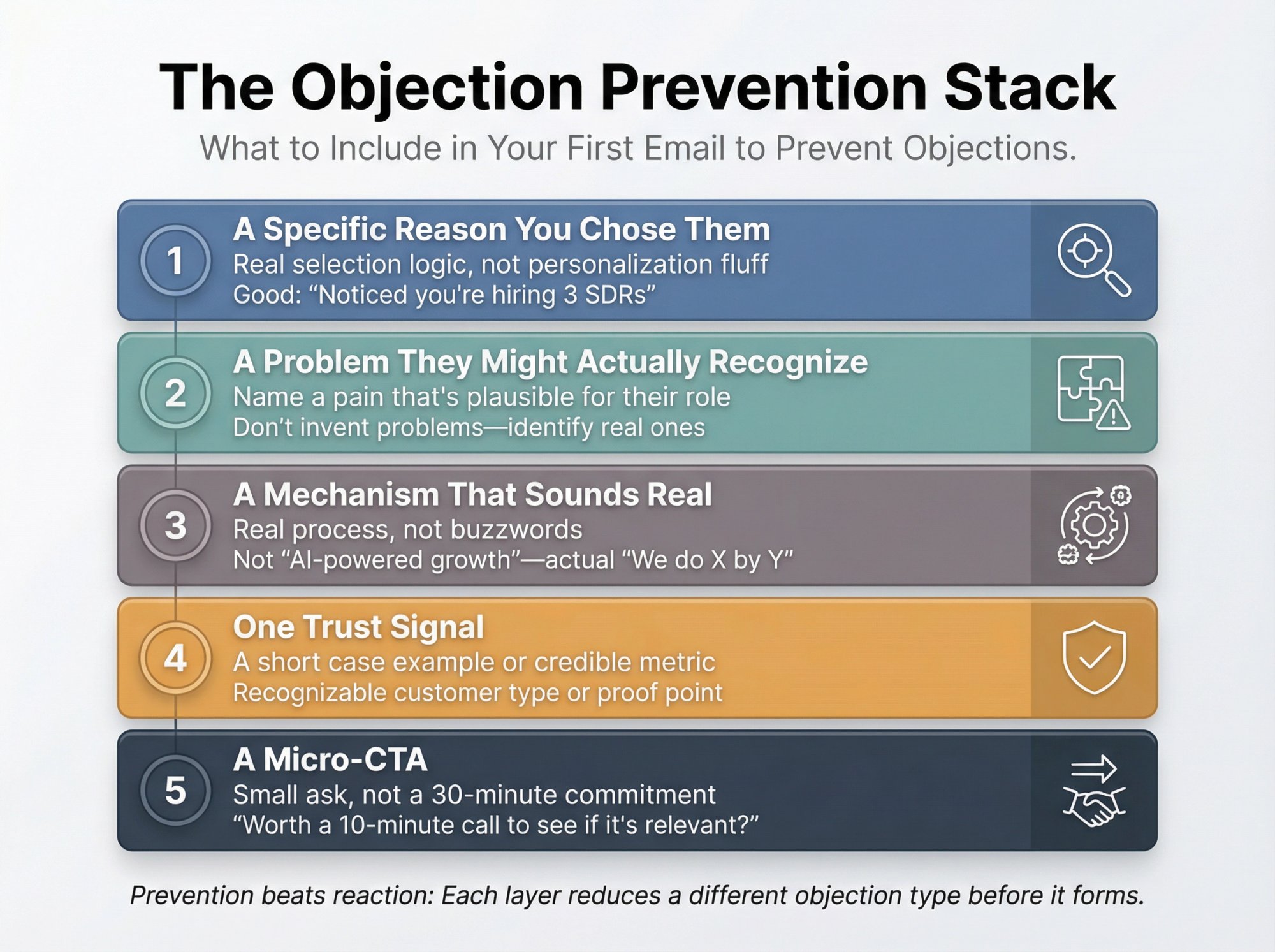
The Objection Prevention Stack (What to Include in Your First Email)
1. A Specific Reason You Chose Them
Not personalization fluff. Real selection logic.
Bad: "Loved your website."
Good: "Noticed you're hiring 3 SDRs" or "Saw you expanded into healthcare."
2. A Problem They Might Actually Recognize
Name a pain that's plausible for their role. Don't invent problems.
3. A Mechanism That Sounds Real
Not "AI-powered growth." Real process: "We do X by Y."
4. One Trust Signal
A short case example, credible metric, or recognizable customer type.
5. A Micro-CTA
Don't force a 30-minute meeting as the first ask. Try:
• "Worth a 10-minute call to see if it's relevant?"
• "Should I send a 3-bullet overview, or not worth it?"
• "Are you the right person for this?"
Learn how to structure your emails for maximum relevance with our guide on prospecting email structure and check out these high-converting cold email templates.
The Simplest Prevention Tactic That Also Protects Deliverability
Make opt-out easy.
It reduces frustration, spam complaints, and pointless follow-ups. This is also aligned with compliance expectations like CAN-SPAM's requirement to provide a way to stop future emails.
A single line like "If this isn't relevant, reply 'no' and I won't email again" does three things:
• Reduces annoyance (people appreciate the courtesy)
• Prevents spam complaints (which hurt your sender reputation)
• Actually gets responses (sometimes people say "no" but then explain why, opening a dialogue)
How Outbound System Reduces Objections at Scale
At Outbound System, we've sent 52M+ cold emails and generated 127K+ leads for 600+ B2B clients. Handling objections at that scale taught us something critical: the best objection handling happens before you send the first email.
Here's how we systematically reduce objections:
1. Private Microsoft Infrastructure for Deliverability
Poor deliverability creates objections. When your emails land in spam or promotions folders, prospects don't see them or they look suspicious when they do.
We use 350 to 700 private Microsoft U.S. IP inboxes (depending on plan) with low per-inbox send volumes. This mimics natural human patterns and maintains 98% inbox placement. When emails consistently hit the primary inbox, you get fewer trust objections and more real engagement.
Learn more about our cold email infrastructure approach and why Microsoft Azure servers are the secret to cold email deliverability.
2. 9-Step Waterfall Enrichment for Relevance
The #1 objection driver is lack of relevance. That starts with targeting.
Our 9-step waterfall enrichment combines multiple data vendors with verification passes before any sequencing begins:
• Syntax validation checks
• SMTP ping verification
• Historic bounce data analysis
• Engagement signal evaluation
This process minimizes "not relevant" objections by ensuring you're reaching the right people with accurate contact information. Clean data means fewer hard bounces, better sender reputation, and more relevant conversations.
Learn how to build high-quality prospect lists and explore our comprehensive cold email list building guide.
3. AI + Human Copy for Personalization That Resonates
Generic messaging triggers instant objections. Our approach combines human-written core copy with AI-driven personalization at the line level.
Human copywriters establish the value proposition and structure. AI systems generate prospect-specific personalization based on company data and triggers. This balance creates messages that feel personal without sounding robotic, driving 6-7% response rates (well above industry average).
Check out our cold email copywriting tips and learn about effective cold email first lines that capture attention.
4. Multi-Channel Coordination
Sometimes an email objection isn't really an email objection. It's a channel-fit issue.
We coordinate cold email, LinkedIn outreach, and calling to increase contact rates through multiple touchpoints. When someone says "not interested" via email, our strategists can pivot to LinkedIn connection requests or introduce calling as an alternative channel, increasing the chances of real dialogue.
Explore our analysis of cold email vs LinkedIn outreach and learn about our LinkedIn lead generation services and cold calling agency services.
5. Dedicated Strategists for Continuous Optimization
Every account gets a dedicated strategist who reviews objections weekly, identifies patterns, and adjusts targeting, messaging, and approach. This turns objections into a learning loop rather than a morale drain.
When you systematically track which industries say "already have someone" most often, or which job titles respond best to which angles, you fix problems upstream. That means fewer objections next month.
Real Results
Clients see tangible improvements when objection handling is systematic:
• A GenAI SaaS company booked 28 qualified meetings in 7 months and generated a $2.4M pipeline
• An M&A advisory firm achieved $200K+ realized net profit in 2 years with 4 new clients closed in 6 months
• A manufacturing firm booked 330 meetings in 12 months
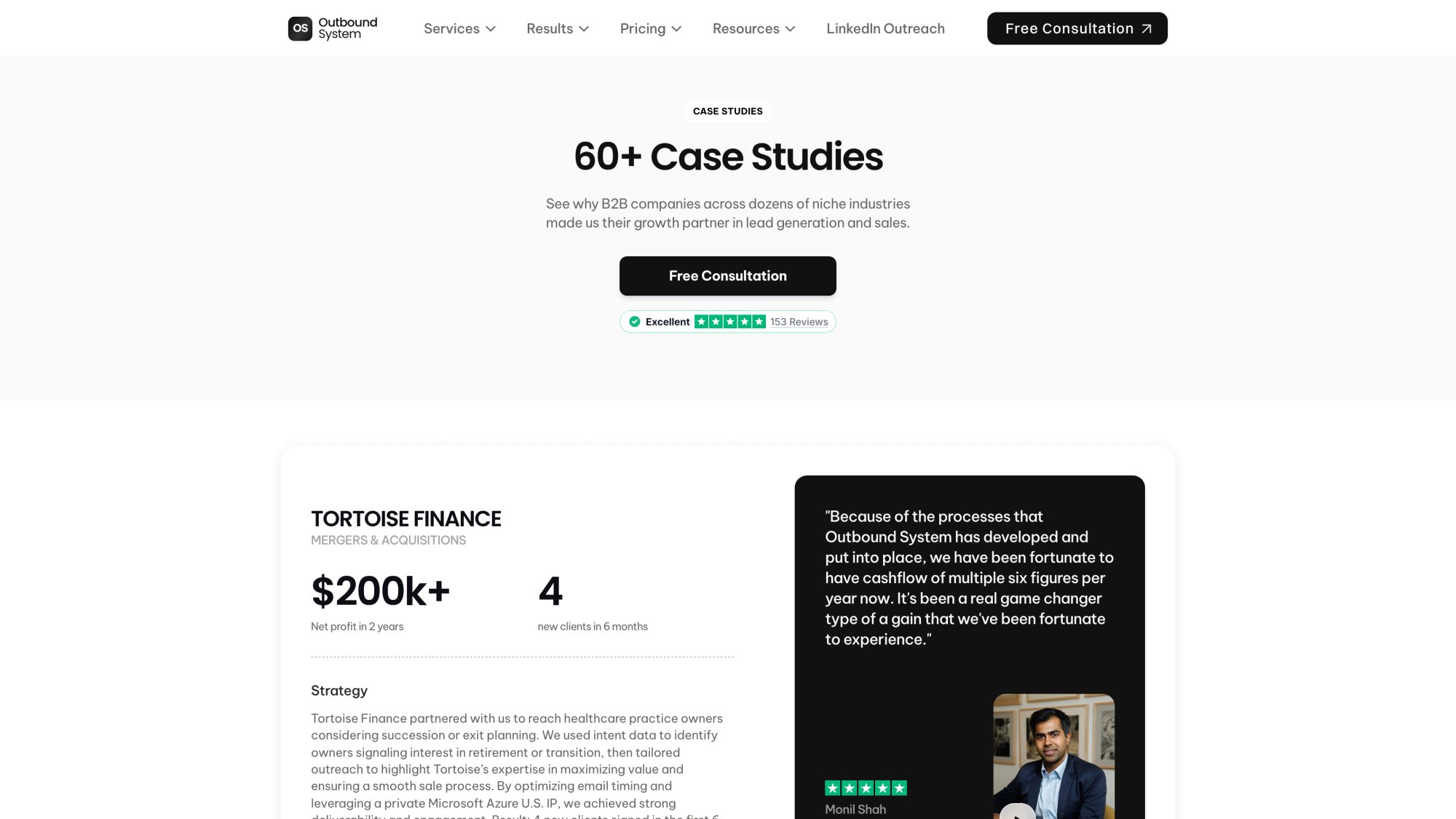
These results don't come from clever templates alone. They come from infrastructure, data quality, personalization, and strategic objection management working together.
Want to see how Outbound System handles objections at scale for your business? Our pricing starts at $499/month with month-to-month contracts and includes everything: private Microsoft infrastructure, 9-step enrichment, AI personalization, and dedicated strategist support. Book a free consultation to discuss your specific needs.
View our detailed case studies and read client testimonials to see real-world results.
Deliverability and Compliance: Protecting Your Infrastructure
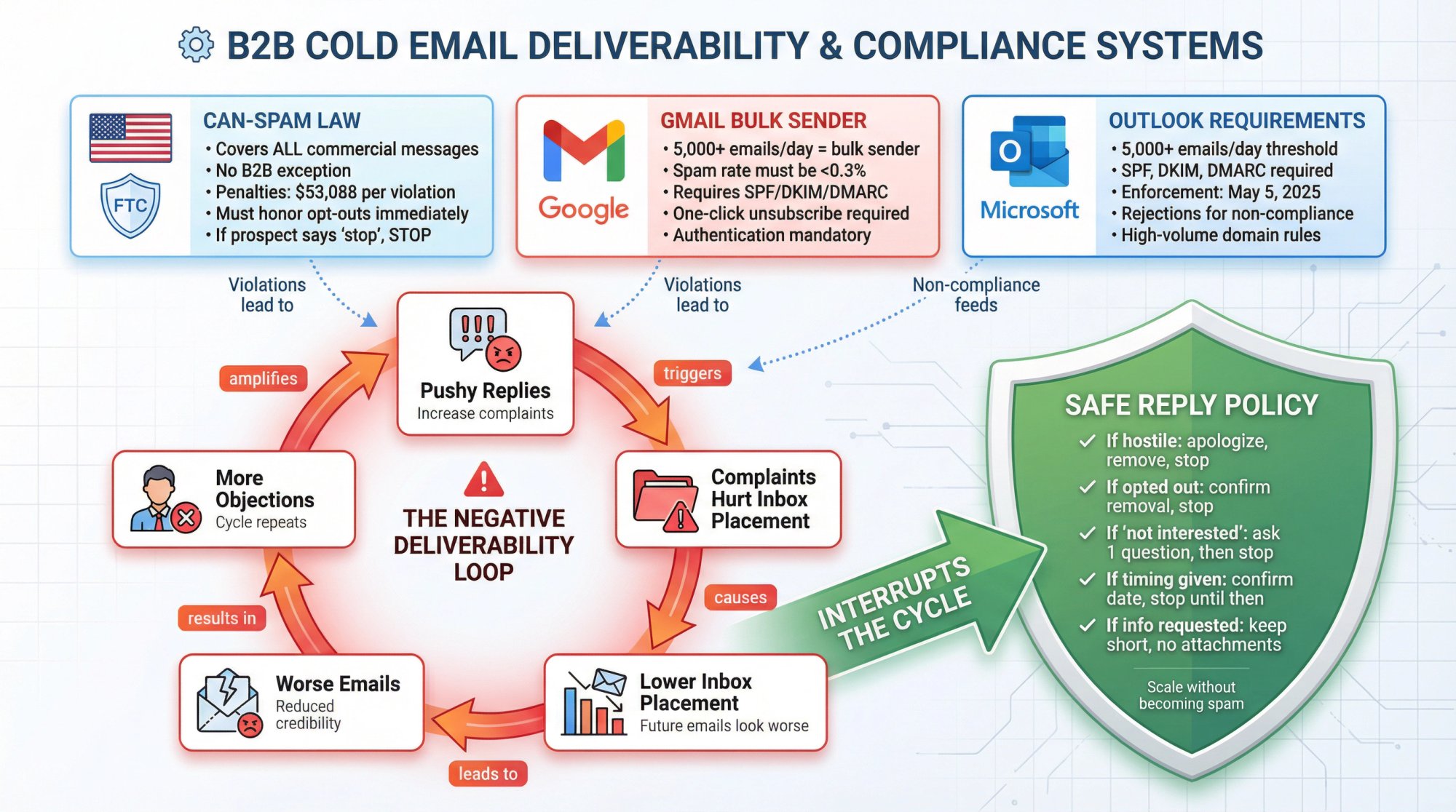
Objection handling and deliverability are connected:
• Pushy replies increase complaints
• Complaints hurt inbox placement
• Lower inbox placement makes future emails look worse
• Worse emails create more objections
A negative loop.
1. CAN-SPAM Basics (US, Including B2B)
The FTC is explicit that CAN-SPAM covers all commercial messages and makes no exception for business-to-business email. Each separate email in violation can be subject to penalties up to $53,088.
Practical takeaway for objections:
• If someone says "stop," treat it as a hard stop
• Do not keep trying to "save" the conversation after an opt-out
Learn more about CAN-SPAM cold email requirements and comprehensive email outreach compliance rules.
2. Gmail and Outlook Bulk Sender Requirements
Why include this in an objections guide? Because the fastest way to hurt deliverability is to annoy people into hitting "spam."
Google's sender guidance states that if you send 5,000+ messages per day to Gmail accounts, you're considered a bulk sender and should keep spam rates below 0.3% (and aim lower). It also requires authentication (SPF/DKIM, and DMARC for bulk senders) and one-click unsubscribe for marketing messages.
Microsoft announced similar enforcement for Outlook: for high-volume domains (5,000+ emails/day), Outlook began rejecting messages that don't meet authentication requirements (SPF, DKIM, DMARC) starting May 5, 2025.
The objection-handling implication:
Every angry thread you "win" can create deliverability damage you "lose" for weeks.
Learn how to set up proper authentication with our DMARC, DKIM, SPF cold email setup guide and explore email deliverability best practices.
3. A Simple "Safe Reply" Policy
• If the prospect is hostile: apologize, confirm removal, stop
• If the prospect opts out: confirm removal, stop
• If they say "not interested": ask one clarifying question, then stop if no response
• If they give timing: confirm the date, stop until then
• If they ask for info: keep it short, no attachments by default
This is how you scale without becoming spam.
Check out our guides on improving email sender reputation and fixing cold emails going to spam.
Turn Objections Into Strategy
Most teams treat objections like annoying one-off events. That wastes the best signal you have.
Track Objections by Category and Segment
You want to know:
• Which industries say "already have someone" most?
• Which job titles say "not relevant" most?
• Which offer gets "send info" but never converts?
When you track this data, patterns emerge. Maybe SaaS companies object on price but manufacturing companies object on timing. That tells you to adjust your approach by vertical.
A Simple Weekly Process That Upgrades Your Entire Outbound Engine
1. Tag every reply with one objection category (the buckets above)
2. Review the top 2 objections by volume
3. Diagnose the real cause:
• Targeting mismatch?
• Offer too vague?
• Trust too low?
• CTA too big?
4. Fix upstream:
• Tighten list criteria
• Rewrite opener to show relevance
• Add proof line
• Shrink the ask
5. Update your objection templates if a new pattern emerges
This turns objections into a learning loop, not a morale killer. After a few cycles, your objection rate drops because you're preventing problems instead of just reacting to them.
Learn more about scalable B2B sales outreach workflows and top B2B sales techniques for systematic improvement.
Quick Reference Guide
If you only remember one thing: match your reply to the objection type.
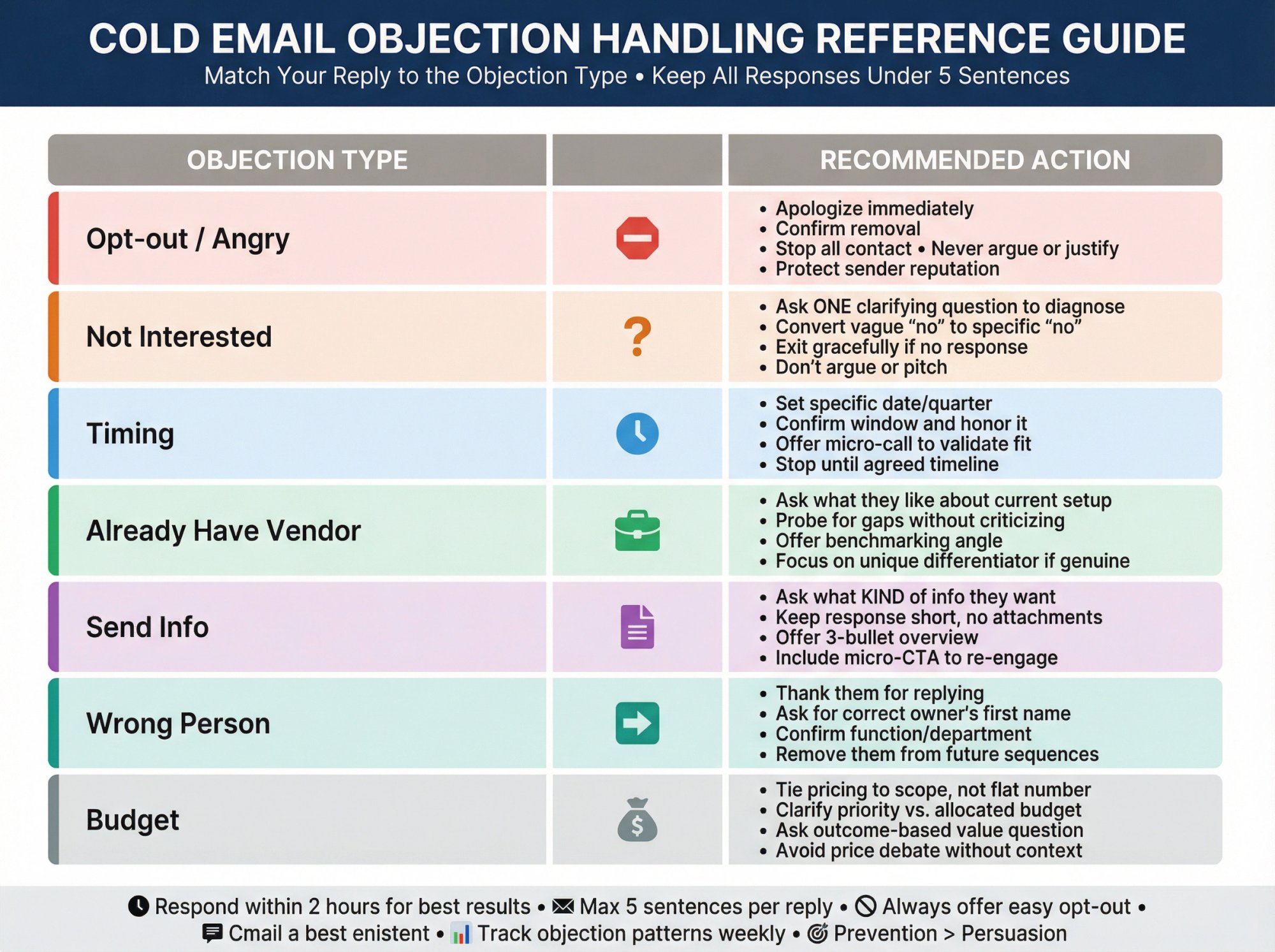
Objection Type | Action |
|---|---|
Opt-out / Angry | Apologize, remove, stop immediately |
Not interested | Ask 1 clarifying question, then exit gracefully |
Timing | Set a specific date, stop until then |
Already have vendor | Ask what they like, probe for gaps, offer benchmarking |
Send info | Ask what kind of info they want, keep it short |
Wrong person | Ask for the correct owner, thank them |
Budget | Clarify scope, confirm priority, avoid price debate |
And keep all replies under 5 sentences.
Frequently Asked Questions
How many follow-ups should I send before stopping?
The data suggests 3 follow-ups is the sweet spot. Research analyzing millions of cold emails shows that campaigns with follow-ups get higher reply rates, but unsubscribe rates grow after the third touch. Our rule: send up to 3 follow-ups spaced 3-5 days apart, with each email answering a different potential objection (relevance, proof, timing). If they don't respond after the 3rd follow-up, stop and move them to a long-term nurture sequence.
Learn about optimal timing for cold emails and the best days to email B2B prospects.
Should I respond to hostile replies?
Yes, but only to apologize and remove them. Never argue or justify your outreach when someone is hostile. A simple "Sorry about that. I've removed you and won't email again" is all you need. Then suppress them immediately in your system. Remember, hostile replies often turn into spam complaints, and those directly harm your sender reputation and deliverability. Protect your infrastructure by making removal instant and frictionless.
Can objection handling hurt my deliverability?
Absolutely. If your replies are pushy, defensive, or too long, recipients may mark future emails as spam. This is especially risky if you're sending 5,000+ emails per day (considered "bulk sending" by Gmail and Outlook). The key is to keep replies helpful and brief, always offer an easy opt-out, and stop immediately when someone asks you to. Think of every reply as protecting your long-term sender reputation, not just winning one conversation.
Explore our detailed guides on email deliverability explained and reducing email bounce rates.
What if they ask for pricing immediately?
Don't send a price without context. Instead, tie pricing to scope: "Happy to share pricing. It depends mostly on [1-2 cost drivers], so I don't give you a useless number: are you trying to solve [use case A] or [use case B]?" This forces a qualification conversation. If they push back, you can share a range, but always anchor it to outcomes. For example, at Outbound System, our plans range from $499 to $999/month depending on volume and channels, and we're transparent about that. But we still ask about their goals first to ensure fit.
Learn more about how much cold email agencies cost and explore cold email agency vs in-house SDR to understand the value comparison.
How do I handle "send info" without seeming pushy?
The trick is to ask what kind of info they want before sending anything: "Happy to. Quick question so I send the right thing: do you want (1) a 3-bullet overview, (2) a relevant case example, or (3) rough pricing? Reply with 1/2/3 and I'll send it." This accomplishes two things. First, it shows respect for their time by tailoring the response. Second, it keeps the dialogue going rather than ending with a one-way info dump. When you do send info, keep it plain text (no attachments) and under 5 sentences.
When is an objection actually a "no"?
An objection is a hard "no" when:
• They explicitly say "stop," "unsubscribe," or "remove me"
• They don't respond after you've asked a clarifying question
• They give a clear, specific reason that you can't address (e.g., "We built this in-house and it's perfect")
In all these cases, respect the no. The difference between good outbound and spam is knowing when to walk away. If you're unsure, err on the side of stopping. You can always add them to a quarterly re-engagement sequence to check in down the road.
Should I acknowledge that my email was unsolicited?
Sometimes, especially if they challenge how you got their contact. Transparency builds trust. A simple "Fair question. I found your contact via public business info (and verified it), and I reached out because [1 sentence relevance]. If you'd rather not get emails like this, reply 'no' and I'll remove you" works well. You're being honest about the cold outreach while still showing it was targeted, not spam. Plus, offering an easy opt-out actually reduces spam complaints.
Learn whether cold email is legal and whether cold email is worth it for your business.
How do automated tools affect objection handling?
Automation is essential for scale, but it has limits. Tools can help you track objections, trigger follow-up sequences, and log replies by category. But the reply itself should feel human. At Outbound System, we use automation for sending and tracking, but our strategists review objection replies and often write personalized responses for high-value prospects. The hybrid approach works best: automate the mechanics, but keep the human touch in high-stakes conversations.
Explore automated lead generation strategies and learn about AI SDR vs human SDR to understand the balance.
What's the difference between cold email and spam?
Legally, under CAN-SPAM, cold email is allowed as long as you include accurate sender information, a clear subject line, and an opt-out mechanism. Spam is email that violates those rules or gets mass-reported by recipients. Practically, the difference is relevance and respect. Cold email is targeted outreach to people who might genuinely benefit. Spam is volume-first messaging with no regard for the recipient. If you're segmenting properly, personalizing messages, and honoring opt-outs, you're doing cold email right.
Compare cold email vs email marketing to understand the distinctions.
How does multi-channel outreach affect objections?
Multi-channel reduces objections by giving prospects choice. Someone who says "not interested" via email might be more responsive on LinkedIn or a phone call. At Outbound System, we coordinate email, LinkedIn, and calling so if one channel gets an objection, we can try another touchpoint without being annoying. The key is spacing: don't hit someone across 3 channels in the same week. Spread touchpoints over 2-3 weeks and use each channel to add value, not just repeat the same pitch.
Learn about LinkedIn outreach strategies for B2B sales and explore cold calling vs cold emailing.
Can I use AI to write objection responses?
You can, but you shouldn't rely on it fully. AI can draft a starting point, but objection responses need genuine empathy and context that only a human can provide. At Outbound System, we use AI for line-level personalization and data analysis, but our human copywriters handle the strategic messaging. If you do use AI, always review and edit the response to make sure it sounds natural and addresses the prospect's actual concern. Generic AI replies often come across as robotic and make things worse.
Explore how to use AI for sales prospecting effectively.
What metrics should I track for objection handling?
Track these five metrics:
1. Objection rate by category (what % of replies fall into each bucket)
2. Conversion rate from objection to meeting (how often your replies work)
3. Objection rate by segment (which industries/roles object most)
4. Time to first objection (are they objecting in email 1 or 3?)
5. Spam complaint rate (the ultimate signal that objection handling is failing)
Review these weekly. If your "not interested" rate is high in one segment, that's a targeting problem. If your conversion rate from objection to meeting is low, your reply templates need work. The goal is to use objections as feedback to improve your entire outbound system.
Additional Resources
If you're building a comprehensive cold outreach system (not just handling objections), these guides from Outbound System pair well with this one:
• Cold Email Requirements: Complete 2026 Compliance Guide - Compliance and deliverability guardrails that prevent objections from becoming spam complaints
• DMARC, DKIM, SPF Cold Email Setup Guide - Technical setup that keeps you in the inbox
• Cold Email vs LinkedIn Outreach: Which Converts Better? - Sequencing logic and why follow-ups work when each email has a job
• How to Build a Prospect List That Converts - Fewer targeting mistakes means fewer "not relevant" objections
• Why You Shouldn't Always Track Cold Email Open Rates - Why replies matter more (especially with privacy changes)
• Sales Prospecting Techniques That Fill Your Pipeline - Objection handling mindset: curiosity beats combativeness
• 10 Cold Email Best Practices to Book More Meetings in 2025 - Foundational practices that reduce objections
• Cold Emailing Strategies for 2025 - Comprehensive strategy framework
• Email Outreach Strategies - Broader outreach best practices
Final thought: The best objection handlers don't just have great templates. They have great systems. They track, learn, and improve every week. They prevent objections by improving targeting and relevance. And they know when to persist and when to stop.
If you treat every objection as a signal rather than a setback, you'll book more meetings and build a sustainable outbound engine that scales.