Getting a CEO or CFO to take a meeting with you isn't just hard. It's deliberately designed to be hard.
Top executives are bombarded with sales pitches every single day. Their calendars are mapped out to the minute. Every meeting request gets screened ruthlessly by assistants who've been trained to say "no" to almost everything. And honestly, most outreach fails for one simple reason: it doesn't give executives a clear reason why this meeting matters to them.
But some sales professionals who use proven prospecting techniques consistently get meetings with C-suite executives. Not occasionally. Consistently.
We've helped over 600 B2B clients book qualified meetings with decision-makers through proven outbound strategies, and we've learned something crucial: getting executive meetings isn't about being pushy or lucky. It's about understanding how executives think, what they care about, and how to prove you're worth their time. This guide shows you exactly how to do that in 2026.
What Do Executives Actually Care About When Evaluating Meetings?
Before you send that email or pick up the phone, you need to understand what's actually happening inside an executive's world.
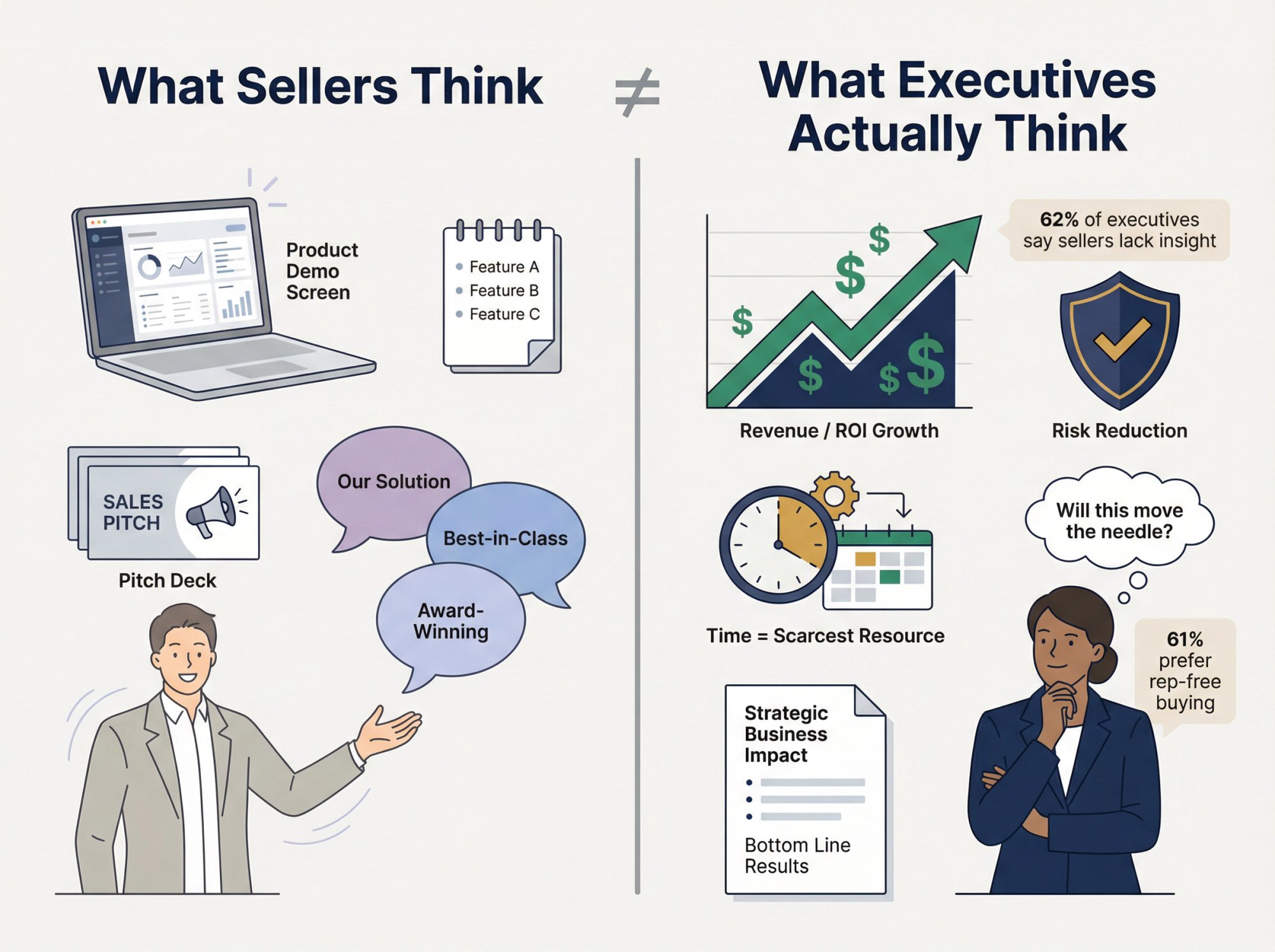
C-suite leaders don't care about your product features. They care about outcomes. Increasing revenue. Reducing risk. Cutting costs. Gaining competitive advantage. When you're pitching a CFO, they're not thinking "does this have a nice dashboard?" They're thinking "will this move the needle on something I actually care about?"
Time is their scarcest resource. That 20-minute meeting you're requesting? It costs them way more than 20 minutes. There's the context switching, the follow-up, the mental energy. They're ruthlessly selective because they have to be. And research shows 62% of executive buyers feel sellers lack insight into their business. Don't be that seller.
What Makes C-Suite Executives Say Yes to Meetings
• They think big picture. Forget features. Executives operate at the level of strategy, risk, and ROI. Your pitch needs to connect to a strategic business issue, not a narrow product detail.
• They demand value and urgency. It's not enough to offer value. They need to know why this matters now. We've seen CFOs literally say "I believe you can save us $10M, but I'm dealing with $50M problems right now." If your pitch doesn't align with their current top priorities, it's a non-starter.
• They expect you to do your homework. This isn't optional. Read their earnings calls. Check their LinkedIn for recent posts. Look for clues about goals or challenges. 75% of C-level buyers say they're influenced by content that's 100% customized to their specific situation. Generic outreach is dead on arrival.
• They value fresh insight. 69% of executives want data or research that's relevant to their business. Leading with a compelling insight (a trend they haven't considered, a benchmark from their industry) can grab attention. Position yourself as someone who brings valuable perspective, not just another pitch.
• They're allergic to fluff. Fortune 500 CEOs have limited tolerance for vague conversations. Skip the preamble. Lead with the strongest benefit. Every sentence should answer: "What's in this for me?"
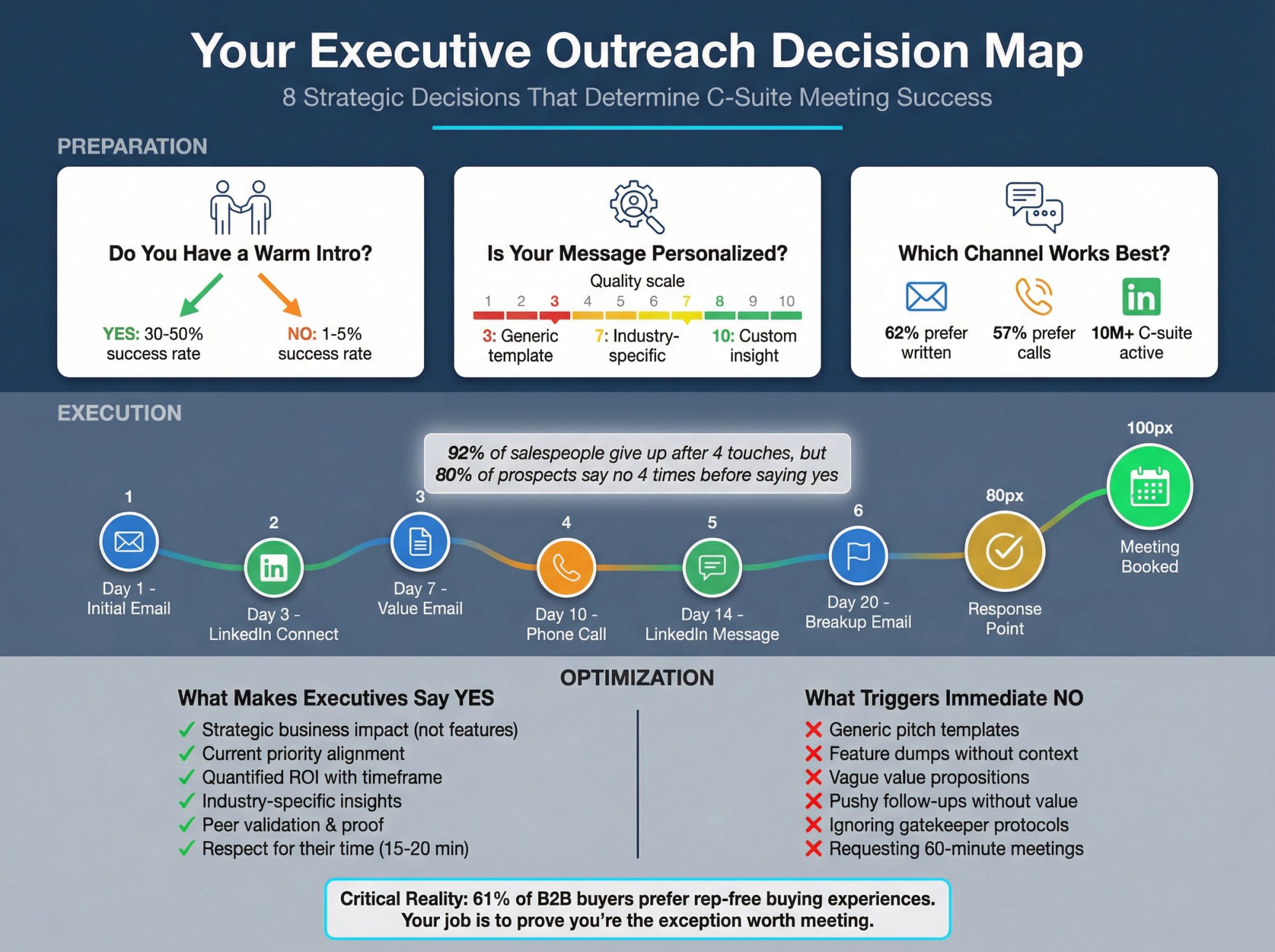
Critical reality check: In 2026, executives are trained to ignore you. A recent Gartner survey found that 61% of B2B buyers prefer a "rep-free" buying experience, and 73% actively avoid suppliers who send irrelevant outreach.
Your competition isn't other vendors. It's the executive's desire to do nothing and research without you.
How to Get Warm Introductions to C-Suite Executives
When it comes to getting executive time, who you know can completely change the game.
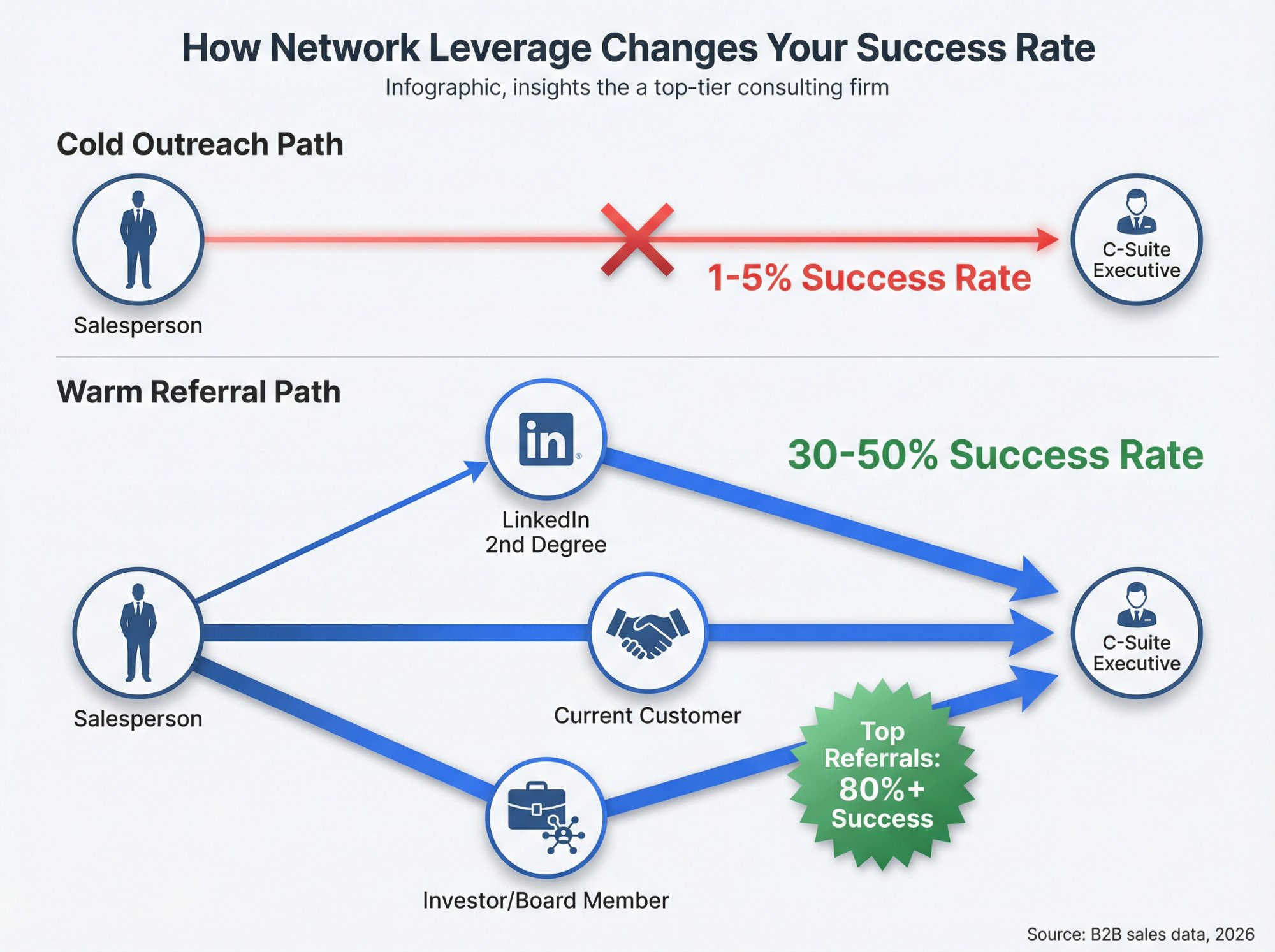
A direct referral from someone the executive trusts converts roughly 30-50% of the time, compared to 1-5% for cold outreach. A truly great referral (from a top client or close colleague) can hit 80%+ success rates. Our own data shows that referrals can boost response rates by up to 10× compared to pure cold pitches.
Why? Because busy CEOs are vastly more likely to respond to a request that comes through someone they trust. The referral does half your work for you. It answers the credibility question before you even say hello.
How to Get Warm Introductions (Even Without Direct Connections)
Start by mining your network. Check LinkedIn for 2nd-degree connections to your target executive. Maybe a current customer used to work with them. Perhaps an investor in your company runs in the same circles. Don't be shy about asking. Reach out to a happy client or mentor and say something like: "I noticed you're connected with [Target CEO]. Given the results we've achieved together, would you be comfortable introducing us?"
Make it clear why a meeting would benefit the executive, so your contact feels confident making the referral. They won't want to waste the CEO's time either.
What to Do When You Don't Have Direct Connections
→ Attend the same industry events. Is there a trade conference where the executive is speaking? That's your chance to either meet them or connect with people who know them. Mentioning a shared event can warm up subsequent outreach.
→ Engage on social media. Follow them on LinkedIn and interact thoughtfully with their posts. If they start seeing your name and smart commentary, you're no longer a complete stranger.
→ Ask for advice (carefully). Sometimes reaching out to an executive's network with a genuine request for advice (not a sales pitch) can open doors. This works better with retired executives or board members who might introduce you to current leaders.
Peer introductions remain the gold standard. A mutual colleague, investor, or customer putting in a good word gets you out of the cold zone immediately.
Pro tip: Make it easy for someone to refer you. Provide a short blurb they can forward explaining who you are and the specific value you offer. And most importantly, honor their trust. Deliver value to the executive so it reflects well on the person who made the introduction.
How to Write Cold Emails That C-Suite Executives Actually Read
Whether you're using email, LinkedIn, or phone, the content of your outreach has to be exceptionally strong.
Your message needs to immediately convey relevance, credibility, and ROI.
How to Write Opening Lines That Grab Executive Attention
The first sentence is make-or-break. Skip "I hope you're doing well" and generic intros. Start with something that matters to them:
Reference a current priority: "I saw in your latest shareholder letter that expanding in Asia-Pacific is a big focus this year..."
Share a relevant insight: "We found that 78% of manufacturers lose market share within 18 months of a new competitor entering, which could impact your APAC expansion. We've identified strategies to counter this."
Name-drop a credible result: "We helped [Peer Company] reduce their cloud spending by 30% in 6 months..." (if the peer is known to them and you have permission to share)
How to Show ROI Executives Care About (Not Product Features)
RAIN Group research found that 75% of C-level executives are influenced by ROI justification and content that's 100% customized to them. Focus on outcomes. Don't say "we improve productivity." Say "we help improve productivity by 20%, which for your company could free up $5M in cash flow next year."
Make it concrete. Quantify the impact with percentages, dollar values, and timeframes.
How Long Should Your Executive Outreach Email Be?
Busy execs will skim your message in seconds. Aim for three short paragraphs or a few bullet points max. Use the BLUF method (Bottom Line Up Front): state your core value right away.
Example:
"Bottom line: I believe [Company] can increase EBITDA by roughly $10M through cost optimization in your supply chain. We've done this for [Client A] and [Client B]. I'd like to share how in a 20-minute meeting."
Format for scannability. Use bold for key numbers. Maybe add a couple bullet points to highlight the benefits. Make it easy to grasp the value in 10 seconds.
How to Build Instant Credibility with C-Suite Decision Makers
Small touches increase trust. If you have relevant experience, mention it: "As a former CTO myself, I understand how tricky it is to balance innovation with security."
If you have a mutual connection, lead with that. If you can offer something of value even without a deal (a benchmarking report, industry insight), mention it. This demonstrates a giving attitude rather than pure selling.
How to Ask for a Meeting (Without Being Pushy)
Don't be vague like "let me know if you're interested." Be specific. Propose a timeframe and make it easy:
"Would you be open to a 20-minute call next week? I'm free Tuesday at 8:00 am or Thursday at 5:00 pm, whichever works better."
Early morning or late afternoon shows you're mindful of their packed schedule. Keep the time commitment modest (15-20 minutes is easier to say yes to than an hour).
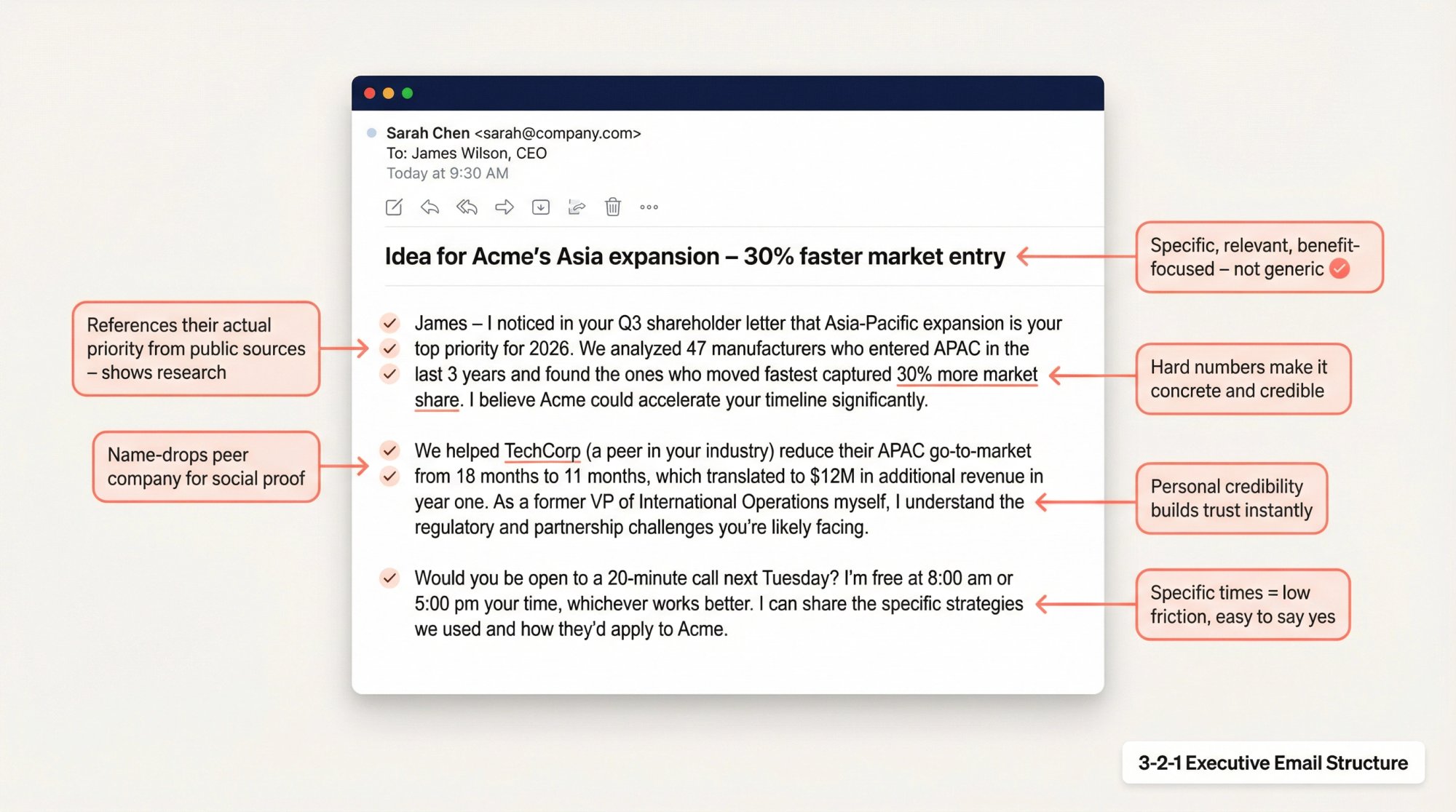
The 3-2-1 Executive Email Structure:
• 3 lines of context (why them, why now)
• 2 lines of proof (why you're credible)
• 1 low-friction ask (safe next step)
This structure keeps your outreach crisp while hitting all the key points.
Before you hit send, read your message from the executive's perspective and ask: "If I were a CEO, would I take this meeting? Is the value crystal clear?" If not, refine it.
Why Multi-Channel Outreach Works Better Than Email Alone
Don't limit yourself to just email or just LinkedIn. Coordinated multi-channel outreach can boost success rates by 2-3× compared to email alone.
Some prospects ignore emails but respond on LinkedIn. Others never pick up calls but reply to a well-timed email. You increase your chances by covering more bases professionally.
Cold Email Best Practices for Reaching C-Suite Executives
Email is often the first touchpoint. But remember, execs get hundreds of emails daily. To avoid instant deletion:
Personalize the subject line. Use something relevant like "Idea for [Company]'s Asia expansion" or "Quick question about [competitor]'s new move." Generic subjects scream spam.
Keep it concise. A short email (three paragraphs, ~100-150 words) is more likely to be read. Executives often check email on their phones, so front-load the value and keep paragraphs tight.
Show credibility early. Mention notable clients you've worked with (if non-confidential) or relevant research you have.
Avoid attachments initially. They trigger spam filters and seem like work. Offer to send materials upon request.
Timing matters. Sending emails at 7:00 am (their time zone) can place your message near the top when they first check. Avoid Friday 5 pm or Monday 9 am when inboxes are overwhelmed.
Do Executives Still Answer Cold Calls? (Yes, Here's When)
Cold calling intimidates people, but it can be surprisingly effective. Research shows 57% of C-level and VP buyers prefer to connect via phone when learning about new solutions. Why? A call allows for quick back-and-forth and saves time versus an email thread.
Call when gatekeepers aren't around. Assistants typically work standard hours. But many execs start early, stay late, or work odd hours. Calling early in the morning (before 8:30 am), during lunch, or early evening increases your odds of reaching them directly.
Friday afternoons are a secret weapon. Around 50% of executives are more open to unsolicited calls on Fridays compared to other days. When other salespeople have mentally checked out for the weekend, your Friday 4 pm call might reach a decision-maker in a relaxed, chatty mood.
Use a permission-based opener. If you reach them, you have seconds to prevent a hang-up. Immediately acknowledge you're an interruption and ask permission:
"Hi [Name], this is [Your Name] from [Company]. I know you're busy. Could I take 30 seconds to explain why I called, and you can decide if it's worth a discussion?"
This disarms them. Most will grant you 30 seconds. When they do, deliver your value proposition confidently and concisely.
Sound like a peer. Executives can immediately tell if you're reading a script. Use a natural tone. Stand up and smile when calling (it actually helps you sound more energetic). Address them by first name if that's the norm in your industry.
Leave a brief, compelling voicemail. Keep it under 30 seconds: "Hello Ms. Lee, this is John from Outbound System. We just helped a firm similar to yours save about $4M in overhead. I believe we could do the same for [Their Company]. I'll send an email as well, but I'd love to speak for 15 minutes. You can reach me at 212-555-1234. Thank you."
Be honest about expectations. Only about 1-3% of cold calls convert on average. But those that do connect can achieve in a 5-minute chat what would take 20 emails.
How to Use LinkedIn to Reach C-Suite Executives
Over 10 million C-level executives are on LinkedIn, and every Fortune 500 company has a presence there. Many CEOs actively post and network because it feels more like professional networking than selling.
Do your reconnaissance first. Read their profile. Note career history, mutual connections, recent posts, shared groups. This provides hooks for conversation.
Warm up the relationship. Unlike email or phone, LinkedIn lets you interact before making an ask. Follow the executive. Like or comment thoughtfully on a couple of their posts. Share one of their company's articles with your network and tag them. This makes your name familiar when you eventually reach out.
Send a personalized connection request. Never use the default invite message. Reference something relevant in 300 characters or less:
"Hi Maria, as a fellow SaaS founder in the logistics space, I enjoyed your post on last-mile delivery challenges. Would love to connect and perhaps share ideas on how we're helping retailers tackle those issues."
Personalized invites can have up to 30% higher acceptance rates.
Lead with value in messages. Once connected, resist the urge to pitch immediately. Offer something helpful first:
"Thanks for connecting, Tom. I saw your interview in CFO Magazine about cost-control initiatives. We studied a similar challenge. If you're interested, I can send over a short case study on reducing IT spend in banks. Let me know."
This feels like networking, not pitching. After providing value, then you can ask for a call.
LinkedIn limits to know:
LinkedIn commonly throttles connection requests. Third-party reporting suggests a range of 100-200 requests per week (this isn't officially published and varies by account health).
Sales Navigator provides 50 InMail credits per month, which renew monthly. Use InMail sparingly for high-value targets where regular outreach is failing.
How Many Follow-Ups Does It Take to Get an Executive Meeting?
Very rarely will one touch secure a meeting. Thoughtful persistence is often the differentiator.
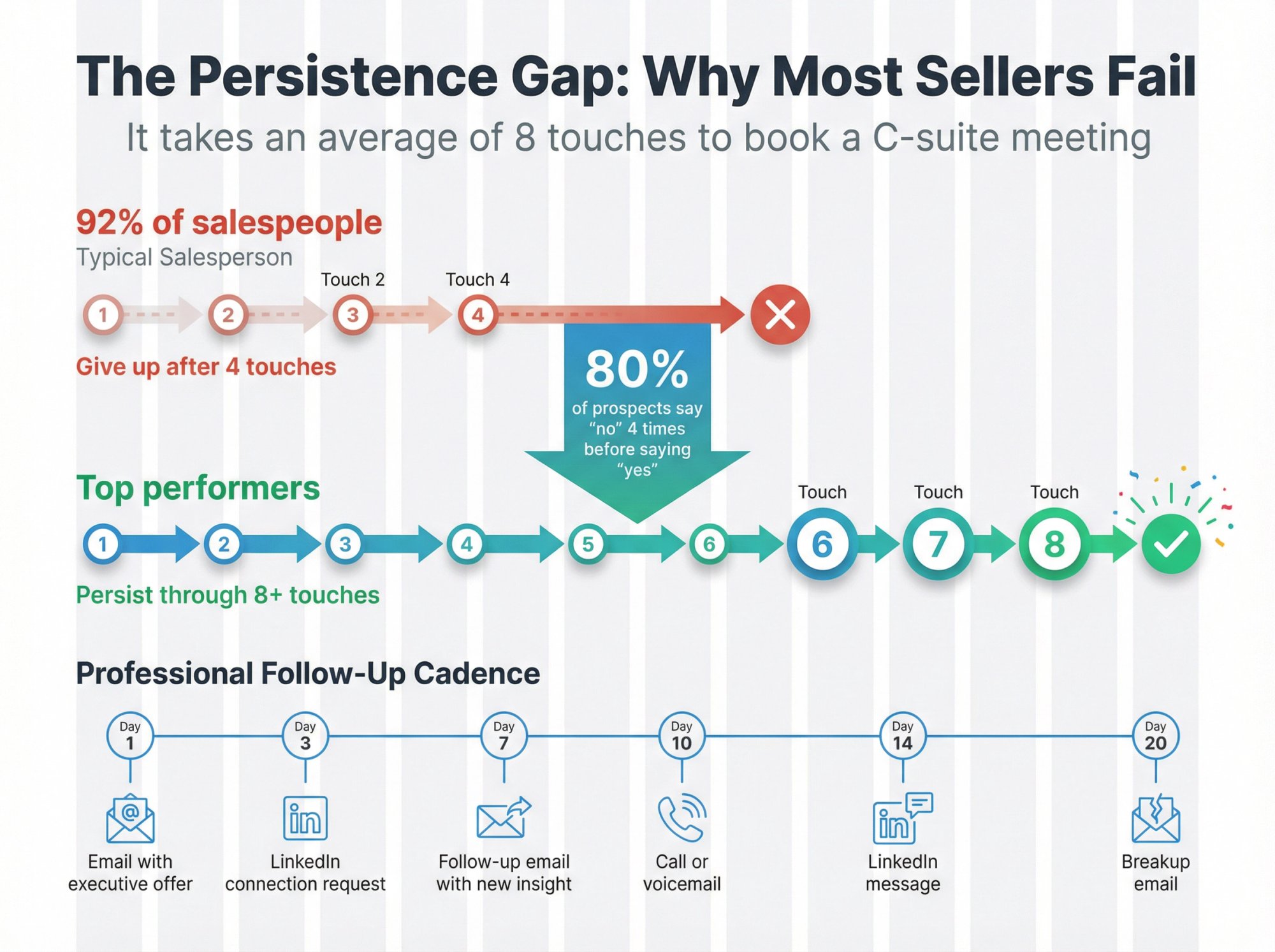
It takes an average of 8 touches to schedule a meeting with a new prospect. Many sellers give up after 2-3 tries, but many buyers only respond after the 6th, 7th, or later contact.
43% of buyers say it's okay for a seller to contact them 5 or more times before breaking through. And 92% of salespeople give up after four "no's," but 80% of prospects say "no" four times before they eventually say "yes."
Persistence pays off. But you have to do it professionally.
How to Follow Up with Executives Without Being Annoying
→ Use a cadence with spacing. Don't email daily. That's harassment. Plan a sequence over a few weeks:
Day | Action |
|---|---|
Day 1 | Email with executive offer |
Day 3 | LinkedIn connection request |
Day 7 | Follow-up email with new insight |
Day 10 | Call or voicemail |
Day 14 | LinkedIn message |
Day 20 | Breakup email |
Vary the days and times. Maybe you catch them at a better moment.
→ Make every touch add value. Don't just say "bumping this to top of inbox." Bring something new each time. Share a relevant case study. Drop a useful article link. Mention a specific idea related to their business. By doing this, you demonstrate value and insight even if they haven't responded yet.
→ Mix up the medium. If three emails haven't gotten a reply, try a phone call or LinkedIn touch. Some executives might silently appreciate your persistence. By the 5th touch, you might get: "Sorry for the delay. I've seen your messages. Let's schedule something next month."
→ Know when to back off. If they explicitly say "no, don't contact me," then stop. Thank them and move on. If you've reached 6-8 touches with zero response, send a breakup email:
"I know your time is extremely valuable. I've reached out a few times and haven't heard back, which tells me the timing may not be right. I don't want to be a pest, so I'll close out for now. If reducing cloud costs by 20% becomes a priority, I'd welcome a conversation. In the meantime, I wish you continued success."
Breakup emails sometimes trigger a response. Even if not, you've been courteous and can circle back in six months with a fresh angle.
Be politely persistent, not pushy. Show confidence in your value without crossing into desperation. Many executives actually respect persistence because it signals you believe in your solution.
How to Get Past Executive Assistants (The Right Way)
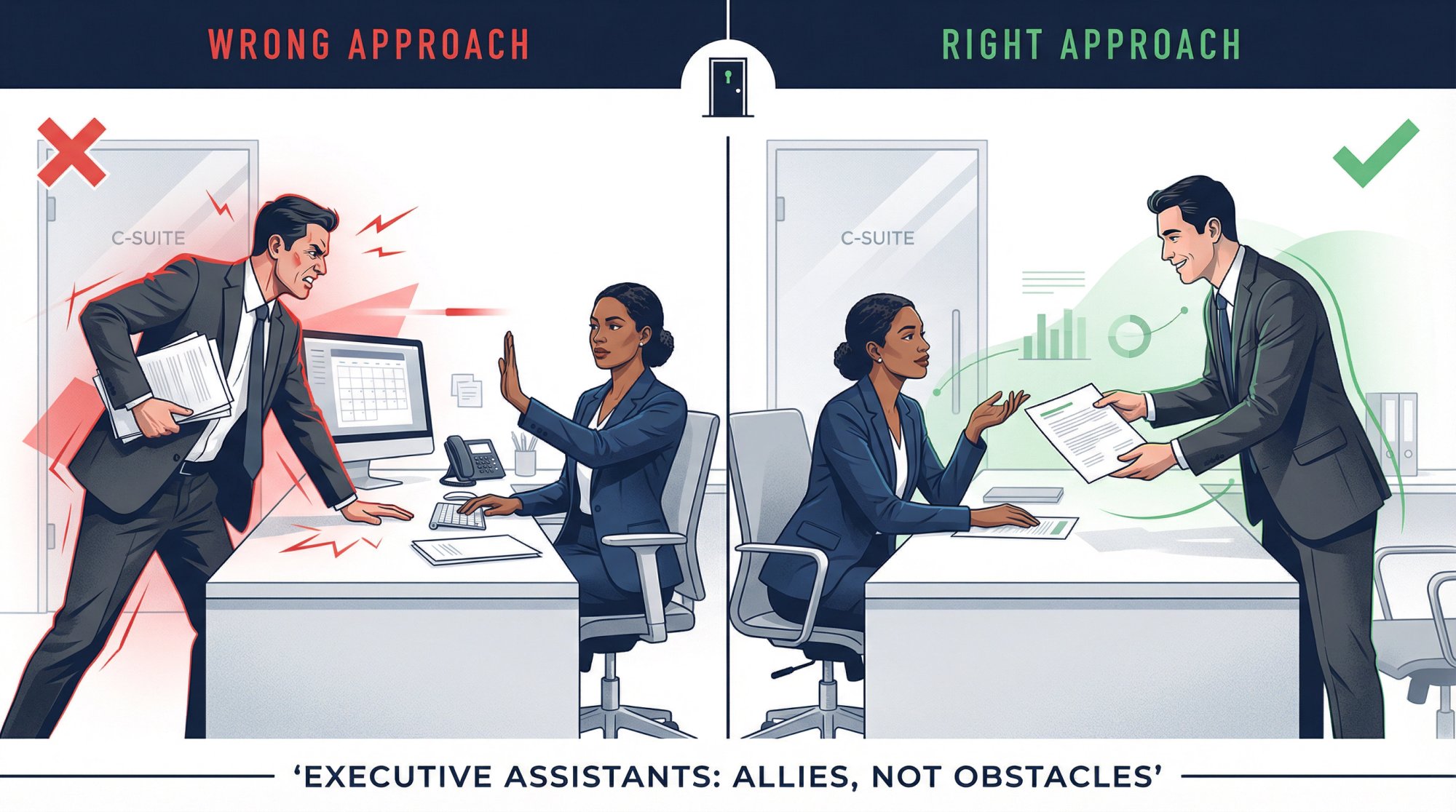
One of the toughest parts of reaching executives is dealing with gatekeepers. Typically executive assistants who screen calls and emails.
These individuals aren't your enemies. They can be powerful allies if you handle interactions right. Their job is to protect the exec's time, so you need to prove that talking to you will be worthwhile.
Treat them with respect. Always be polite, warm, and authentic. Learn their name if possible. On a call: "Hi, I was hoping to speak with Ms. Roberts. You must be her assistant. I know you're extremely busy too, so I'll be brief." A little courtesy goes a long way.
Many EAs have been with their execs for years and have significant influence. Offending them guarantees failure.
Enlist their help. Rather than trying to bulldoze past them, ask their advice:
"Maybe you can help me. I have an insight on [X] that I believe could benefit Mr. CEO. I realize he's hard to reach. In your opinion, what's the best way to get on his calendar for 15 minutes, given the topic?"
This framing (asking for guidance) can recruit them onto your side. If they see real value, they might advocate internally.
Equip them with value. Often an assistant will ask: "Can you send me something to pass along?" Be ready. Have a concise overview or one-pager they can forward. When you email, consider cc'ing the assistant with a note: "I've cc'd [Name] to ensure this reaches you at a convenient time." This shows respect for their process.
Be slightly bold, but not dishonest. Some advise tactics like calling and saying "I'm following up on correspondence." Use caution. Deceptive ploys backfire if discovered. Instead, reference an actual prior touch: "I sent Mr. CEO an email about a week ago regarding [value proposition]. I'm calling to follow up on that." This is truthful and reminds the assistant there's a prior thread.
Find creative bypasses. If the front door is heavily guarded, is there a side door? Maybe the CFO or another C-suite member is easier to reach. Have a valuable conversation with them, then get referred internally to the CEO.
Once in contact, make their life easy. If an assistant schedules a call, promptly send any info they request. Be punctual. Send a thank-you note to the assistant as well after a good meeting, expressing appreciation for arranging it. This human touch is remembered.
Never treat an EA as insignificant. Some sales pros have made the fatal mistake of being rude to an assistant, only to find out that assistant has the CEO's ear and effectively blacklists them. On the flip side, assistants who become allies can open gates rather than bar them.
How to Meet C-Suite Executives at Conferences and Industry Events
While much outreach is remote, don't overlook the power of face-to-face interaction.
Meeting a C-suite executive in person (even briefly) can leave a strong impression and sometimes lead to a formal meeting later.

Industry conferences and trade shows. Executives often appear at high-profile events as speakers or attendees. If you know your target exec will be there:
Ask a smart question during their panel Q&A (make it memorable, not a sales pitch). Approach afterward with a quick comment. Be brief and respectful. Introduce yourself, exchange business cards, but don't corner them. For example:
"Great insights on the panel, thanks. By the way, I'm John from Outbound System. We're working on something that could possibly address the [issue] you mentioned. Would it be okay if I followed up via email?"
If they say yes, you now have a warm reference ("met at X event and you suggested I reach out").
Executive roundtables or invite-only gatherings. Sometimes you can access small group discussions through industry associations or partner organizations. These are golden for relationship building. If you're at a dinner or roundtable with a C-level exec, focus on building rapport, not selling. Show genuine interest in their viewpoints. Your aim is to be remembered as that sharp person with useful perspectives. Afterward, connect on LinkedIn and send a note referencing the enjoyable chat.
Office hours or outreach events. Some execs (especially in tech) do "open office hours" on LinkedIn or participate in entrepreneur meetups. If applicable, use these. Just be prepared. If you get a few minutes, have your value prop ready.
In all in-person settings: be brief, brilliant, and gone. Fortune 500 CEOs have limited patience for small talk with strangers. If you speak with one, make it count quickly. A one-sentence intro, one or two sentences of tailored value or a great question, then listen.
Sometimes asking a great question is more powerful than pitching on the spot: "What did you find most challenging about scaling into Europe?" Their answer gives you insight to follow up later.
Always follow up after an in-person encounter. Send a short note referencing the interaction and reiterate your meeting request with tailored value. The fact that you've met gives you an edge over purely digital outreach.
How Outbound System Helps Scale Executive Outreach
Everything we've covered so far works. But there's a problem: doing it at scale is exhausting.
Coordinating multi-channel sequences, maintaining deliverability across hundreds of emails, personalizing each message, tracking touchpoints, managing data quality. It's a full-time job. And if you're doing it manually or with patchwork tools, you're leaving opportunities on the table.
That's why we built Outbound System.
Why Email Deliverability Makes or Breaks Executive Outreach
Getting into executive inboxes isn't just about writing good emails. In 2026, Gmail requires SPF and DKIM for all senders, and if you send more than 5,000 messages per day, you need SPF, DKIM, and DMARC plus one-click unsubscribe. Yahoo has similar requirements: keep spam rates below 0.3%, honor unsubscribes within 2 days. Microsoft announced bulk sender requirements for those sending 5,000+ emails daily.
Most companies don't have the infrastructure to handle this properly. Shared IP pools get you lumped in with spammers. DIY setups create deliverability nightmares.
How Outbound System Gets 98% Inbox Placement with Executives
We run our cold email system on 350 to 700 Microsoft Azure U.S. IP inboxes (depending on tier). This distributed sending pattern mimics natural human behavior and keeps each inbox below spam thresholds. Result: 98% primary inbox placement and 6-7% response rates across our client base.
But infrastructure is just part of it. We also provide:
Feature | Why it matters for C-suite outreach |
|---|---|
Triple-verified data minimizes wasted touches. You can't afford to bounce emails to a CFO. | |
AI generates prospect-specific lines based on company data and triggers. Humans write the core value prop. This combination maintains credibility while scaling personalization. | |
We orchestrate email, LinkedIn, and calling in synchronized sequences. The persistence strategies we discussed? We automate them while keeping them feeling human. | |
Unlimited A/B testing | Rapidly iterate on messaging, segments, and offers with real-time metrics. |
Dedicated account strategist | Someone who analyzes performance data with you and refines approach based on what executives actually respond to. |
We've sent 52 million+ cold emails, generated 127,000+ leads, and helped clients close $26 million in revenue using this system.
Transparent pricing, no long-term commitments
Plan | Monthly Price | Emails per Month | Contract |
|---|---|---|---|
Starter | $1,499/month | Up to 15,000 | Month-to-month |
Growth | $2,499/month | Up to 30,000 | Month-to-month |
Scale | $3,999/month | Up to 60,000 | Month-to-month |
Both include AI personalization, enrichment, unified inbox, CRM integrations, real-time metrics, and your dedicated strategist. Month-to-month contracts. No getting locked into 12-month deals.
If you're serious about getting C-suite meetings at scale, you need infrastructure that works. You need data that's clean. You need messages that are personalized. And you need a system that coordinates everything without requiring you to babysit it daily.
That's what we do. See how it works.
C-Suite Meeting FAQs: Your Top Questions Answered
How many touchpoints does it really take to get a C-suite meeting?
On average, about 8 touches. But it can vary widely. Some executives respond on the first well-crafted message (especially if it's a warm intro). Others might need 10-12 touches spread over weeks. The key is varying your approach (email, LinkedIn, phone) and adding value with each touch rather than just repeating the same pitch.
What's the best time to call an executive?
Early morning (before 8:30 am), during lunch, or early evening. These are times when gatekeepers often aren't screening calls, so you're more likely to reach the exec directly. Friday afternoons can also work well. Around 50% of executives are more receptive to calls on Fridays when the week is winding down.
Should I use email, LinkedIn, or phone?
All three. Multi-channel outreach can boost success rates by 2-3× compared to using just email. Some execs ignore emails but respond on LinkedIn. Others prefer phone calls. By coordinating touchpoints across channels, you maximize your chances of connecting.
How do I get past gatekeepers?
Treat them as allies, not obstacles. Be respectful and professional. Ask for their advice on the best way to reach the executive. Equip them with a concise one-pager or value statement they can pass along. Never be rude or dismissive. Executive assistants have significant influence and can either open the gate or close it permanently.
What should I say in my first outreach message?
Lead with something relevant to them (a current priority, a compelling insight, or a peer result). Keep it to three short paragraphs max. Focus on outcomes they care about, not product features. End with a clear, low-friction ask like a 15-20 minute call at specific times. Make it obvious why this is worth their time. See our best cold email templates.
How long should I wait between follow-ups?
Space your touches out over days, not hours. A good cadence might be: email on Day 1, LinkedIn on Day 3, follow-up email on Day 7, call on Day 10, LinkedIn message on Day 14. This feels persistent without being pushy. Each touch should add new value (a case study, an article, a specific insight).
What if I don't have any warm introductions?
Start building them. Mine your LinkedIn for 2nd-degree connections. Attend industry events where your target execs show up. Engage thoughtfully with their content on social media over time. If you absolutely can't find a warm path, your cold outreach needs to be exceptional. Lead with strong insights, be ultra-specific about value, and use multi-channel persistence.
How do I prove I'm worth an executive's time?
Do your homework. Reference their specific business challenges or goals. Share relevant data or insights they haven't considered. Mention credible results you've achieved for similar companies. Offer something valuable even without a deal (a benchmarking report, industry analysis). The more tailored and insight-rich your outreach, the more credible you become.
Getting meetings with C-suite executives isn't easy. They're busy, selective, and insulated by design. But it's absolutely doable when you understand how they think, craft value-focused messages, use multi-channel persistence, and treat gatekeepers as allies.
The strategies in this guide work. We've seen them work across hundreds of clients and thousands of executive meetings.
If you want to scale this approach without burning out your team, Outbound System provides the infrastructure, data quality, and multi-channel coordination you need. But whether you work with us or not, the principles are the same.
Start with one target account. Do the research. Find the warm intro if possible. Craft a killer message. Follow up persistently but professionally. And when you get that meeting, deliver the value you promised.
The door to the C-suite is tough to open. But once you understand how the lock works, it's just a matter of using the right key.