Commercial real estate is a strange business. Deals can hit seven figures. Sales cycles stretch for months. Everyone says they're "relationship-first."
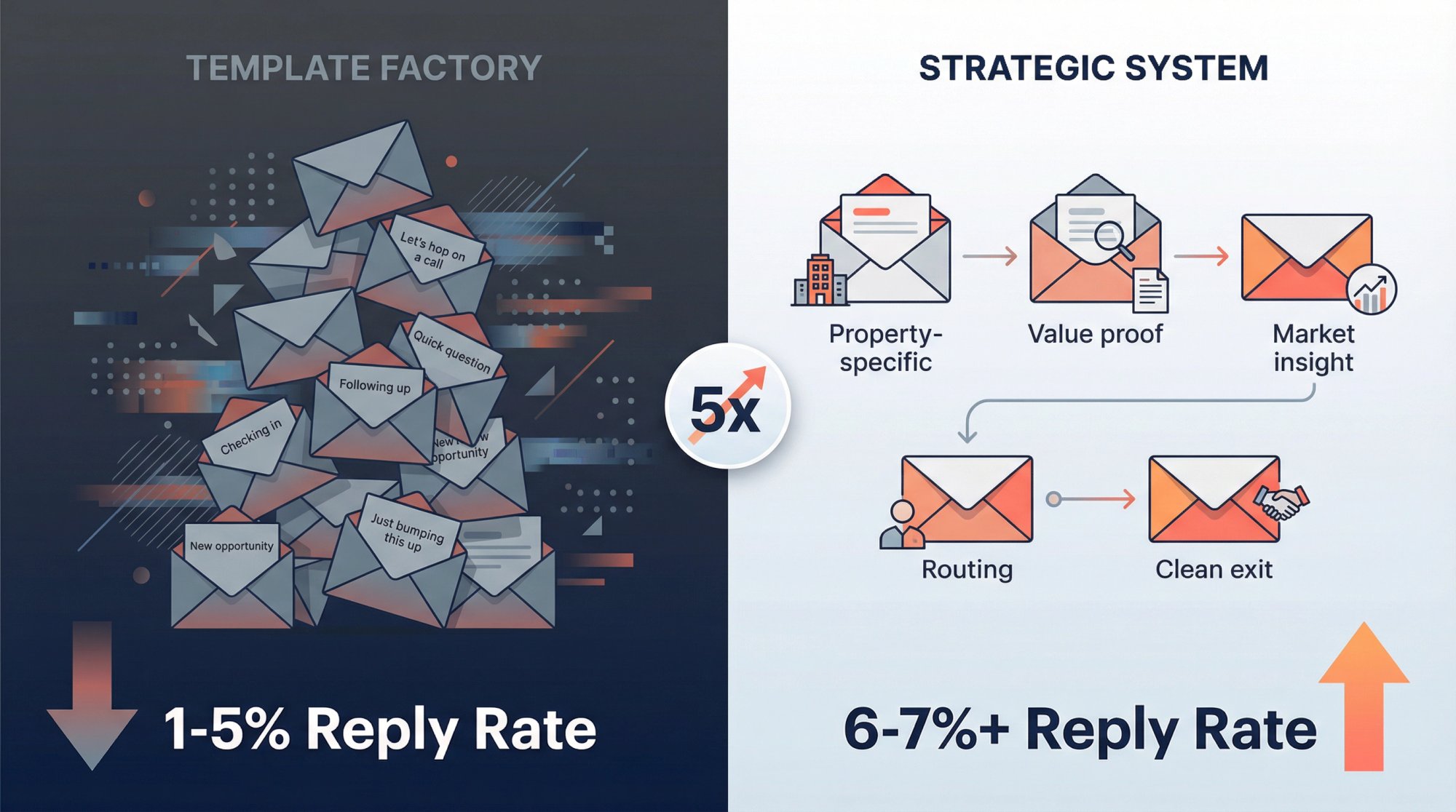
But inboxes are flooded with cold outreach that feels like it came from a template factory.
If you searched for five cold emails for commercial real estate, you're probably trying to do one of these things:
• Book meetings with property owners (to sell, refinance, broker, or switch property management)
• Reach tenants or tenant representatives (for leasing, subleases, expansions, renewals)
• Sell a CRE product or service (property management software, facilities, construction, energy, security)
• Break through gatekeepers and get routed to decision-makers without burning your reputation
What actually works isn't a clever one-off email. It's a repeatable 5-email sequence that starts real conversations with the right people and turns them into booked appointments.
This guide gives you exactly that. We'll show you the templates, the CRE-specific personalization hooks, and the 2026 deliverability requirements that determine whether your emails even reach inboxes. By the way, we've sent over 52 million cold emails for 1,000+ B2B companies at Outbound System, so we know what separates the emails that get replies from the ones that get ignored.
Most CRE cold emails fail because they optimize for the sender's needs ("Let's hop on a call") instead of the prospect's concerns ("Is this worth my time and does it create risk for me?"). Industry benchmarks show typical reply rates hover around 1-5%. But teams using smart cold email tactics routinely see 6-7%+ reply rates.
The difference? They understand that 73% of decision-makers say personalization matters in cold outreach. They lead with value, not pitches. And they follow a system.
Why CRE Cold Emails Fail (And How to Fix It)
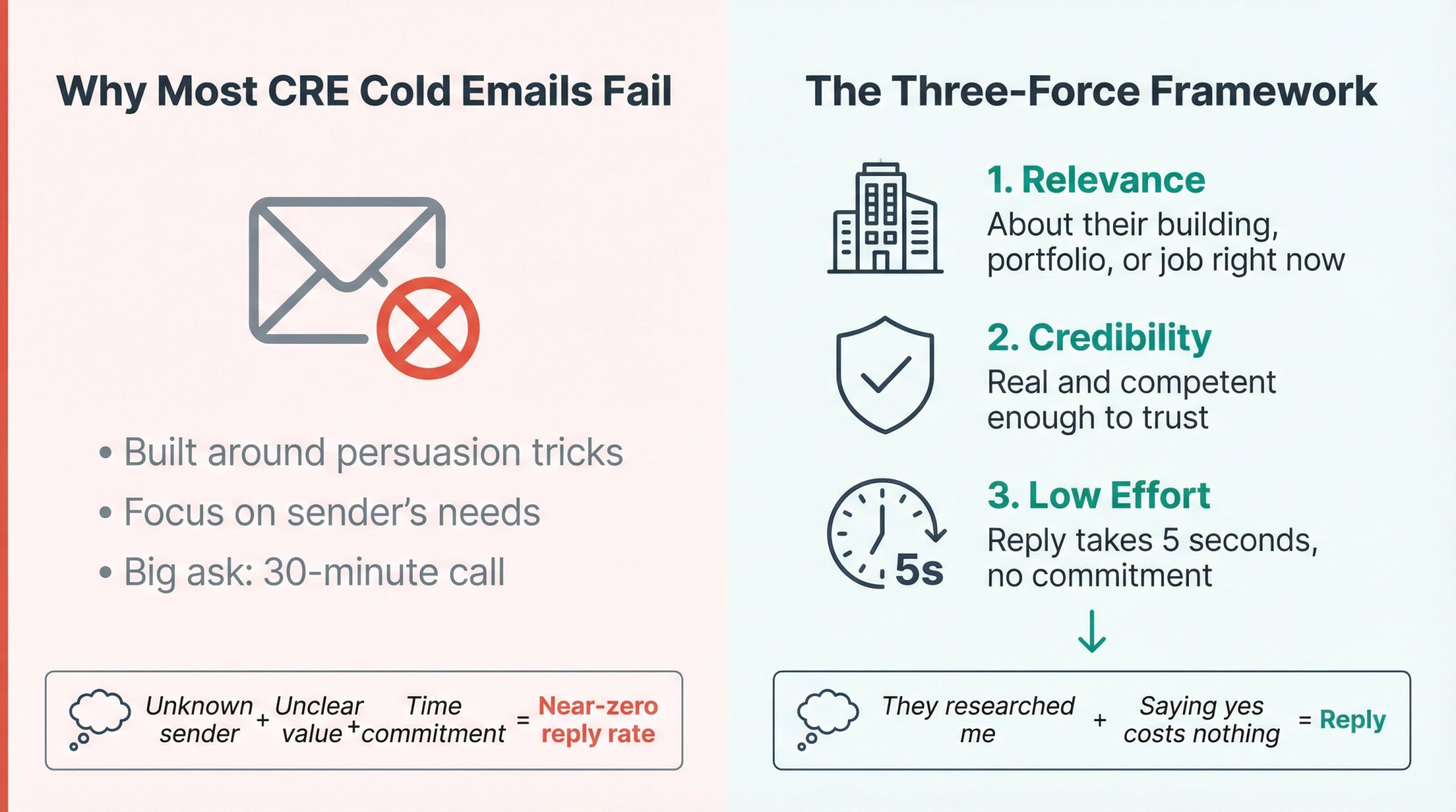
A prospect replies when three forces align:
1. Relevance: "This is about my building, my portfolio, or my job right now."
2. Credibility: "This person seems real and competent enough to trust with a conversation."
3. Low effort: "Replying takes me 5 seconds and doesn't commit me to anything."
Most templates fail because they're built around persuasion tricks instead of risk reduction. When a property owner gets an email asking for a 30-minute call to discuss "opportunities," their brain immediately calculates the downside. Unknown sender. Unclear value. Definite time commitment. The reply probability drops to near zero.
The winning move isn't clever copywriting. It's reducing the perceived risk of replying.
That's why the sequence below is built around a specific reason you're reaching out (tied to their property or role), a tiny ask (yes/no question, routing request, permission to send something), and proof you did basic homework (you know their property address, asset type, or recent activity).
When you nail these three things, prospects think: "This person isn't spamming everyone. They actually researched me. And saying yes costs me nothing." That's when reply rates jump.
Who Can Use These 5 Commercial Real Estate Emails?
This sequence works across CRE personas. You just swap the offer and the hook to match who you're targeting:
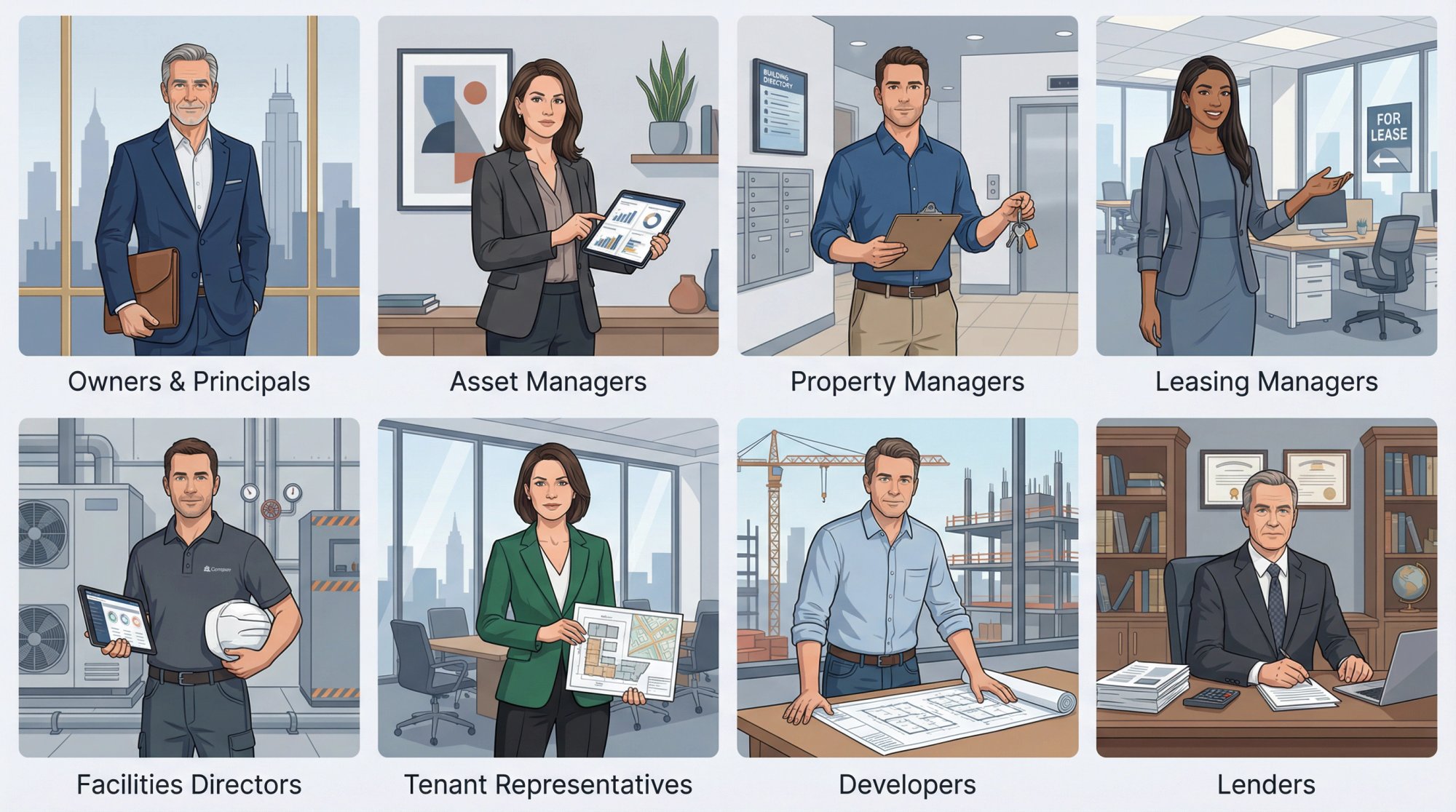
Owners and principals
Asset managers
Property managers
Leasing managers
Directors of facilities and operations
Tenant representatives and corporate real estate
Developers
Lenders and capital markets professionals
The structure stays the same. The personalization variables change based on what matters to each persona.
How to Target Your CRE Cold Email Campaign
If you skip this step, your emails will read like spam even if your writing is decent.
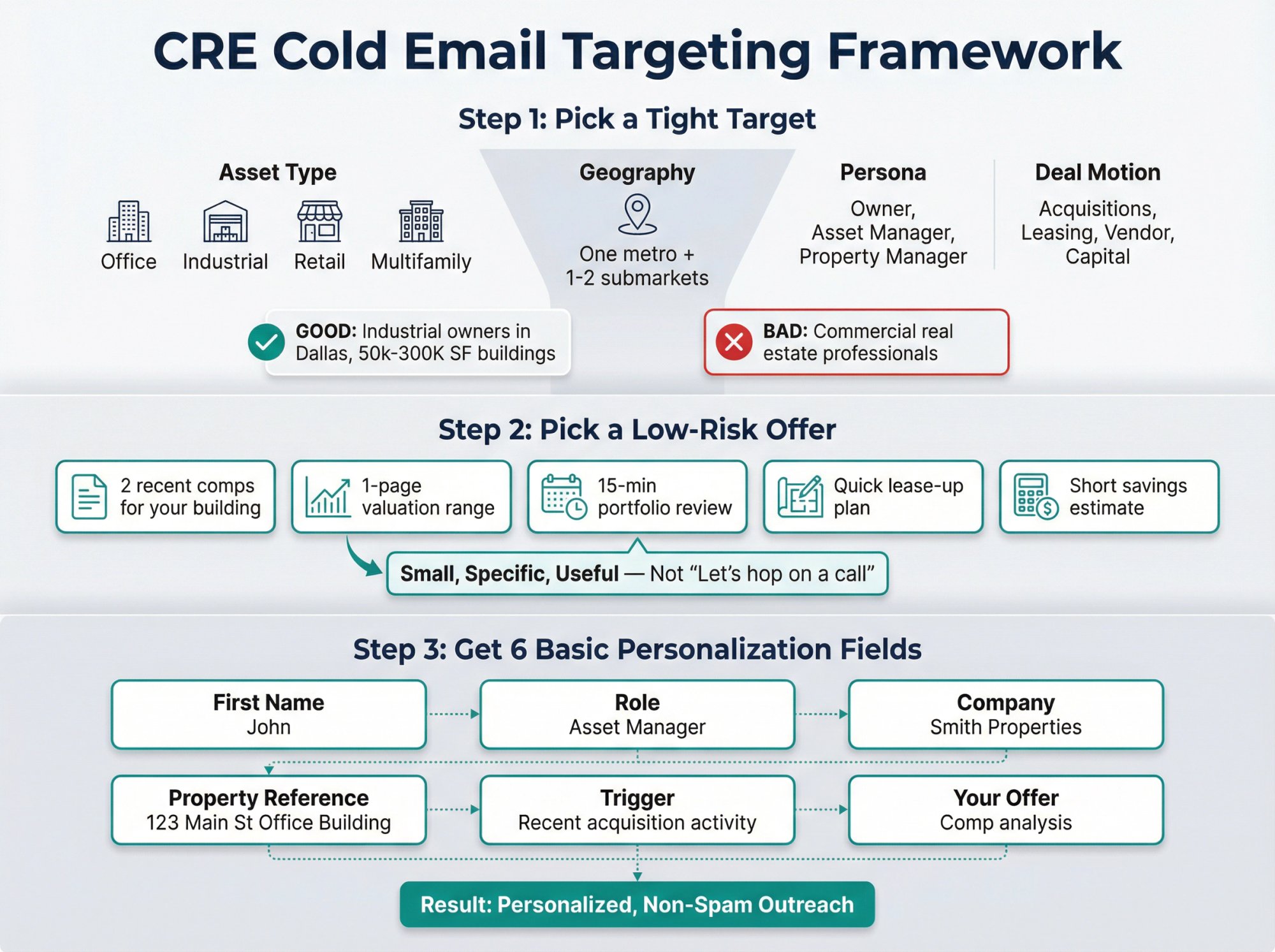
Pick a Tight Target
Choose these four things:
Element | Example |
|---|---|
Asset type | Office, industrial, retail, multifamily, self-storage, medical |
Geography | One metro + one or two submarkets |
Persona | Owner, asset manager, property manager, facilities director, tenant rep |
Deal motion | Acquisitions, leasing, vendor/service, capital |
Good example: "Industrial owners in Dallas who own 50,000 to 300,000 SF buildings."
Bad example: "Commercial real estate professionals."
The tighter you get, the more your emails feel like they were written specifically for the recipient. Because they actually were.
Pick a Low-Risk Offer (Not "A Call")
Your first email shouldn't ask for a 30-minute meeting. That's a big ask. Start with something prospects can say yes to without mentally signing a contract.
Examples (swap based on your business):
→ "I can send 2 recent comps relevant to your building."
→ "Want a 1-page valuation range and likely buyer profile?"
→ "Open to a 15-minute portfolio review focused on reducing operating expenses?"
→ "Worth sharing a quick lease-up plan for [submarket]?"
→ "Should I send a short savings estimate based on your building type?"
Notice the pattern. Each offer is small, specific, and useful. You're not asking them to commit to anything beyond receiving information.
Get 6 Basic Personalization Fields
You can run world-class outreach with just these six data points:
First name
Role (owner, PM, asset manager, etc.)
Company name
One property or portfolio reference (address or "your [submarket] industrial portfolio")
One trigger or reason to reach out (public and non-creepy)
Your specific offer
That's it. You don't need 47 fields of enrichment data. You need these six, done correctly.
Cold Email Deliverability Requirements for 2026
A lot of "cold email advice" ignores a critical fact: inbox providers now enforce baseline requirements that determine whether you land in inbox, Promotions, junk, or get outright rejected.
This isn't optional. It's the table stakes for email deliverability in 2026.
Authentication Is Mandatory at Scale (SPF, DKIM, DMARC)
Google: Starting February 1, 2024, senders to Gmail need authentication. If you send more than 5,000 messages per day to Gmail accounts, you must have SPF + DKIM + DMARC and meet additional requirements like one-click unsubscribe.
Yahoo: Beginning February 2024, Yahoo enforced standards including authentication and keeping spam complaint rates low. For bulk senders, SPF + DKIM + DMARC are required, plus unsubscribe requirements.
Microsoft (Outlook.com): On April 2, 2025 (updated April 30, 2025), Microsoft announced new requirements for domains sending more than 5,000 emails per day to Outlook.com consumer domains. SPF, DKIM, and DMARC are required. Non-compliant mail gets routed to Junk and potentially rejected.
If you're sending at any kind of scale, you need this setup. Period.
At Outbound System, we handle all of this infrastructure for you (350 to 700 Microsoft U.S. IP inboxes depending on your plan, all fully authenticated and warmed). But if you're doing it yourself, get these three authentication protocols configured before you send email one.
One-Click Unsubscribe Is Table Stakes
Google's sender guidelines spell out one-click unsubscribe requirements for marketing messages at volume. Yahoo requires a list-unsubscribe header (one-click recommended), a visible unsubscribe link, and honoring unsubscribes within 2 days.
The technical standard behind one-click unsubscribe is RFC 8058.
Bottom line: include a working unsubscribe method in every email. Make it one-click if you're doing any volume.
CAN-SPAM Basics (US) You Actually Need to Follow
The FTC's CAN-SPAM compliance guide covers the basics: no deceptive headers or subjects, include a clear opt-out, honor opt-outs promptly.
If you run multi-inbox sending, opt-outs must suppress across your entire system, not just one inbox. We covered this in detail in our CAN-SPAM cold email requirements guide.
If You Email Outside the US, Rules Are Different
• Canada (CASL): Generally requires consent and specific identification/unsubscribe rules. CRTC FAQ has details.
• UK: ICO guidance discusses lawful bases like consent and legitimate interests. Business-to-business marketing rules apply.
• EU: GDPR and ePrivacy regulations govern B2B outreach. Treat email outreach compliance as a real project, not a footer line.
This section isn't meant to scare you. It's meant to keep you out of trouble. Follow the rules, authenticate your domains, and give people an easy way to opt out. That's how you protect deliverability long-term.
5 Cold Email Templates for Commercial Real Estate
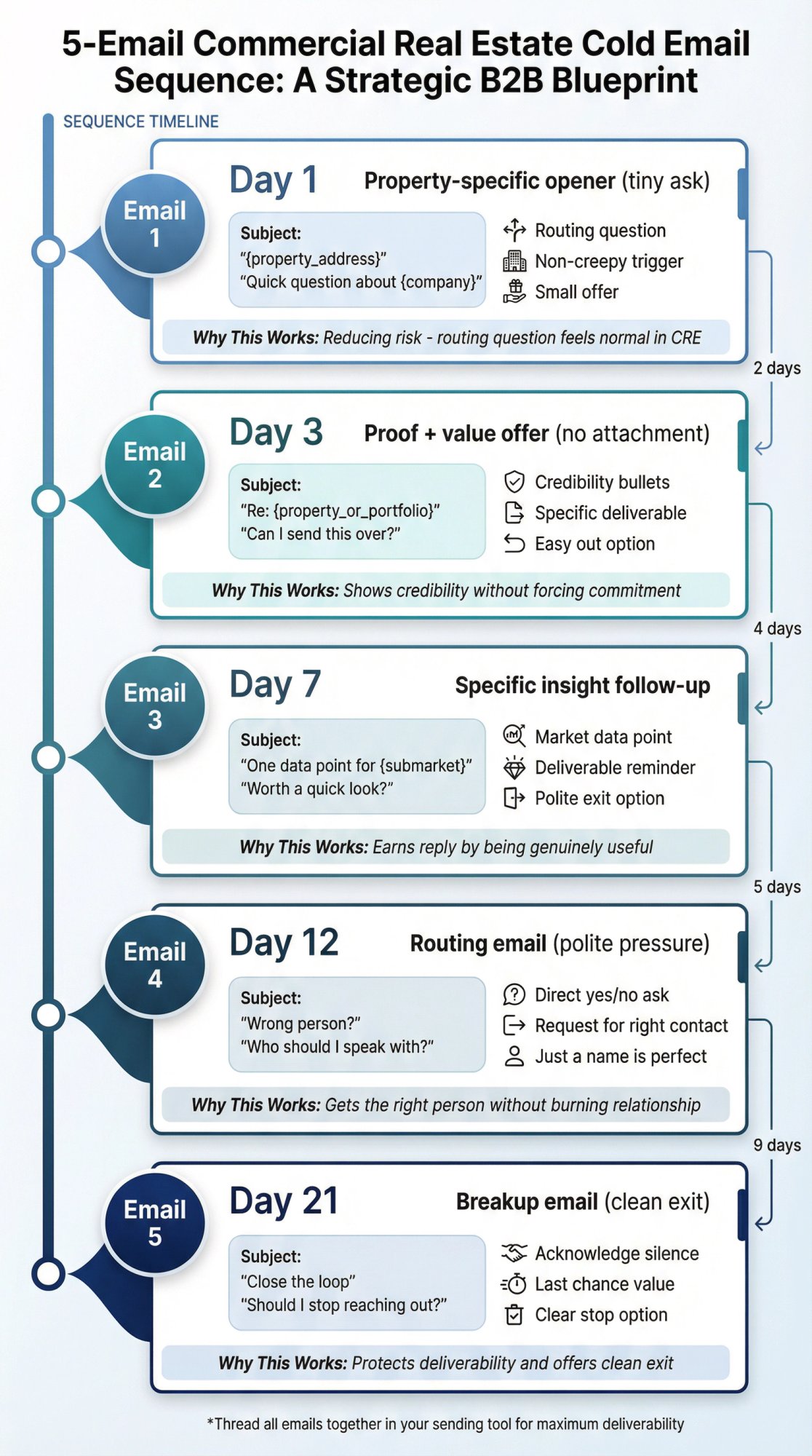
The sequence is built around days as recommendations, not hard rules. Keep them in the same thread if your sending tool supports it.
Recommended Send Cadence:
Send Day | Purpose | |
|---|---|---|
Email 1 | Day 1 | Property-specific opener (tiny ask) |
Email 2 | Day 3 | Proof + value offer (no attachment) |
Email 3 | Day 7 | Specific insight follow-up |
Email 4 | Day 12 | Routing email (polite pressure) |
Email 5 | Day 21 | Breakup email (clean exit) |
What to Include in Every Email Footer:
• Your name + company
• Physical mailing address (CAN-SPAM requirement)
• A working unsubscribe method (ideally one-click for bulk sending)
Now let's break down each email.
Email 1: Property-Specific Opener (Get Routed or Get Permission)
Goal: Get routed to the right person or get permission to send something useful.
Subject Line Options:
• {property_address}
• Quick question about {company}
• {submarket} {asset_type}
• Who handles {leasing / dispositions / facilities}?
Template:
How to Fill {topic} + {small_offer} (Pick One):
Scenario | Topic | Small Offer |
|---|---|---|
Acquisitions / off-market | "a potential purchase" | "1-page value range + 2 nearby sale comps" |
Leasing / tenant rep | "vacancy/lease-up strategy" | "3 bullet ideas for {submarket} tenants + one comp set" |
Property management | "property management" | "a quick operating plan and fee comparison" |
Facilities/vendor services | "{HVAC/roofing/security/energy}" | "a quick savings estimate or risk audit based on building type" |
Debt/capital | "refi/debt options" | "a short lender list + terms snapshot for {asset_type}" |
Why This Works:
It doesn't force a call. It asks a routing question first, which is low effort and feels normal in CRE. Even if they're not the right person, you've made it easy for them to forward you to someone who is.
The trigger line shows you did homework. The offer is small enough to say yes without risk.
Email 2: Proof + Value (No Attachment, Just Ask)
Goal: Show credibility and make "yes" easy.
Subject Line Options:
• Re: {property_or_portfolio}
• Can I send this over?
• {submarket} comps
Template:
CRE Deliverables That Actually Get "Yes":
• "2 recent sale comps + buyer profiles"
• "3 tenant categories actively expanding in {submarket}"
• "10-minute 'operating expense leakage' checklist for {asset_type}"
• "3 lenders currently quoting {asset_type} in {market}"
• "Mini rent positioning note (no fluff, 1 page)"
Important: Don't attach the PDF in Email 2 if you care about deliverability. Ask permission first. Send it after they reply.
Why This Works:
You're showing credibility by offering something specific and structured. The three bullets prove you're not winging it. And the last line gives them an easy out (forward to someone else) while keeping the conversation alive.
Email 3: Specific Market Insight (Not a Generic Nudge)
Goal: Earn the reply by being useful.
Subject Line Options:
• One data point for {submarket}
• {asset_type} in {submarket}
• Worth a quick look?
Template:
Examples of Insights That Feel Real (Not Creepy):
• "Seeing more {tenant type} inquiries in {submarket} than last quarter."
• "A lot of owners I talk to are revisiting {topic: CAM recoveries, energy spend, lease renewals} right now."
• "We're seeing decision cycles shorten when the ask is a 1-page review first, not a full proposal."
You could also use a specific market stat like: "Industrial vacancies just hit 7.0% while rent growth slowed to around 2.0% year-over-year" (based on recent NAR data).
The key is specificity. If your insight could apply to 10,000 people, it's not an insight. It's filler.
Why This Works:
You're not just following up to follow up. You're adding value with each touch. Even if they don't reply, you're building credibility as someone who knows the market.
Email 4: Routing Question (Polite Pressure to Get the Right Contact)
Goal: Get the right person even if they're ignoring you.
Subject Line Options:
• Wrong person?
• Who should I speak with?
• Quick redirect
Template:
Why This Is High-Leverage in CRE:
Organizations are layered. Your first contact is often not the decision-maker. This email gets you routed correctly without burning the relationship.
People are surprisingly willing to help with a simple redirect. And if they are the right person, this email often triggers a response because it's a direct yes/no question.
Email 5: Clean Exit Email (Stop Without Burning Reputation)
Goal: Stop wasting sends and protect deliverability, while giving one last easy "yes."
Subject Line Options:
• Close the loop
• Should I stop reaching out?
• Last try
Template:
Why This Works:
No guilt. No theatrics. You're being respectful of their time and their inbox. And sometimes, this is the email that finally gets a response because it's so straightforward.
It also protects your sender reputation. Continuing to email non-responders hurts deliverability. The breakup email gives you a clean exit.
How to Write the First Line of Your CRE Cold Email
You don't win by explaining your company in the first line.
You win by proving, fast, that this email isn't random.
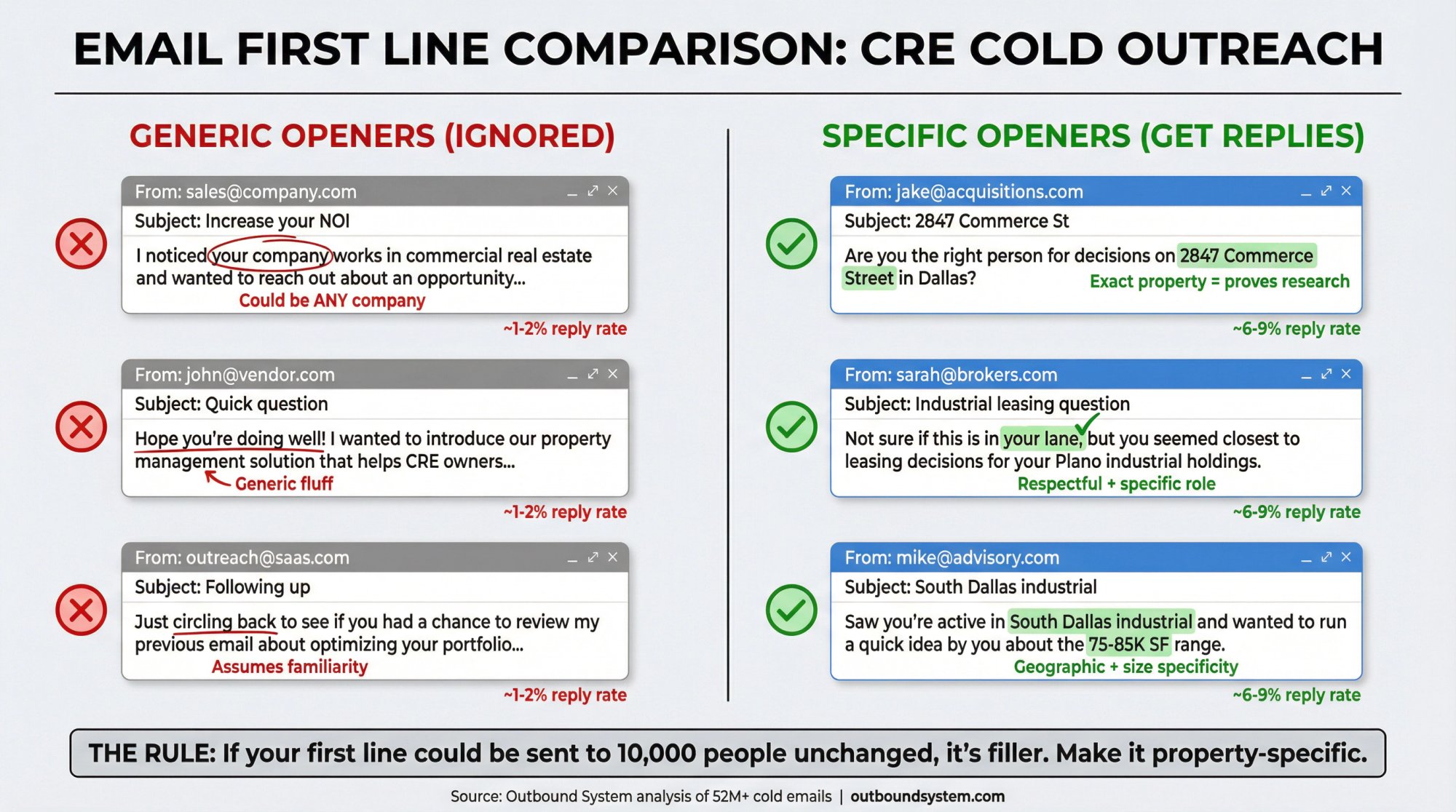
At Outbound System, we've analyzed millions of cold emails. The pattern is clear: generic openers get ignored. Specific openers get replies.
CRE-specific first-line patterns you can use safely:
Pattern 1: The "Property Anchor"
• *"Are you the right person for decisions on {property_address}?"*
• "I'm reaching out about your {submarket} {asset_type} holdings."
Pattern 2: The "Role Respect"
• "Not sure if this is in your lane, but you seemed closest to {topic} at {company}."
Pattern 3: The "Trigger Without Creep"
• "Saw you're active in {submarket} and wanted to run a quick idea by you."
If your first line could be sent to 10,000 people unchanged, it's not a first line. It's filler. Rewrite it.
Best Subject Lines for Commercial Real Estate Cold Emails
CRE subject lines win when they look like a normal internal email: short, specific, boring.
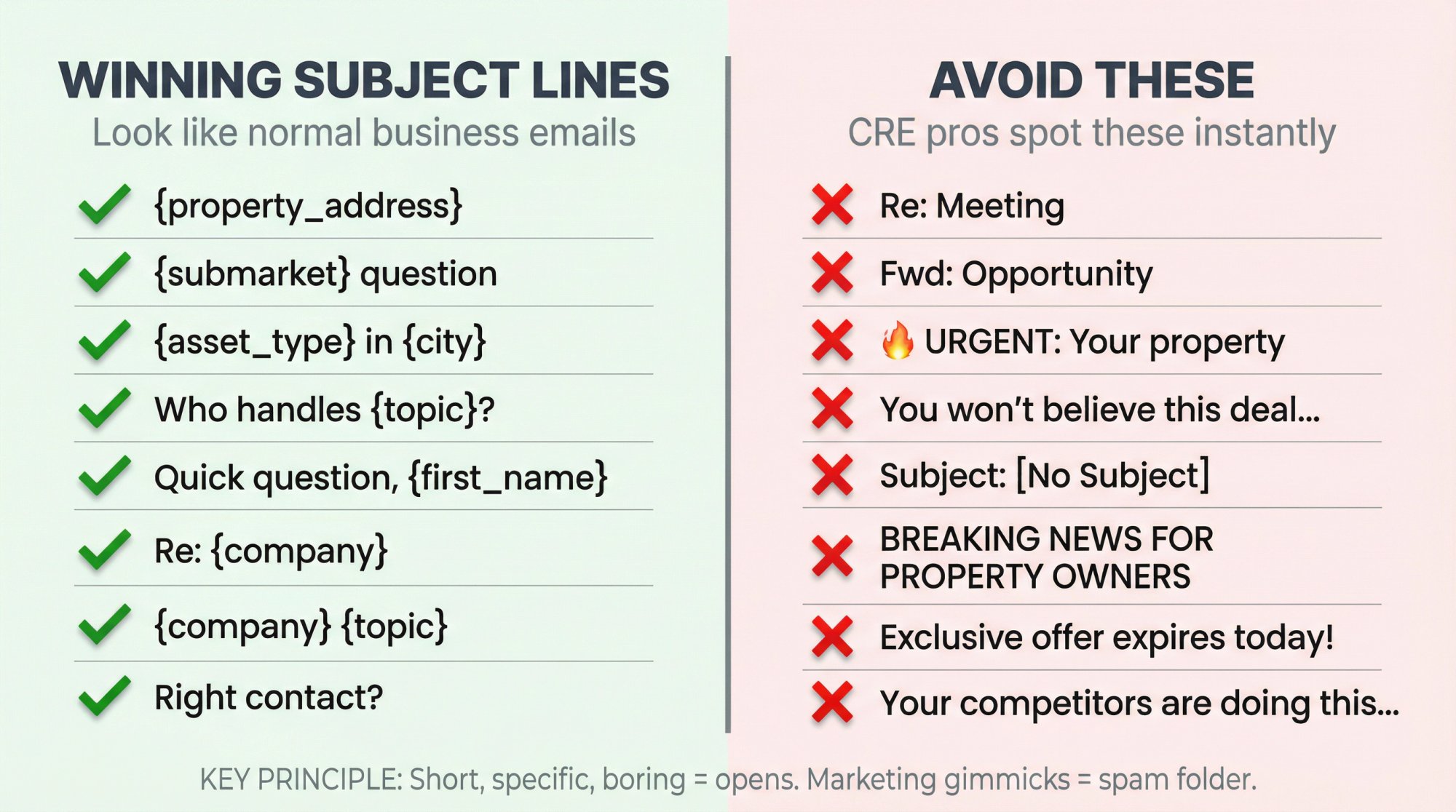
Use:
• {property_address}
• {submarket} question
• {asset_type} in {city}
• Who handles {topic}?
• Quick question, {first_name}
• Re: {company}
• {company} {topic}
• Right contact?
Avoid:
Don't use fake reply tricks (Re:/Fwd: when it's not true). Google explicitly warns against misleading headers and subjects.
Keep it simple. CRE professionals can spot marketing gimmicks from a mile away.
How Outbound System Handles CRE Cold Email at Scale
If you want to run cold email sequences like the one above but don't want to manage the infrastructure, data, and optimization yourself, that's exactly what we built Outbound System to do.
Here's how we handle commercial real estate cold email for clients:
Complete Infrastructure Management
We run 350 to 700 Microsoft U.S. IP inboxes (depending on your plan), all authenticated with SPF, DKIM, and DMARC. This distributed sending architecture keeps your emails out of spam and maintains high deliverability even at scale.
Why Microsoft infrastructure? Because shared IP pools are a gamble. When you share IPs with thousands of other senders, one bad actor tanks everyone's reputation. Private infrastructure gives you control.
Our system delivers 98% inbox placement across our client base.
9-Step Waterfall Enrichment for Data Quality
Bad data kills cold email campaigns. Hard bounces damage sender reputation. Wrong contacts waste your time.
We use a 9-step waterfall enrichment process that combines multiple data vendors with rule-based verification. Every contact gets:
• Syntax validation
• SMTP ping verification
• Historic bounce data analysis
• Engagement signal evaluation
The goal: minimize hard bounces and maximize reply probability by ensuring contact accuracy before we send email one.
AI Personalization + Human Copywriting
We don't use templates. We combine human-written copy (establishing core value proposition and structure) with AI-powered personalization (generating prospect-specific lines based on data, company info, and triggers).
This approach delivers 2.8x higher response rates compared to template-based outreach.
For CRE specifically, we pull personalization hooks like:
• Property addresses and asset types
• Recent portfolio activity (acquisitions, dispositions, lease signings)
• Submarket trends relevant to their buildings
• Role-specific pain points (operating expense optimization for PMs, lease-up challenges for leasing managers)
Every email feels hand-written because it basically is.
Real Results from CRE and B2B Clients
We've sent 52 million+ cold emails for 1,000+ B2B companies and generated 127,000+ leads that turned into $26 million in closed revenue.
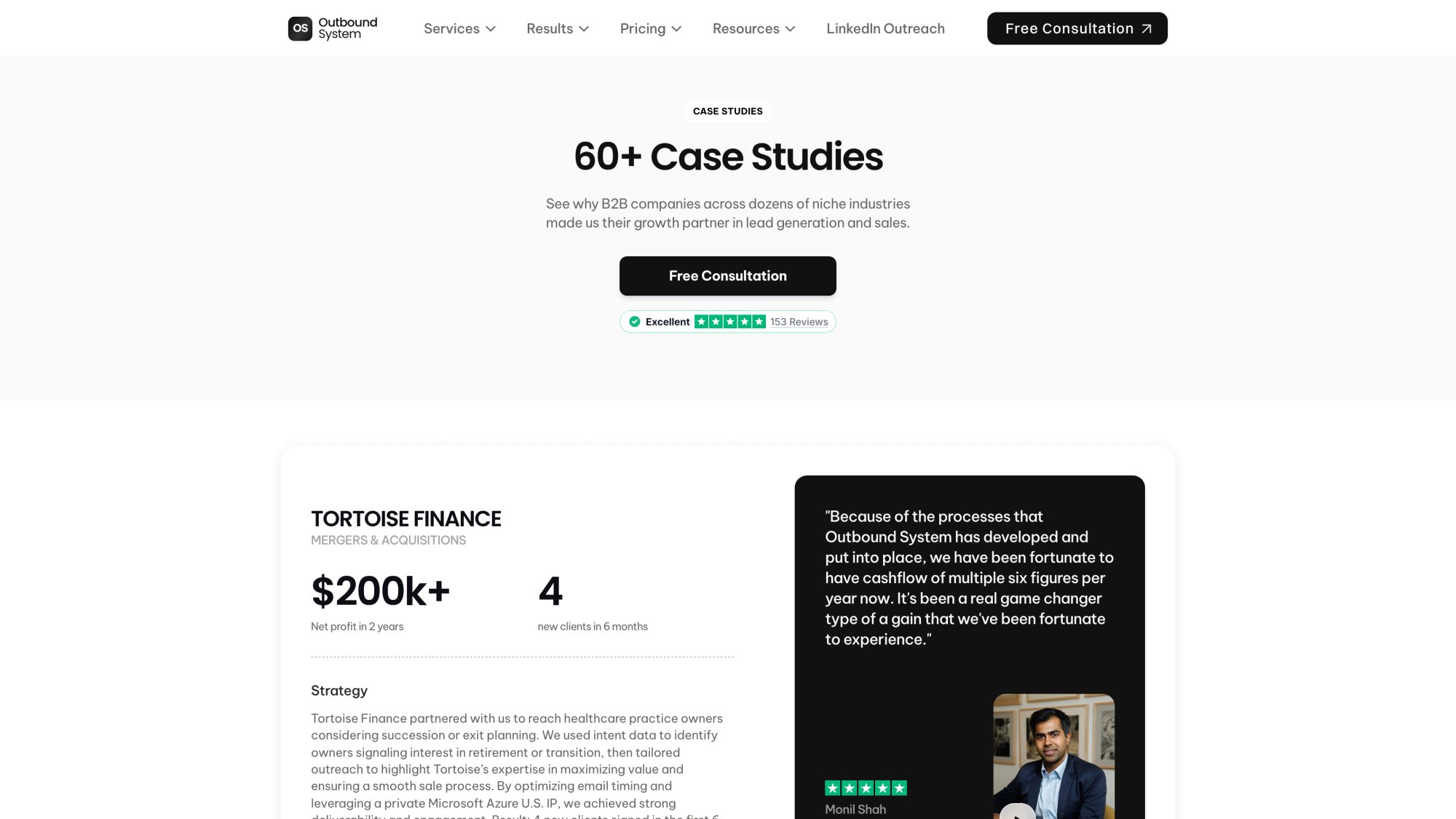
Case study examples:
Client | Results |
|---|---|
Enterprise GenAI SaaS Company | 28 qualified meetings in 7 months, $2.4M pipeline |
M&A Advisory Firm | $200K+ realized net profit in 2 years, 4 new clients in 6 months |
You can see 50+ detailed case studies here.
Transparent Pricing, No Long-Term Contracts
We run month-to-month. You're not locked in.
Plan | Monthly Price | Emails per Month | Contract |
|---|---|---|---|
Starter | $1,499/month | Up to 15,000 | Month-to-month |
Growth | $2,499/month | Up to 30,000 | Month-to-month |
Scale | $3,999/month | Up to 60,000 | Month-to-month |
Both plans include:
• AI personalization + human copywriting
• 9-step waterfall enrichment
• Unified inbox for managing replies
• Real-time metrics dashboard
• Direct CRM integrations
• A/B testing
• Dedicated account strategist
If you want to go deeper on the technical setup (domains, authentication, warming), we've documented everything:
• Cold Email Infrastructure Setup: Complete Guide
• DMARC/DKIM/SPF Cold Email Setup Guide
• CAN-SPAM Cold Email Requirements (2026 Guide)
Or just book a free 15-minute consultation and we'll walk you through exactly how we'd build your CRE outbound system.
What to Measure in Your CRE Cold Email Campaign
Ignore Open Rates as Your Primary KPI
Apple Mail Privacy Protection can download remote content in the background and hide IP addresses. This makes open rates noisy and unreliable.
At Outbound System, we recommend optimizing for replies and meetings, not opens.
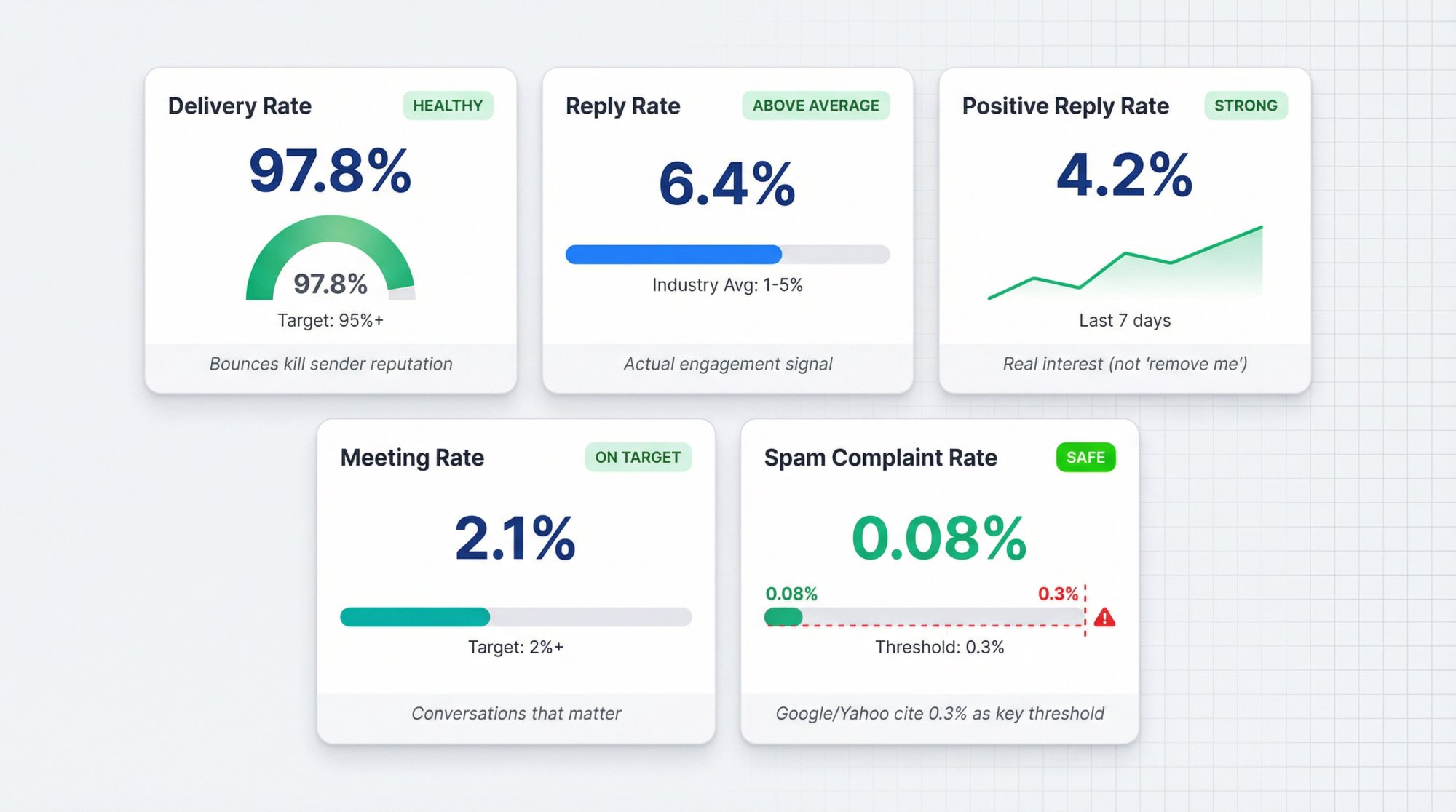
Track These Instead
Metric | Why It Matters |
|---|---|
Delivery rate | Bounces kill your sender reputation |
Reply rate | Actual engagement signal |
Positive reply rate | Real interest (not "remove me") |
Meeting rate | Conversations that matter |
Spam complaint rate | Google and Yahoo cite 0.3% as a key threshold |
If your spam complaint rate creeps above 0.3%, you're in dangerous territory. Fix your targeting, offers, and list quality before you keep sending.
Best Time to Send Cold Emails for CRE
There's no universal "best time," but you need a strong default to start testing from.
Our analysis of 16.5 million cold emails across 2024 showed Thursday had the highest reply rate in that dataset.
If you want a clean CRE default:
• Send Tuesday to Thursday
• Start with morning local time (8-10 AM in prospect's timezone)
• Then test two other time buckets (early afternoon, late afternoon)
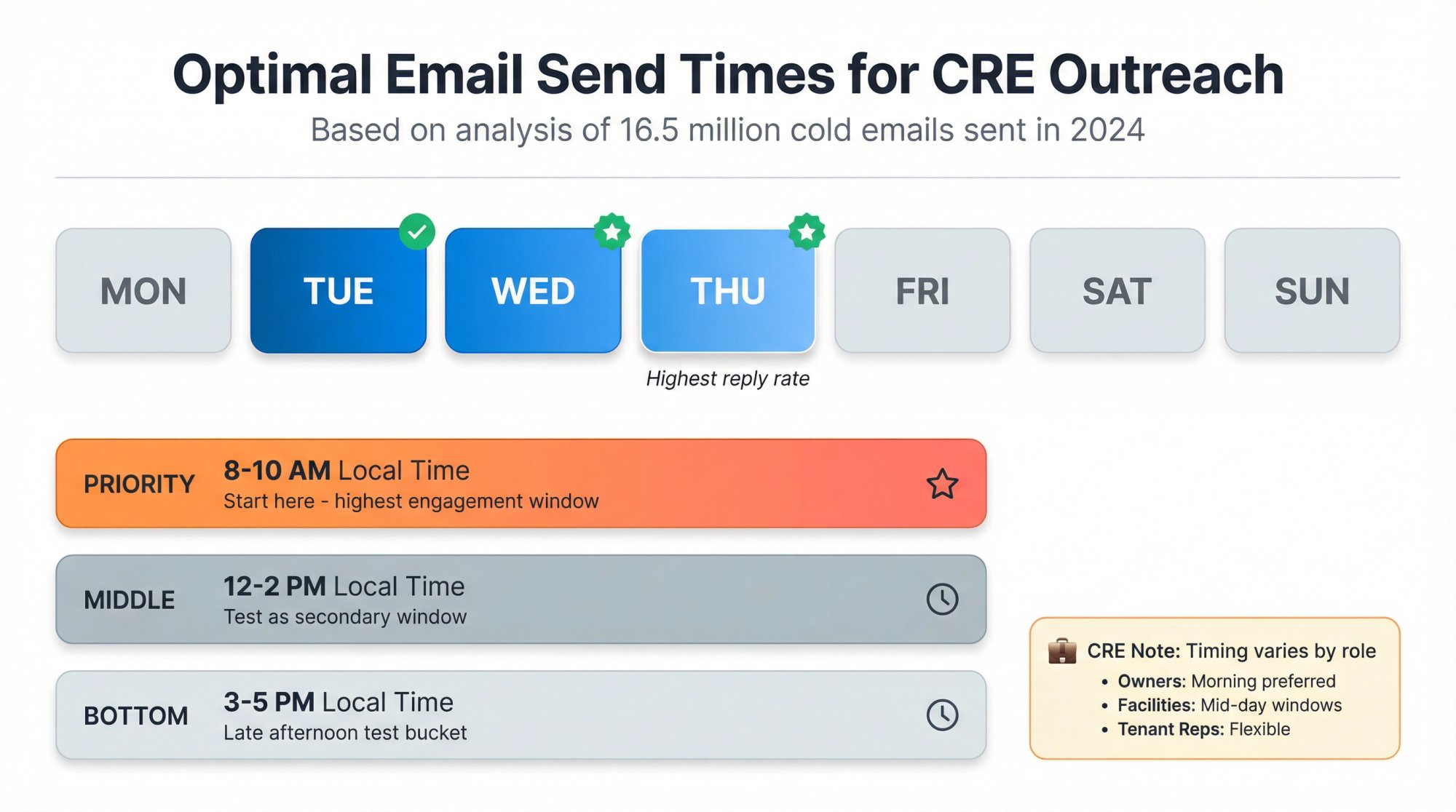
Don't overfit to one study. CRE audiences vary (owners vs. facilities directors vs. tenant reps operate on different schedules). Test, measure, optimize.
Frequently Asked Questions
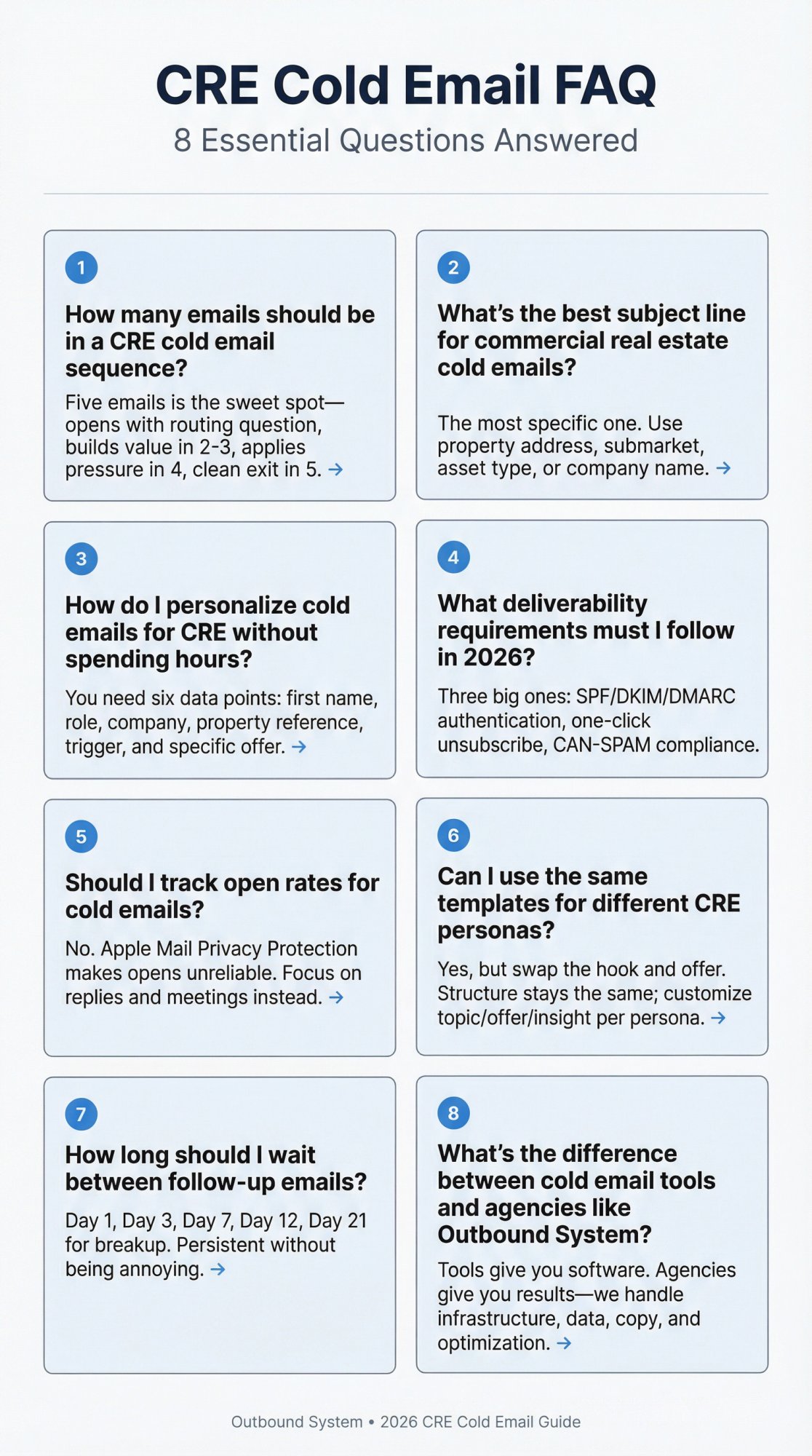
1. How many emails should be in a CRE cold email sequence?
Five emails is the sweet spot.
Email 1 opens the conversation with a routing question or tiny ask. Emails 2-3 provide value and build credibility. Email 4 applies polite pressure with a redirect request. Email 5 is the clean exit (the breakup email).
Going beyond 5 emails risks annoying prospects and hurting your sender reputation. Stopping at 2-3 emails leaves opportunities on the table (many people need multiple follow-up touches before they respond).
2. What's the best subject line for commercial real estate cold emails?
The best subject line is the most specific one.
Use the property address, submarket, asset type, or company name. Examples: {property_address}, {submarket} question, {asset_type} in {city}.
Avoid generic marketing language. CRE professionals can spot mass emails instantly. Make it look like a normal business email, not a campaign blast.
3. How do I personalize cold emails for CRE without spending hours?
You need six data points:
First name
Role
Company
Property or portfolio reference
Trigger or reason to reach out
Your specific offer
Get these six right and you can run effective personalization at scale. Lead enrichment tools like Sales Navigator, ZoomInfo, or enrichment services (or Outbound System's 9-step enrichment process) can automate most of this.
The key is making the first line and the offer feel property-specific, not generic.
4. What deliverability requirements must I follow in 2026?
Three big ones:
• Authentication (SPF, DKIM, DMARC): Required by Google (5k+/day threshold), Yahoo, and Microsoft for high-volume senders.
• One-click unsubscribe: Required for bulk marketing emails.
• CAN-SPAM compliance: Physical address, working opt-out, no deceptive headers.
If you're sending outside the US, add CASL (Canada), GDPR (EU), and UK regulations to the list.
This isn't optional. Miss these and your emails hit spam or get rejected outright.
5. Should I track open rates for cold emails?
No. Focus on replies instead.
Apple Mail Privacy Protection makes open rates unreliable (downloads remote content in the background, inflating opens). Track reply rate, positive reply rate, and meeting rate instead. These are real engagement signals.
6. Can I use the same templates for different CRE personas?
Yes, but swap the hook and offer.
The structure (5-email sequence with routing, value, insight, redirect, breakup) works across personas. But:
• For owners: offer comps, valuations, buyer profiles
• For property managers: offer operating expense audits, fee comparisons
• For leasing managers: offer tenant demand data, rent positioning
• For facilities directors: offer savings estimates, risk audits
Customize the topic, offer, and insight to match what each persona cares about.
7. How long should I wait between follow-up emails?
Use this cadence:
• Email 1: Day 1
• Email 2: Day 3 (2 days later)
• Email 3: Day 7 (4 days later)
• Email 4: Day 12 (5 days later)
• Email 5: Day 21 (9 days later, the breakup)
This spacing feels natural. You're persistent without being annoying. Adjust based on your industry norms, but this is a solid default.
8. What's the difference between cold email tools and agencies like Outbound System?
Tools give you software. Agencies give you results.
Cold email tools provide sending infrastructure. You handle:
• Data sourcing and enrichment
• Copywriting and personalization
• Domain setup and authentication
• Inbox warming
• Campaign optimization
• Reply management
Outbound System handles all of that for you. We run the infrastructure (350-700 Microsoft IPs), source and verify the data (9-step enrichment), write and personalize the copy (AI + human), and book the meetings directly into your calendar.
You get 98% inbox placement and 6-7% response rates without managing any of the technical complexity.
If you have time and technical expertise, tools can work. If you want predictable pipeline without the operational headache, that's what our cold email agency is built for.
Ready to Scale CRE Cold Email the Right Way?
You now have the five-email sequence, the CRE personalization framework, and the 2026 deliverability requirements you need to run effective cold email outreach in commercial real estate.
But knowing the strategy and executing at scale are two different things.
If you want us to run this end-to-end for you (infrastructure, data, copy, optimization, booking), book a free 15-minute consultation with Outbound System. We'll show you exactly how we'd build your CRE outbound pipeline.
We've sent 52 million+ cold emails, generated 127,000+ leads, and helped clients close $26 million in revenue. We know what works in B2B sales in 2026.
And we run it month-to-month. No long-term contracts. No risk.
Let's turn your CRE cold email from a shot in the dark into a predictable meeting-generation system.