You're sitting on deals worth millions. Problem is, so are your competitors. And right now, they're in the inbox of the same business owner you're trying to reach.
M&A deal sourcing in 2026 isn't about who has the best network anymore. It's about who shows up first, with the right message, in a crowded inbox. Outbound System has run cold email campaigns for M&A advisors like Tortoise Finance, helping them sign 4 new sell-side clients in 6 months and add over $200,000 in annual profit. That didn't happen by accident.
This guide will show you exactly how to use cold email to source deals, sign clients, and fill your pipeline without sounding like every other advisor flooding inboxes with generic "we have buyers" spam. You'll get the frameworks, templates, compliance fundamentals, and real numbers you need to build a system that works.
Why M&A Deal Sourcing with Cold Email Works in 2026
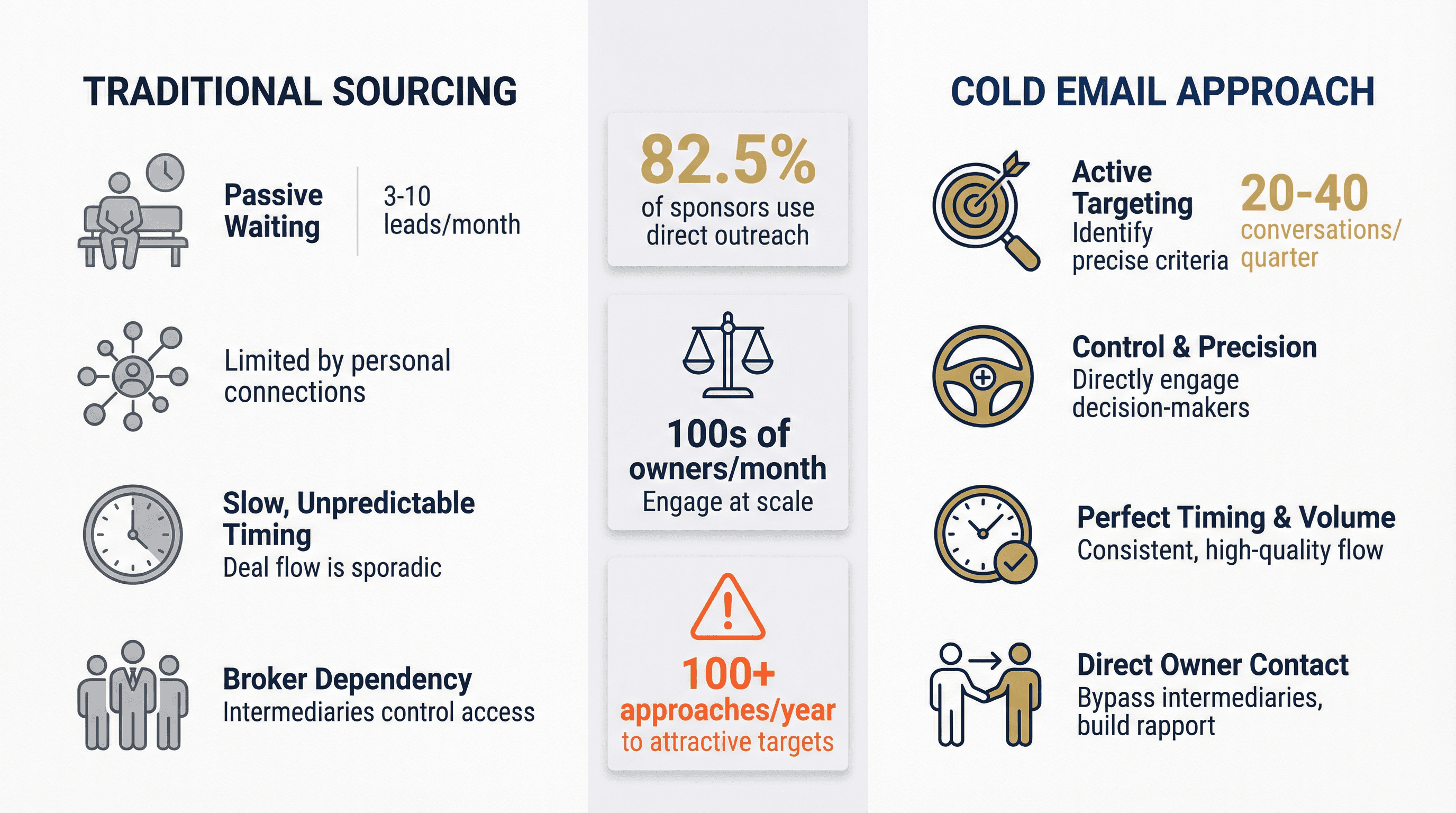
Let's start with reality. 82.5% of independent sponsors use direct owner outreach as part of their deal origination strategy. Not networking. Not broker relationships. Direct outreach.
Why? Because proprietary deals beat competitive processes every single time. When you contact an owner directly, you're finding opportunities that aren't listed on marketplaces, aren't represented by brokers, and haven't been shopped to 15 other buyers. One investor put it perfectly: "Proprietary is the slowest, but has the highest probability and best fit" for successful closes.
Cold email gives you three things traditional sourcing can't:
→ Scale.
You can reach hundreds of qualified owners per month. A traditional advisory might generate 3-10 leads monthly through referrals alone. With systematic outreach, you can add 20-40 conversations per quarter from owners you specifically targeted.
→ Control.
You're not waiting for deals to come to you. You're actively hunting the exact companies that fit your criteria. Want to focus on healthcare practices with retiring owners? Industrial manufacturers in the Midwest? SaaS companies at $5-15M revenue? You pick, you reach out, you control the pipeline.
→ Timing.
You catch owners at the right moment. Maybe they just hit a growth milestone and are considering options. Maybe they're burned out and ready to explore an exit. When you're reaching out consistently, you'll eventually hit them when the timing is right. Research shows that companies with 20+ years of operating history are far more likely to be salable, and 80% of businesses that start never sell at all. Target smart, reach out proactively, and you'll find the ones that actually matter.
But there's a dark side to this. Business owners in attractive sectors get approached over 100 times per year by PE firms, advisors, and brokers. Industry analysis calls it an "unprecedented wave of unsolicited offers" hitting founders' inboxes. Your email needs to stand out, or it's just more noise.
What Makes M&A Cold Email Different from B2B Sales
Selling M&A advisory services via cold email isn't like selling software subscriptions. The stakes are higher, the skepticism is sharper, and the mistakes are more expensive.
Here's what makes M&A outreach uniquely hard:
Sophisticated, skeptical audience
You're not emailing mid-level managers. You're emailing CEOs, founders, and business owners who've built something valuable. They've seen every angle. A template email triggers instant deletion. Generic flattery gets ignored. They know what you're trying to do, and they're evaluating whether you're legit or just another cold caller looking for a commission.
Trust and confidentiality concerns
Owners worry about word getting out. If employees, competitors, or partners hear they're considering a sale, it can blow up deals before they start. They're cautious about responding to unsolicited approaches because they don't know if you're credible, if you'll keep things confidential, or if you're just going to shop their company to a dozen unqualified buyers without permission.
Extreme competition and outreach fatigue
Companies that fit the M&A sweet spot get hammered. Multiple emails per week from different advisors, PE shops, and corporate development teams. Many owners just ignore everything. Industry research notes that most bankers and brokers use the same playbook (explaining historically high valuations and generic buyer interest). Owners have heard it all. Your message needs to be different.
Long sales cycles and timing
Even if an owner is interested, M&A isn't a one-call close. They might reply "Maybe in a year or two." Or "Thanks, not ready now." This isn't rejection. It's reality. Part of your job is nurturing relationships over months or years, being there at the right moment. Some deals you source via cold email today won't close for 12-18 months.
But here's the thing. Despite these challenges, cold email works. It just has to be done right.
2024+ Cold Email Deliverability Requirements You Can't Ignore
Before we talk about what to say, let's talk about whether your emails will even land in the inbox. Starting in early 2024, Gmail, Yahoo, and Microsoft rolled out stricter requirements for bulk senders. Ignore these and your emails go to spam. Period.
Here's what changed:
Gmail requirements
Google now requires SPF or DKIM authentication for all senders. If you're sending 5,000+ emails per day to Gmail addresses, you need SPF, DKIM, and DMARC authentication. You also need one-click unsubscribe for marketing messages, and you must keep spam complaint rates below 0.3% in Postmaster Tools.
Yahoo requirements
Yahoo's sender requirements are nearly identical. Authentication is mandatory. Bulk senders need SPF, DKIM, and DMARC pass with alignment. Spam rates must stay under 0.3%. You need a list-unsubscribe header with one-click capability, a visible unsubscribe link, and you must honor unsubscribes within 2 days.
Microsoft requirements
Microsoft announced similar requirements for domains sending more than 5,000 emails daily to outlook.com, hotmail.com, and live.com addresses. SPF, DKIM, and DMARC (at least p=none) are required, plus unsubscribe and list hygiene guidance.
Provider | Authentication | Spam Rate Limit | Unsubscribe |
|---|---|---|---|
Gmail | SPF or DKIM (bulk: all 3) | <0.3% | One-click for marketing |
Yahoo | SPF/DKIM (bulk: all 3 + alignment) | <0.3% | One-click + 2-day honor |
Microsoft | SPF/DKIM/DMARC for 5K+ daily | Not specified | Guidance provided |
Why this matters for M&A specifically:
Inbox providers judge you by signals, not intentions. They can't tell you're a legitimate M&A advisor. They see patterns:
• Authentication. Are you who you say you are?
• Complaint rate. Do recipients hate your mail?
• Bounces. Are you emailing garbage addresses?
• Engagement. Do people reply, or do they delete and report spam?
M&A cold email often fails because it looks like impersonation. Vague identity, generic "we have buyers" language, no clear value. When owners don't recognize you and your email feels off, they hit "spam." Once that happens enough times, you're fighting an uphill battle with every inbox provider.
Real benchmarks: What good looks like
Reply rates vary wildly based on targeting, offer, and trust signals. But here are the numbers from recent research:
Execution Level | Reply Rate Range | Description |
|---|---|---|
Baseline | 1-4% | Industry average for B2B cold email campaigns |
Solid execution | 6-10% | Strong targeting, proper infrastructure, good messaging |
Elite execution | 10%+ | Tight targeting, real relevance, strong trust signals |
Industry benchmarks show average reply rates of 1-4% across B2B cold email campaigns.
Recent analysis of millions of cold emails sent between January and December 2024 reported an average reply rate of 5.8% (down from 6.8% in 2023).
Outbound System's 2026 data shows clients achieving 6-7% response rates through proper targeting, infrastructure, and messaging.
Also worth noting: Research shows that emails without open tracking perform better. Translation: focus on replies and meetings, not open rates. (More on why later.)
How to Build Your M&A Target List (Quality Over Quantity)
Any successful M&A email campaign starts with targeting. You can't email every business owner in America and hope for deals. You need a focused list of prospects who actually fit what you do.
Here's how to build that list:
Define your ideal client profile
Be specific. Not "business owners." More like:
• Industry: HVAC, dental practices, specialty manufacturing, SaaS, distribution, etc.
• Size: Revenue and EBITDA bands you actually serve (e.g., $5-50M revenue)
• Ownership structure: Founder-owned, family-owned, PE-backed
• Geography: Where you can realistically close deals
• Complexity: Regulated industries, multi-location, specific niches
• Trigger events: Reasons they might respond now (retirement age, expansion, consolidation)
Research shows that data quality accounts for 60% of the success rate of a campaign. A well-chosen, clean list of 200 perfect-fit contacts will beat a scraped list of 2,000 semi-relevant contacts every time.
Use M&A-specific trigger events
The best outreach targets owners who have a reason to consider options now. Look for:
• Founder age and succession signals: Owners nearing retirement, transition language in interviews or bios
• Expansion signals: New locations, recent acquisitions, major hiring pushes
• Financial tightening: Layoffs, refinancing activity, cash flow challenges
• Lifestyle cues: Business milestones, "stepping back" language in LinkedIn posts
• Sector consolidation: PE roll-ups in their industry, recent competitor acquisitions
• Regulatory pressure: Healthcare changes, compliance requirements, industry shifts
For example, Outbound System helped Tortoise Finance (an M&A advisory firm) target healthcare practice owners showing signs of retirement and succession planning. The campaigns used intent data to identify owners visiting pages about exit options, then tailored outreach around maximizing value and smooth sale processes. Result: 4 new clients signed in 6 months.
Follow the 1-2 contacts per company rule
Industry data explicitly shows that blasting 10+ contacts per company correlates with lower reply rates compared to reaching just 1-2 decision-makers per company. Owners hate carpet bombing. It signals you don't know who to talk to, and it makes you look desperate.
Target the CEO, founder, or owner directly. Sometimes the president or managing partner. Avoid generic info@ addresses. Get personal emails whenever possible.
Verify everything
Use email verification tools to validate addresses before sending. Hard bounces kill your sender reputation. Multiple sources emphasize that emailing the wrong person or using bad data makes deal sourcing exponentially harder. Spend the extra time ensuring accuracy. It pays off in higher response rates and better deliverability.
Sources to build from
LinkedIn Sales Navigator, industry associations, licensing boards, trade show exhibitor lists, local business journals, and niche databases specific to your vertical.
Mix and match. No single source has everything. The more sources you cross-reference, the better your data quality. Outbound System uses 9-step waterfall enrichment to ensure maximum accuracy.
4-Sentence Cold Email Framework That Gets M&A Replies
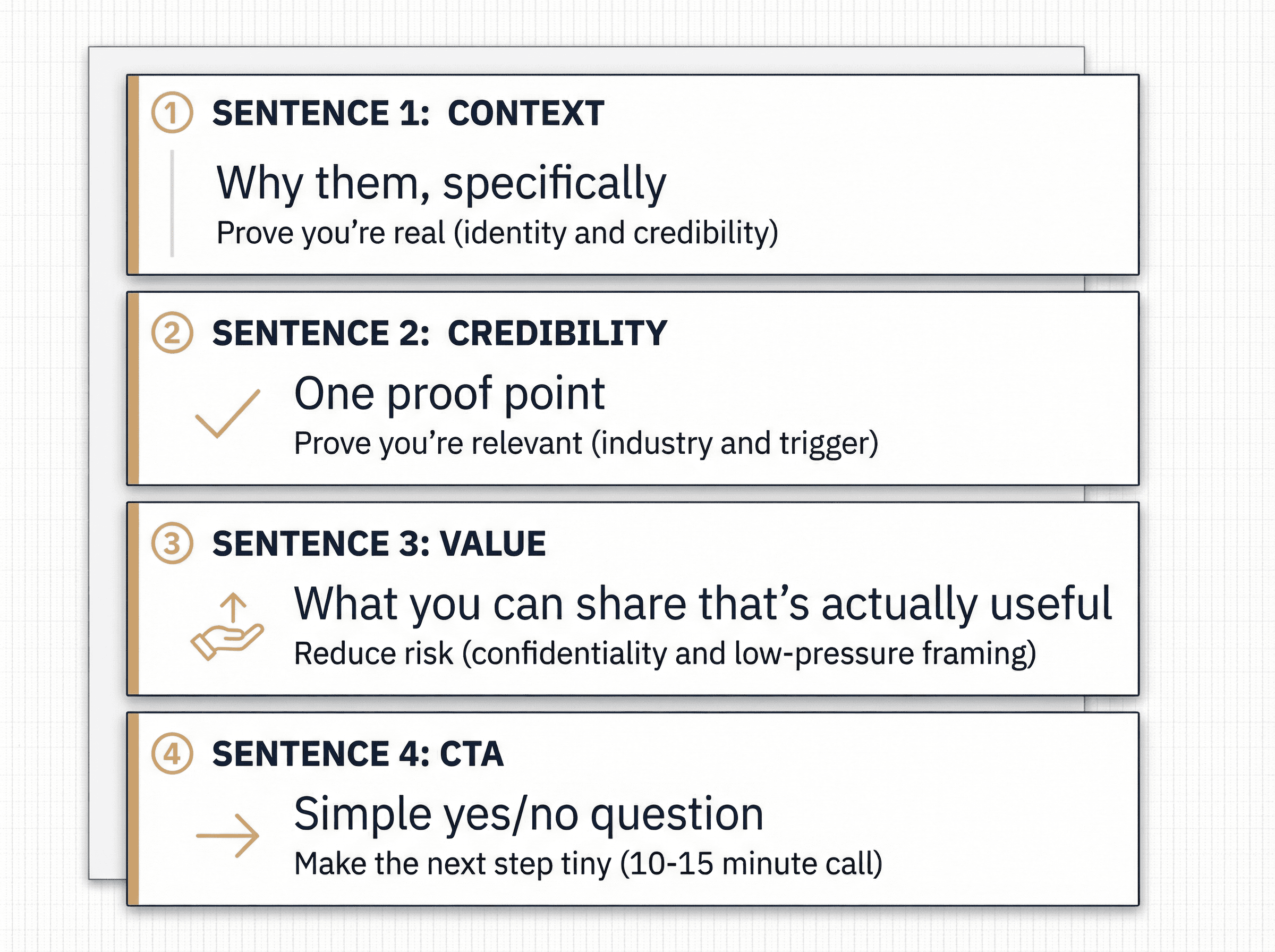
Your cold email needs to do four things fast:
① Prove you're real (identity and credibility)
② Prove you're relevant (industry and trigger)
③ Reduce risk (confidentiality and low-pressure framing)
④ Make the next step tiny (10-15 minute call, or "worth a chat?")
Here's the structure:
→ Sentence 1 (Context): Why them, specifically
→ Sentence 2 (Credibility): One proof point (niche focus beats big logos)
→ Sentence 3 (Value): What you can share that's actually useful
→ Sentence 4 (CTA): Simple yes/no question
Keep it short. Research shows that emails with 6-8 sentences and under 200 words performed best. Your goal isn't to sell. It's to earn a reply.
Subject lines that get opened
Keep them under 50 characters. Make them specific to the recipient. Avoid clickbait and salesy language.
Examples that work:
• "Quick question, [Company Name]"
• "Succession planning"
• "[Industry] valuation question"
• "Confidential question"
• "Is [Company] considering options?"
Tie it to the company or owner. Make it feel tailored, not blasted. Industry experts note that owners can spot templates instantly. The subject line is your first test.
Opening lines that prove you're real
The first line of your email must be highly personalized. Reference something specific about the company or owner:
• "Noticed you expanded to [city] recently"
• "Saw [Company] was featured in [Publication] for [specific achievement]"
• "Your niche is consolidating. [Competitor] just got acquired by [Buyer]"
• "You serve [specific customer type], which is exactly where buyers are paying premiums"
It has to mention something specific to the target. You need personalized compliments or observations that prove you did your homework, not generic praise like "Loved your website" or "Congrats on your success." Owners have seen that 10,000 times.
The value proposition (what's in it for them)
After proving you're real, tell them what you can offer:
For sell-side: "We help [industry] owners explore exit options and maximize valuation. Our last client in your space achieved a 7x EBITDA valuation, well above initial expectations."
For buy-side: "We represent a group looking to partner with successful [industry] companies to help them scale. One partner company doubled revenue in 2 years while maintaining operational efficiency."
Social proof matters. Case studies and specific results make your offer tangible. Avoid vague promises. Be concrete.
Call to action that lowers friction
End with a simple ask:
"Would you be open to a 15-minute call next week to discuss whether now might be a good time to explore options for [Company]?"
"If not, I completely understand. Happy to be a resource whenever the timing is right."
"You can also grab a spot on my calendar here: [link]"
Offer flexibility. Acknowledge they're busy. Give them an easy out while making it simple to say yes. Industry experts advise using action verbs and suggesting specific next steps.
4-Email Follow-Up Sequence That Closes M&A Meetings
Most cold email success comes from follow-ups, not first emails. Plan for 2-3 follow-ups for prospects who don't respond. Here's the cadence we recommend:
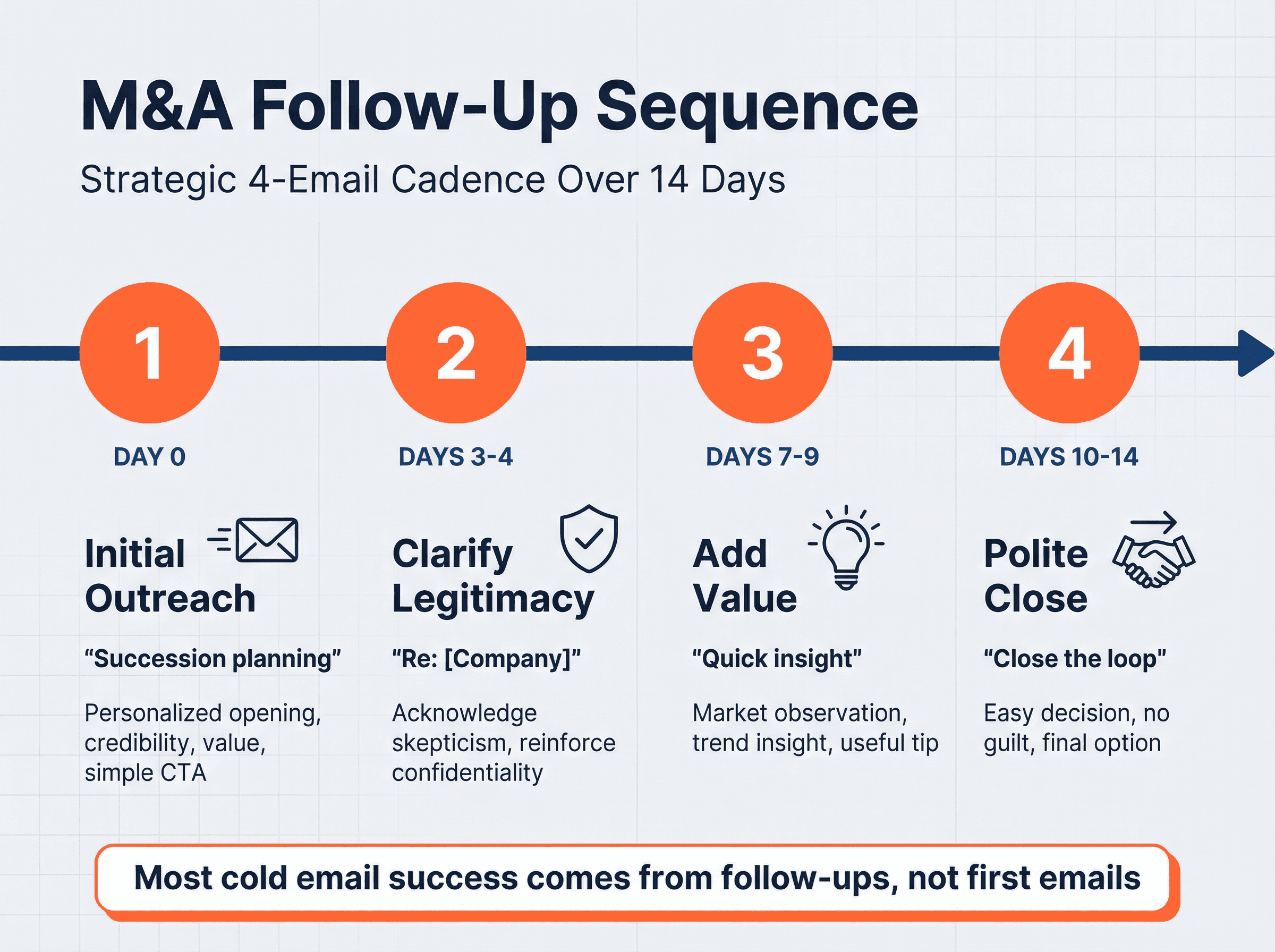
Email 1: Initial outreach
Use the 4-sentence framework. Personalized opening, brief credibility, clear value, simple CTA.
Example:
Subject: Succession planning
Hi [First Name],
Noticed [personalization: specific milestone, recent news, industry development].
We work with [industry] owners when they want a clear view of valuation and exit options, even if they're not selling soon. We just guided another [industry] founder through a sale to a Fortune 500, achieving a 9-figure valuation.
If you've ever considered what a liquidity event might look like for [Company], we could provide a confidential assessment and connect you with pre-vetted buyers who value companies like yours.
Open to a 12-minute call next week, or should I disappear?
Email 2 (3-4 days later): Clarify legitimacy, reduce risk
Keep it short. Acknowledge skepticism. Reinforce confidentiality.
Subject: Re: [Company]

Just bumping this, [First Name].
Totally get that M&A outreach can feel spammy. We're not shopping your business and I'm not asking for financials over email.
If you ever plan to step back in 12-36 months, having a baseline valuation and exit readiness plan usually saves owners a lot of money and stress.
Worth a short call, or not a priority this year?
Email 3 (7-9 days later): Add value (small insight)
Give them something useful. A market observation, a trend insight, a brief tip.
Subject: Quick insight
[First Name], one thing I'm seeing in [industry]:
[1-2 sentence insight: consolidation trend, buyer preference, common value driver]
If you want, I can send a short summary of what buyers care about most for [industry] deals right now.
Want me to send that?
Email 4 (10-14 days later): Polite close
Give them an easy decision. Don't guilt trip.
Subject: Close the loop

Last note from me, [First Name].

Should I (a) send a valuation/comps snapshot outline for [industry] owners, or (b) close the file?
Either answer is helpful.
Why this works: It's built around trust, low pressure, and clear next steps. No fake urgency. No "we have a buyer" when you don't. Just professional persistence. Learn more about follow-up tactics.
M&A Cold Email Templates You Can Use Right Now
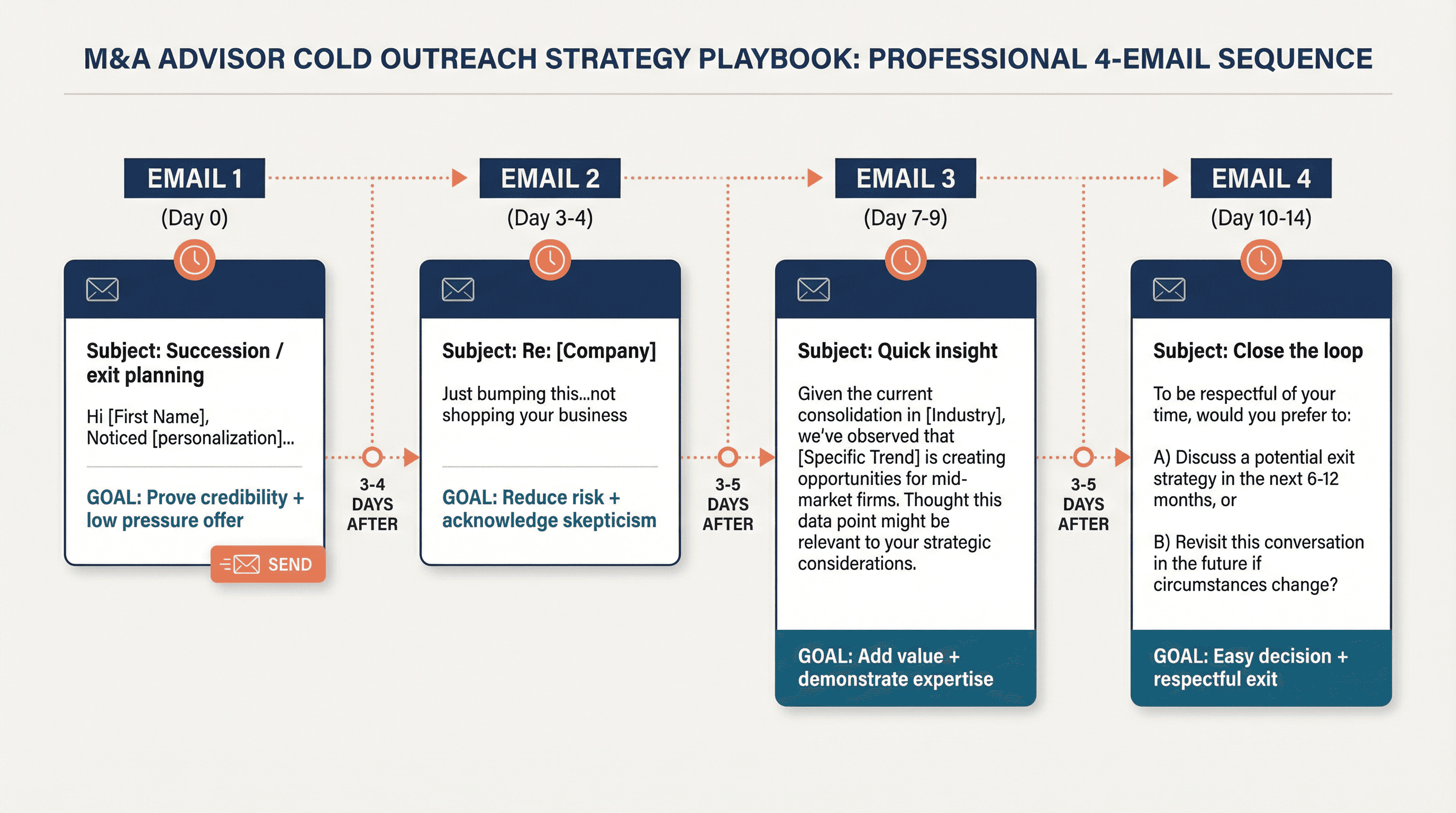
Below are full template sets for three scenarios. Don't just copy-paste. Adapt them to your voice and your targets.
Sell-side/exit planning template set
Subject line options:
"Quick question, [Company]"
"Succession / exit planning"
"[Industry] valuation question"
"Confidential question"
"Is [Company] considering options?"
Email 1 (Initial):
Email 2 (3-4 days later):
Email 3 (7-9 days later):
Email 4 (10-14 days later):
Buy-side sourcing template set
Use this when you're looking for acquisition targets on behalf of a buyer. Critical: Don't claim you have a buyer if you don't. Be honest.
Email 1 (Clean and honest):
Email 2 (5-7 days later):
Email 3 (7-9 days later):
Referral partner template set
CPAs, wealth managers, estate attorneys, and commercial bankers can be huge deal flow sources. Lead with how you behave, not what you want.
Email 1:
Email 2 (5-7 days later):
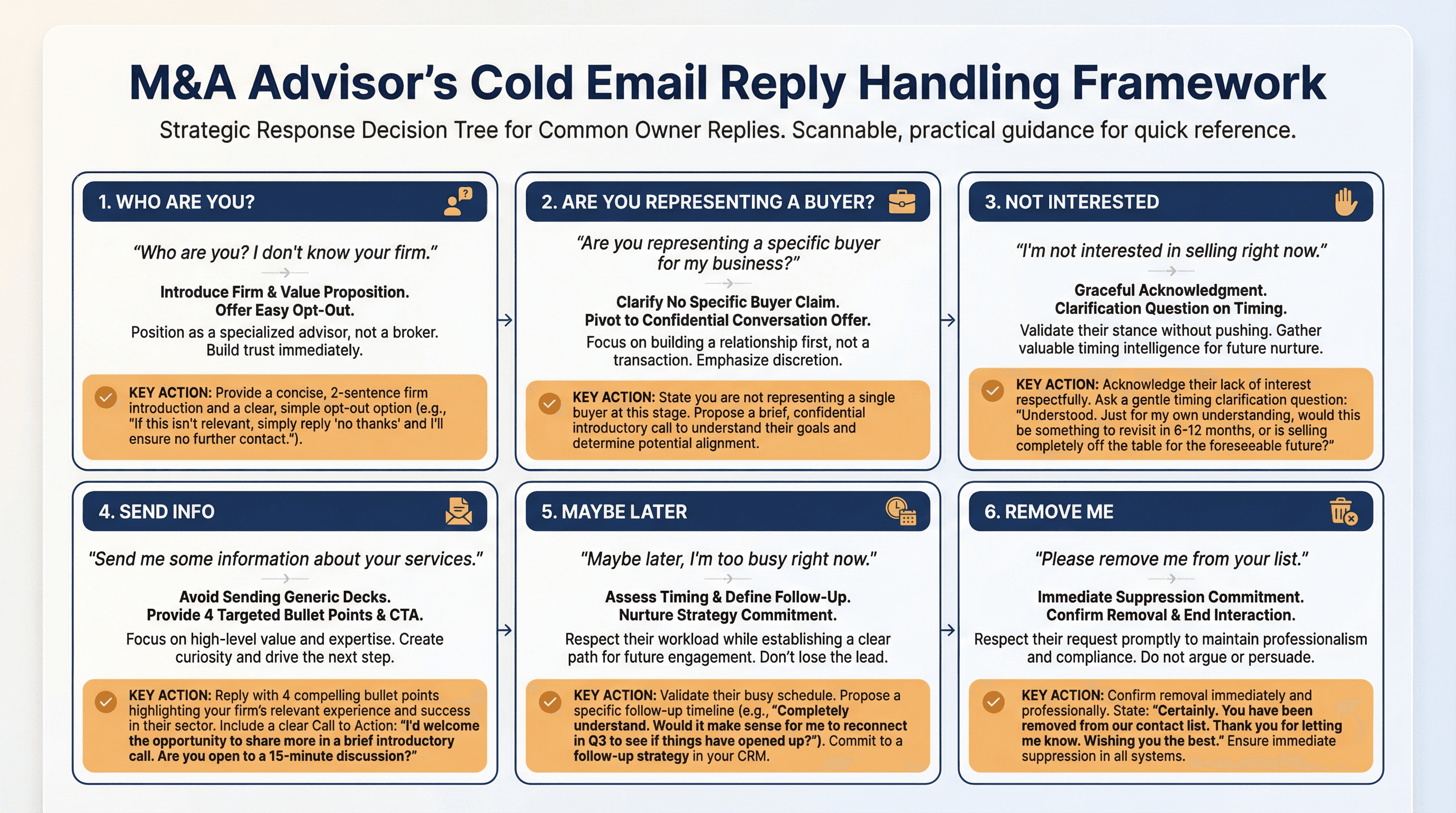
How to Handle Cold Email Replies (Where Deals Get Made)
In M&A, replies often look like this:
"Not interested"
"Who are you / what firm?"
"Are you representing a buyer?"
"Send info"
"Maybe later"
"Remove me"
You need prepared responses that don't argue, don't dump pitch decks, and don't sound desperate. Here's how to handle each:
"Who are you?"
"Are you representing a buyer?"
"Not interested"
"Send info"
Don't send a deck. Send 4 bullets.
"Remove me"
Then actually suppress them. If you don't, you deserve the spam report.
Cold Email Personalization That Actually Works (vs Fake Flattery)
Fake personalization:
"Loved your website"
"Congrats on your success"
"I saw your LinkedIn post"
Owners have seen this 10,000 times. It signals you didn't actually research anything.
Real personalization (choose one):
• "Noticed you expanded to [City]"
• "Saw you hired a CFO recently"
• "Your niche is consolidating. [Competitor] just got acquired"
• "You serve [specific customer type], which is exactly where buyers are paying premiums"
• "You're licensed in [State] and a lot of owners there are thinking about succession"
The goal isn't flattery. It's proof you did your homework. Industry experts emphasize that business owners spot templates instantly. Personalization must be genuine.
Cold Email Compliance Rules for M&A Advisors (CAN-SPAM, CASL, GDPR)
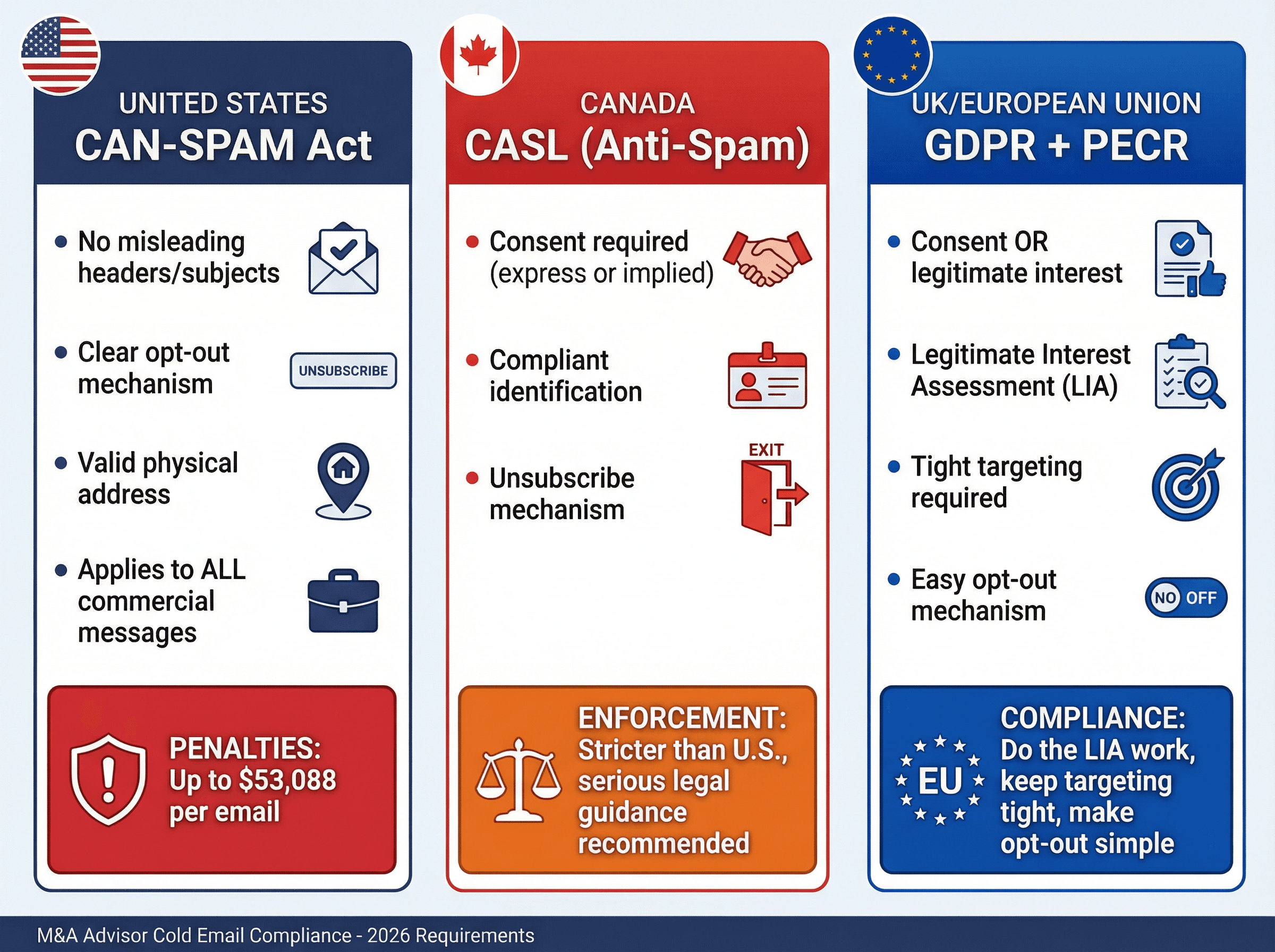
I'm not your lawyer. But here's the baseline you need to know:
United States: CAN-SPAM
The FTC makes it clear CAN-SPAM applies to all commercial messages, including B2B. Requirements include:
• No misleading headers or subjects
• Clear opt-out mechanism
• Valid physical postal address
• Penalties can be up to $53,088 per email for violations
Practical takeaway: Always include a simple opt-out line ("Reply 'no' and I'll stop") and follow it. Include your company address in your signature. Learn more about compliance.
Canada: CASL
Canada's anti-spam law is stricter. Consent matters (express or implied in limited cases). You need compliant identification and unsubscribe mechanisms.
Practical takeaway: If you're emailing Canadian recipients, get serious legal guidance and be conservative. Don't wing it.
UK/EU: GDPR + PECR
The UK ICO explains that in B2B marketing contexts, the most relevant lawful bases under UK GDPR are consent and legitimate interests. PECR may require consent in some cases.
The European Data Protection Board has issued guidance on legitimate interest assessments, including in direct marketing contexts.
Practical takeaway: Don't hand-wave "legitimate interest." Do the work (LIA), keep targeting tight, and make opt-out dead simple. Read about email outreach compliance.
Jurisdiction | Law | Key Requirement | Penalty Range |
|---|---|---|---|
United States | CAN-SPAM | No misleading info, clear opt-out, physical address | Up to $53,088/email |
Canada | CASL | Consent (express or implied), compliant ID, unsubscribe | Varies, strict enforcement |
UK/EU | GDPR + PECR | Legitimate interest or consent, opt-out mechanism | Varies, can be substantial |
How to Set Up Cold Email Deliverability Infrastructure
Here's the "do this or nothing else matters" list:
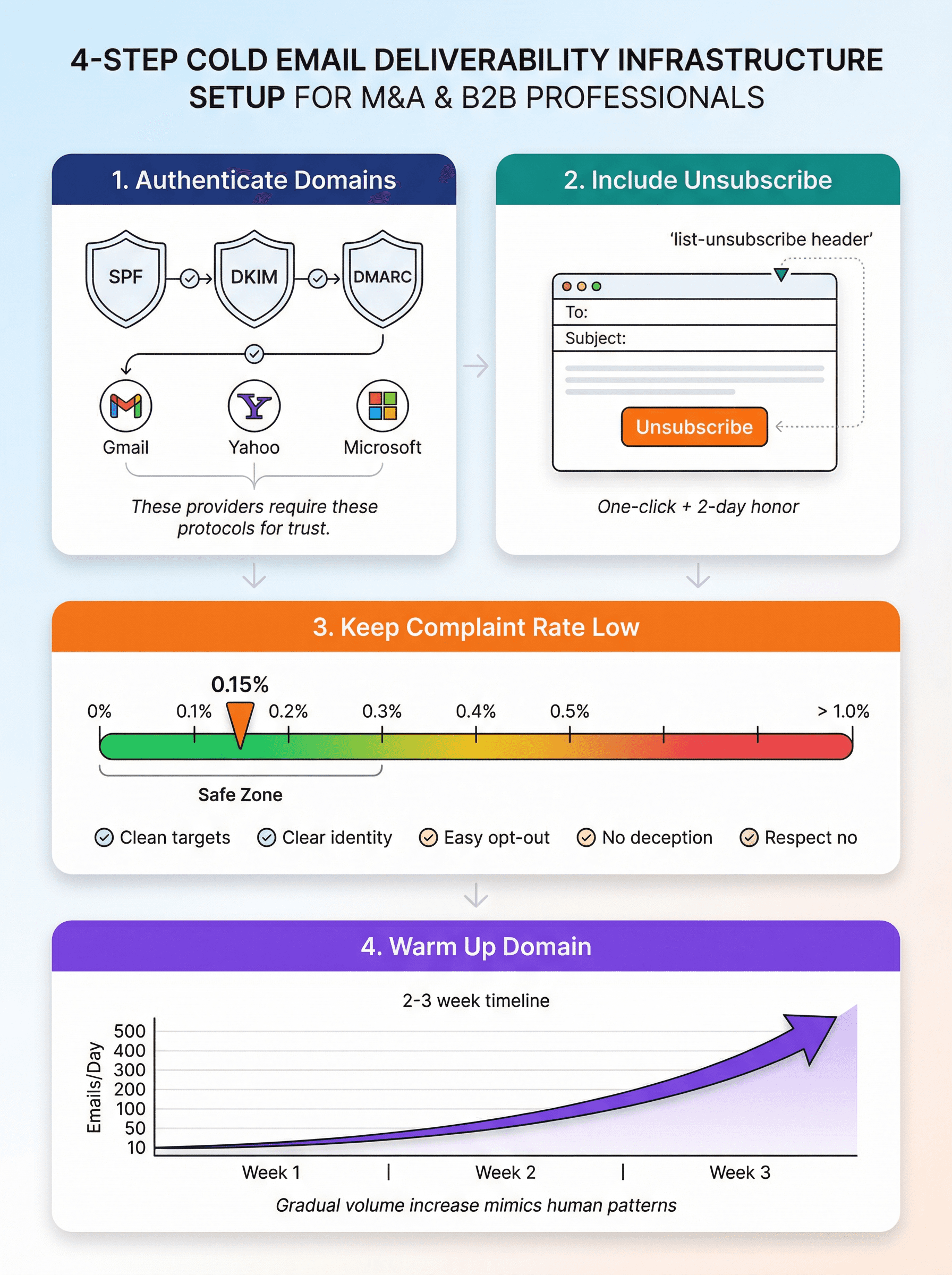
1. Authenticate domains (SPF, DKIM, DMARC)
Gmail requires SPF or DKIM for all senders. For bulk senders, SPF + DKIM + DMARC.
Yahoo requires authentication and for bulk senders includes DMARC pass with alignment.
Microsoft announced SPF/DKIM/DMARC requirements for high-volume senders to outlook.com.
Set these up before you send a single email. Your IT team or email service provider can help. Learn more about email authentication.
2. Include unsubscribe properly
Gmail: Marketing/subscribed messages must support one-click unsubscribe plus visible unsubscribe link (bulk senders).
Yahoo: List-unsubscribe header (one-click recommended) plus visible link plus honor within 2 days.
Even if you're doing one-to-one B2B outreach and technically not "bulk," it's good practice to include a simple opt-out line like: "If I reached the wrong person, just let me know and I won't bother you again."
3. Keep complaint rate low
Google explicitly calls out keeping spam rates in Postmaster Tools below 0.3%.
Yahoo also calls out spam rate below 0.3%.
How you actually keep complaint rate low:
• Email fewer, better targets
• No deception (fake "Re:" tricks, fake forwards, fake buyers)
• Clear identity and reason for outreach
• Easy opt-out
• Stop emailing people who said no
Learn more about reducing email bounce rates and email deliverability best practices.
4. Warm up and configure your sending domain
If you're sending substantial volume, don't blast from your everyday email account. Set up a dedicated domain or subdomain for outreach, authenticate it, and spend 2-3 weeks "warming up" by sending a few emails per day and gradually increasing.
Outbound System uses hundreds of private Microsoft Azure IP addresses to distribute sending across low-volume inboxes, mimicking natural human patterns. This approach helped Tortoise Finance achieve high deliverability while reaching healthcare practice owners at scale.
You don't need that level of infrastructure to start, but the principle matters: send from trusted infrastructure and avoid sudden spikes in volume. Learn about email warmup services.
What to Track: Cold Email Metrics That Actually Matter
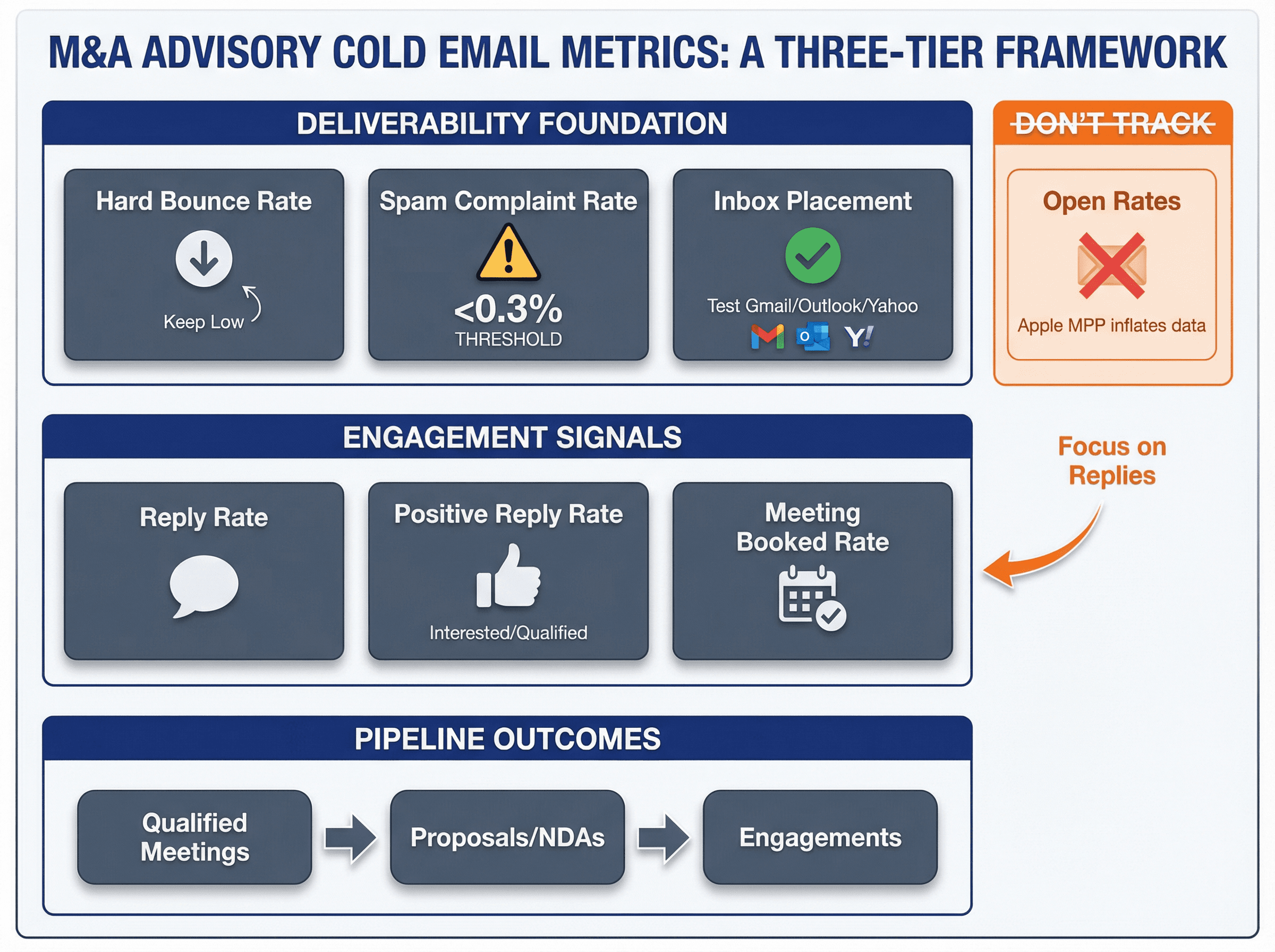
Track these metrics:
Deliverability
• Hard bounce rate (keep it low)
• Spam complaint rate (providers call out 0.3% as key threshold)
• Inbox placement (test across Gmail/Outlook/Yahoo)
Engagement
• Reply rate
• Positive reply rate (interested/qualified)
• Meeting booked rate
Pipeline
Qualified meetings leads to proposals/NDAs leads to engagements
Why open rates don't matter:
Apple's Mail Privacy Protection inflates open rates. Apple pre-fetches email content, so emails show as "opened" even if the recipient never read them. Industry research confirms that all emails sent to Apple Mail users will be reported as opened, regardless of whether the user actually opened the email.
Focus on replies and meetings. Those are real engagement signals. Read more about why you shouldn't track open rates.
M&A Cold Email Case Study: $200K+ in Annual Profit
Outbound System ran outreach for Tortoise Finance, an M&A advisory firm, targeting healthcare practice owners considering succession or exit planning. The approach:
• Used intent signals related to retirement and transition
• Tailored messaging around maximizing value and smooth sale processes
• Leveraged deliverability infrastructure (private Microsoft Azure US IP)
• Focused on building trust and reducing perceived risk
Result: 4 new sell-side clients signed in the first 6 months. $200,000+ net annual cashflow increase for Tortoise Finance over two years.
That's the core point: M&A outreach works when it's targeted, credible, and process-driven, not spammy. When you combine the right list, the right message, and the right infrastructure, you get results. Explore more case studies.
How to Start Cold Email for M&A in 14 Days
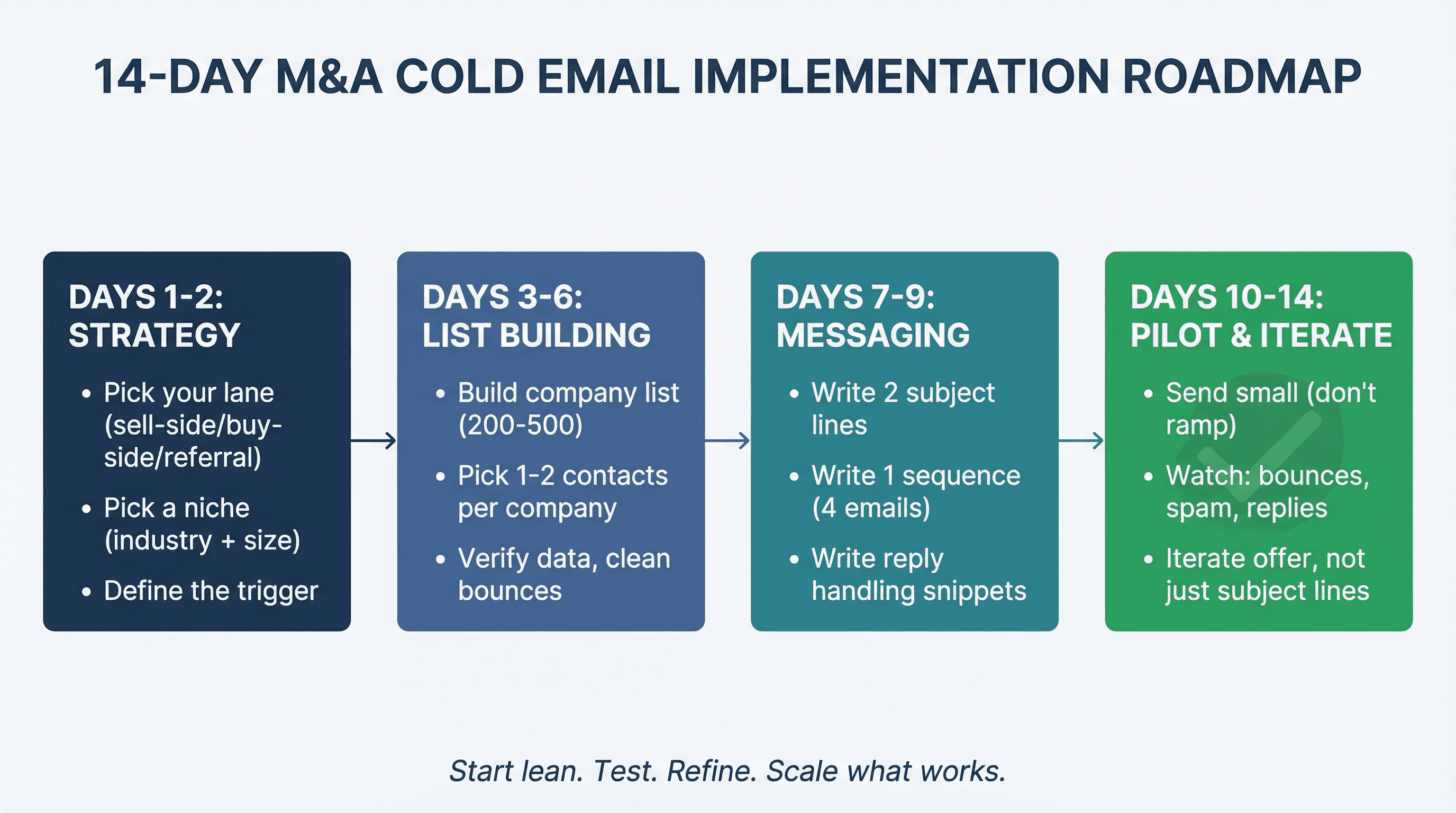
Want to start running M&A cold email campaigns? Here's how:
Days 1-2: Strategy
• Pick your lane (sell-side vs buy-side vs referral)
• Pick a niche (industry plus size band)
• Define the trigger you'll lead with
Days 3-6: List building
• Build company list (200-500 targets to start)
• Pick 1-2 contacts per company
• Verify data, clean bounces
Days 7-9: Messaging
• Write 2 subject lines
• Write 1 sequence (4 emails)
• Write reply handling snippets
Days 10-14: Pilot and iterate
• Send small (don't ramp to the moon)
• Watch: bounces, spam complaints, replies
• Iterate the offer, not just subject lines
Start lean. Test. Refine. Scale what works. Learn how to track your cold email campaigns.
Done-For-You Cold Email for M&A Advisors
Look, you can do all of this yourself. Or you can partner with a team that's done it hundreds of times.
Outbound System provides fully managed cold email, LinkedIn, and calling for B2B companies, including M&A advisors. We handle:
• Infrastructure: 350-700 Microsoft Azure US IP inboxes for high deliverability
• Data quality: 9-step waterfall enrichment and triple-verified emails
• Copywriting: Human-written sequences with AI personalization
• Strategy: Dedicated account strategist to optimize campaigns
• Compliance: Built-in unsubscribe handling and CAN-SPAM compliance
We've worked with advisors like Tortoise Finance to generate qualified sell-side client meetings, resulting in closed engagements and significant profit increases.
Why advisors choose us:
• You focus on closing deals, not managing sending infrastructure
• Month-to-month contracts (no long-term commitment)
• Transparent pricing starting at $1,499/month
• Real case studies with verifiable results
• Multi-channel approach (email, LinkedIn, calling)
Ready to fill your pipeline with qualified M&A conversations?
Book a 15-minute consultation to discuss your specific situation and see if we're a fit. No pressure, no pitch deck. Just a conversation about whether cold outreach makes sense for your firm.
Cold Email for M&A Advisors: FAQs
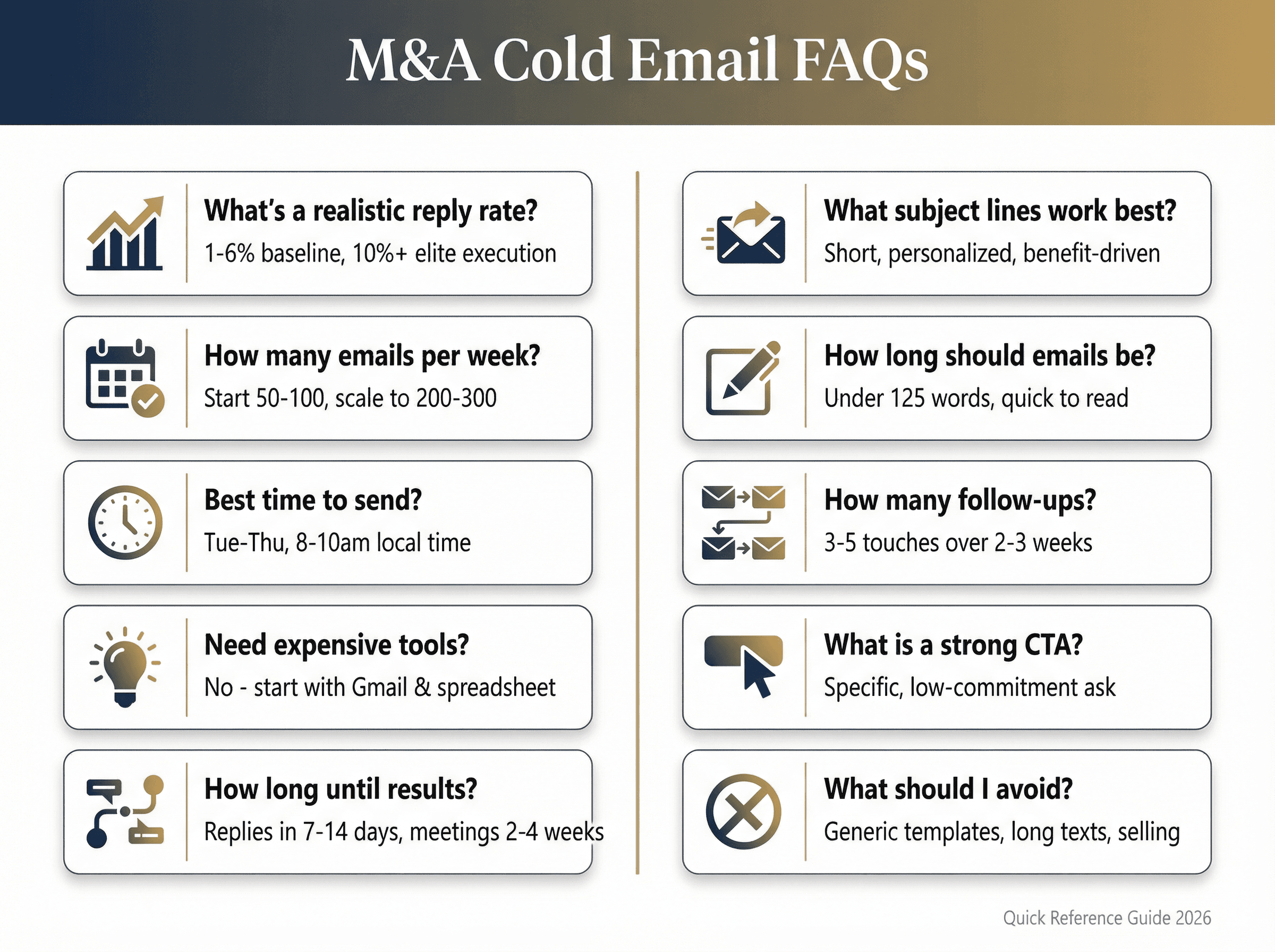
What's a realistic reply rate for M&A cold email?
Depends on your targeting and message quality. Industry benchmarks show 1-6% for baseline execution, 6-10% for solid execution, and 10%+ for elite execution with tight targeting and strong trust signals. M&A tends to be on the lower end initially because of owner skepticism, but the value per reply is exponentially higher than typical B2B sales.
How many emails should I send per week?
Start with 50-100 per week. Focus on quality over volume. Once you dial in your message and see positive replies, you can scale to 200-300 per week. Never blast thousands at once. It kills deliverability and looks desperate. Learn more about email sending volume.
Should I use my main company email or a separate domain?
If you're sending fewer than 50 emails per week, your main company email is fine (assuming proper authentication). If you're scaling up, set up a dedicated subdomain for outreach (e.g., if you're at advisors.com, use outreach.advisors.com or advisors-mail.com). This protects your main domain's reputation if something goes wrong. Learn about domain warmup.
How do I handle "not interested" replies?
Respond professionally: "All good. Appreciate the quick reply. Before I disappear: is it a 'not ever' or just 'not this year'?" This often opens a dialogue. If they confirm "not ever," thank them and remove them from your list. Some will clarify "not now," which means you can follow up in 6-12 months.
What's the best time to send M&A cold emails?
Mid-week mornings (Tuesday-Thursday, 8-10am local time) tend to perform best for B2B. But M&A owners check email at odd hours too. Test different times. More important than the hour is the day of the week. Avoid Mondays (inbox overload) and Fridays (people are mentally checked out). Read about the best time to send cold emails and best days to email.
Do I need expensive tools to start?
No. You can start with Gmail, a simple CRM, and a spreadsheet. As you scale, consider tools for email verification, sending automation, and tracking. But don't let tools stop you from starting. Outbound System provides fully managed infrastructure if you'd rather outsource it. Compare cold email agency vs in-house SDR.
How long until I see results?
First replies typically come within 7-14 days of your initial send. First meetings book within 2-4 weeks. First closed deals can take 3-12 months depending on your sales cycle. M&A is a long game. Don't expect instant closings. But you'll know within a month if your message resonates.
Should I hire someone or use a service like Outbound System?
If you have time to learn deliverability, compliance, copywriting, and list building, you can do it yourself. If you'd rather focus on closing deals and let specialists handle outreach, a service makes sense. Outbound System works with M&A advisors who want a predictable pipeline without managing infrastructure. Book a call to discuss your situation. Learn about cold email agency costs.
What about LinkedIn vs. email for M&A?
Both work. Email is more direct and scalable. LinkedIn is good for relationship-building and warming up cold prospects before emailing. Best approach: multi-channel. Email for initial outreach, LinkedIn for follow-up or nurturing, phone calls for high-priority targets. Outbound System offers integrated email + LinkedIn + calling campaigns for maximum coverage. Compare cold email vs LinkedIn outreach.
How do I avoid looking like spam?
Personalize every email. Use plain text (no fancy HTML). Keep it short. Lead with value, not your credentials. Include an easy opt-out. Send from authenticated domains. Target carefully (don't blast everyone). Follow up politely. And most importantly, actually be legitimate. If you're offering real value to the right people, you won't look like spam. Learn how to fix cold emails going to spam.
Take Action: Start Filling Your M&A Pipeline Today
M&A deal sourcing via cold email isn't a secret anymore. It's standard practice in 2026. The differentiation is in execution. Targeting the right owners, crafting messages that build trust, handling deliverability correctly, and following up persistently without being annoying.
You can build this yourself, or you can partner with a team that's done it 600+ times. Either way, the fundamentals are here. Start with a tight list, a strong offer, and a professional follow-up cadence. Test, measure, refine.
And if you want help, Outbound System is here. We've helped M&A advisors like Tortoise Finance fill their pipelines with qualified meetings and close significant engagements.
Book a 15-minute consultation and let's see if we're a fit.