
Searching for "Instantly alternatives" usually means you're dealing with one of these problems.
Your deliverability is tanking and you can't figure out why. The "cheap" tool turned expensive once you added domains, email accounts, and data credits. You're drowning in technical setup when you should be closing deals. Or you're running an agency and hitting hard limits on workspace management.
We run Outbound System, a done-for-you B2B outbound agency. So yes, we'll show you how services like ours compare to software. But this guide is built to be useful even if you never become a client.
Everything below uses publicly available data from late 2024 through late 2025. Pricing and features change constantly in this space, so always verify current details on vendor sites before making decisions.
Why Do People Search for Instantly Alternatives?
On the surface, "Instantly alternatives" sounds like a simple comparison shopping request.
Underneath, most people searching this are in one of five distinct situations:
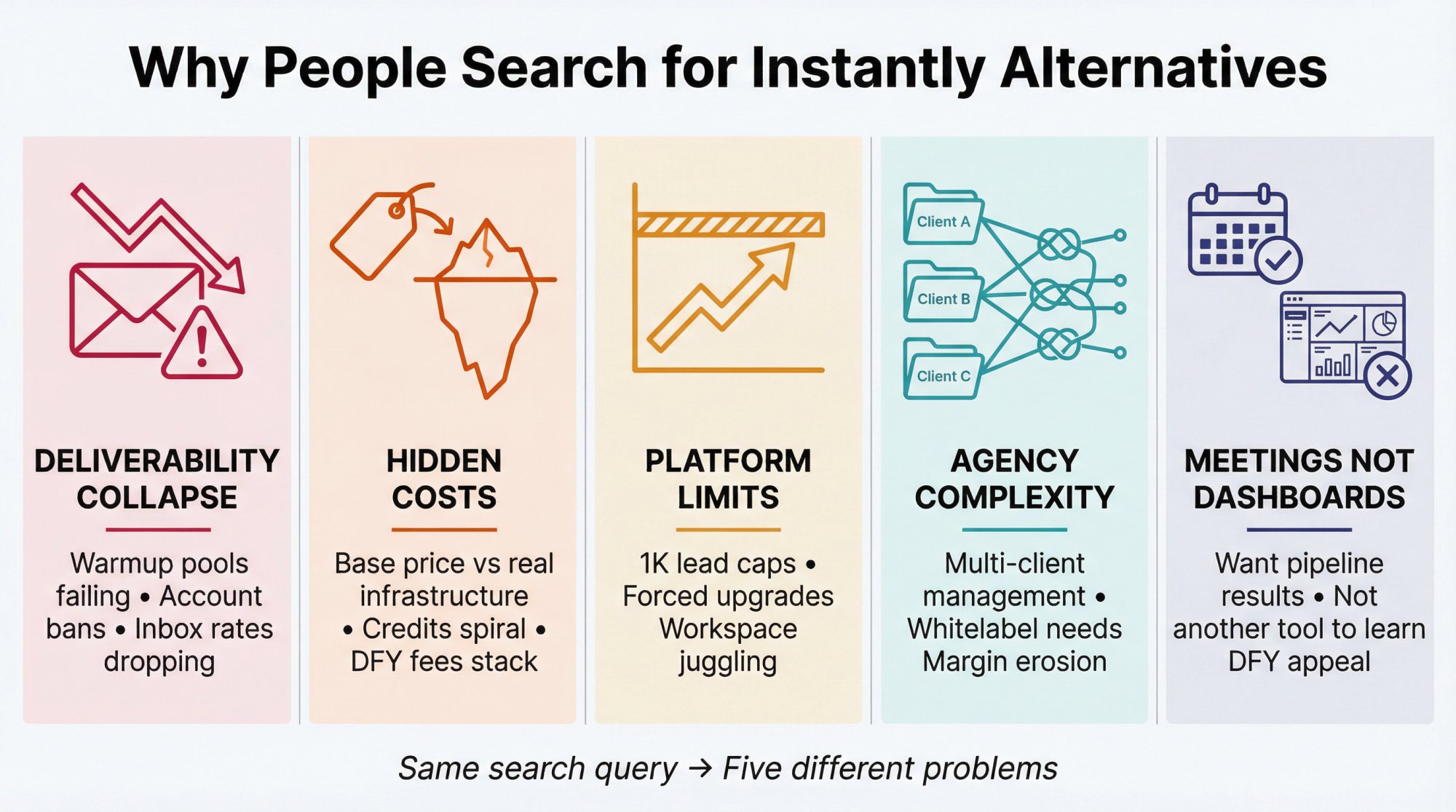
1. Deliverability is Collapsing
Your warmup pool isn't protecting you. Accounts are getting banned. Inbox placement drops after a few weeks of solid performance.
Reddit threads from 2025 show multiple users whose Instantly warmup and DFY accounts got suspended even at conservative volumes. Other users report that pooled warmup networks are taking hits from stricter Gmail and Yahoo enforcement in 2025.
2. The Real Cost is Way Higher Than Advertised
Pricing for cold email platforms often looks simple on the surface, but once you add the actual infrastructure (domains, email accounts, credits, possibly DFY services), monthly spend climbs far above sticker price.
Multiple 2025 cost breakdowns show how monthly expenses escalate sharply once you buy enough accounts and credits for serious volume. This is where understanding cold email infrastructure becomes absolutely critical.
3. You're Hitting Platform Limits
Growth plan users hit lead caps (1,000 saved leads per month on entry tiers). Then you need to upgrade, add external tools, or juggle multiple workspaces.
4. Agency Setups are Getting Complicated
Managing multiple clients requires:
→ Whitelabel capabilities
→ Unlimited inboxes without per-client upsells
→ Clean workspace separation
→ Predictable margins that don't erode with scale
Many tools push hard on agency use cases with unlimited inboxes. Platform providers are building VIP and DFY offerings to compete in this space.
5. You Want Meetings, Not Another Dashboard
Some buyers realize they don't want to become deliverability engineers, copywriters, and data scientists.
That's where service alternatives like Outbound System come in. You pay more than a tool subscription, but you offload 90% of the work.
The real job to be done isn't "swap Instantly for a random tool."
It's this: pick the right system to turn cold prospects into pipeline, with acceptable risk, workload, and cost.
The best "alternative" is whichever system actually delivers meetings, not just another dashboard to learn.
Which Instantly Alternative Should You Choose?
Before diving into specific tools, use this 2-minute filter.
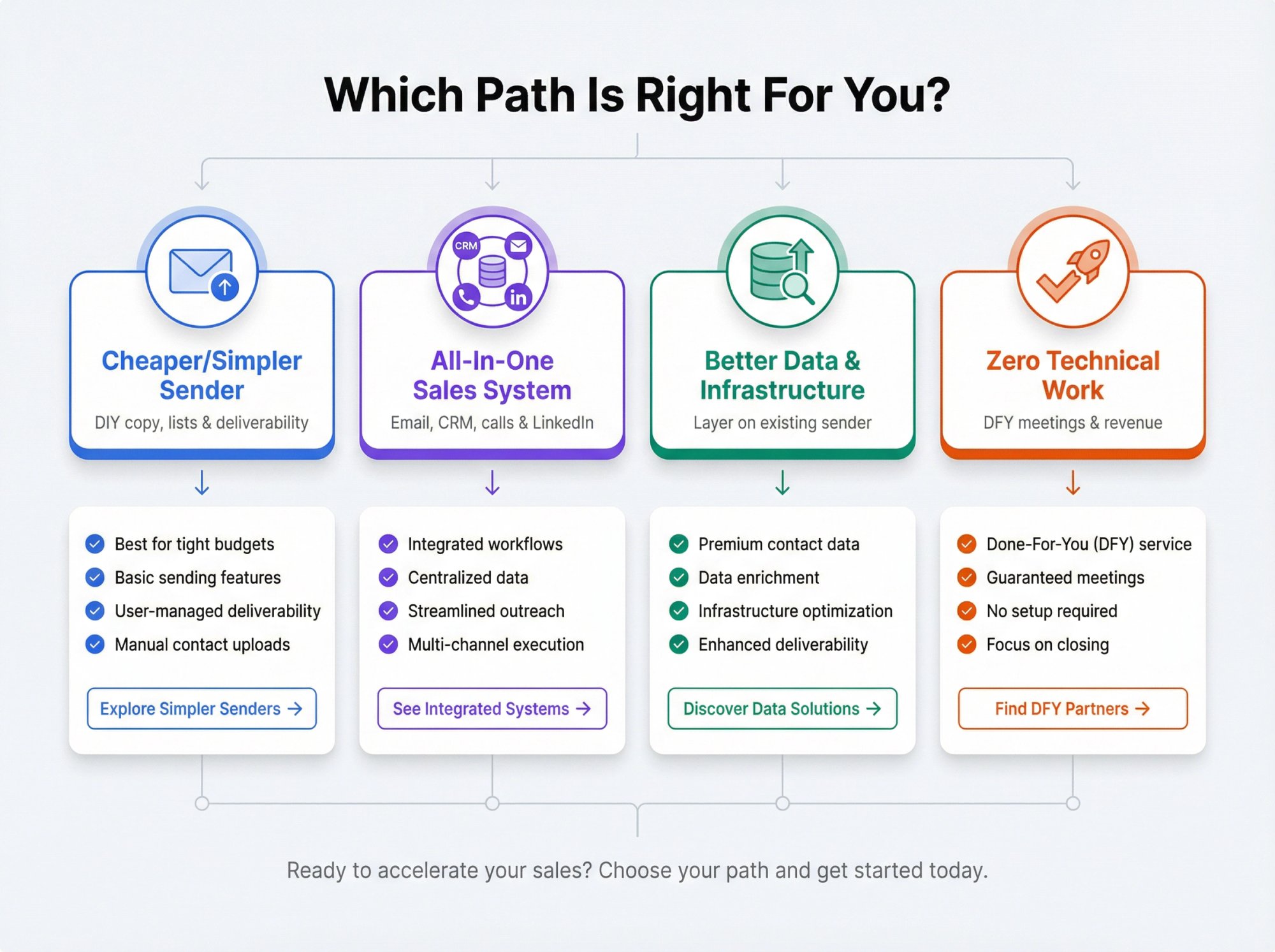
If you want:
A Cheaper or Simpler Sender
...and you're comfortable doing your own copy, lists, and deliverability work.
→ Look at various cold email sending platforms
An All-In-One Sales System
...with email, CRM, and sometimes calls or LinkedIn built in.
→ Look at sales engagement platforms with multiple channels
Better Data and Infrastructure
...on top of a sender you already like.
→ Look at data enrichment solutions and third-party warmup tools
Zero Technical Work with Booked Meetings
...and you care more about revenue than which tool runs under the hood.
→ Look at done-for-you outbound systems:
DFY versions of various platforms
Agencies like Outbound System, which build and run the entire cold email system including copy, data, infrastructure, and optionally LinkedIn outreach and cold calling
We'll cover all four paths in depth.
What Are Instantly's Strengths and Weaknesses?
You can't evaluate alternatives without understanding what Instantly actually does.
What Instantly Does Well
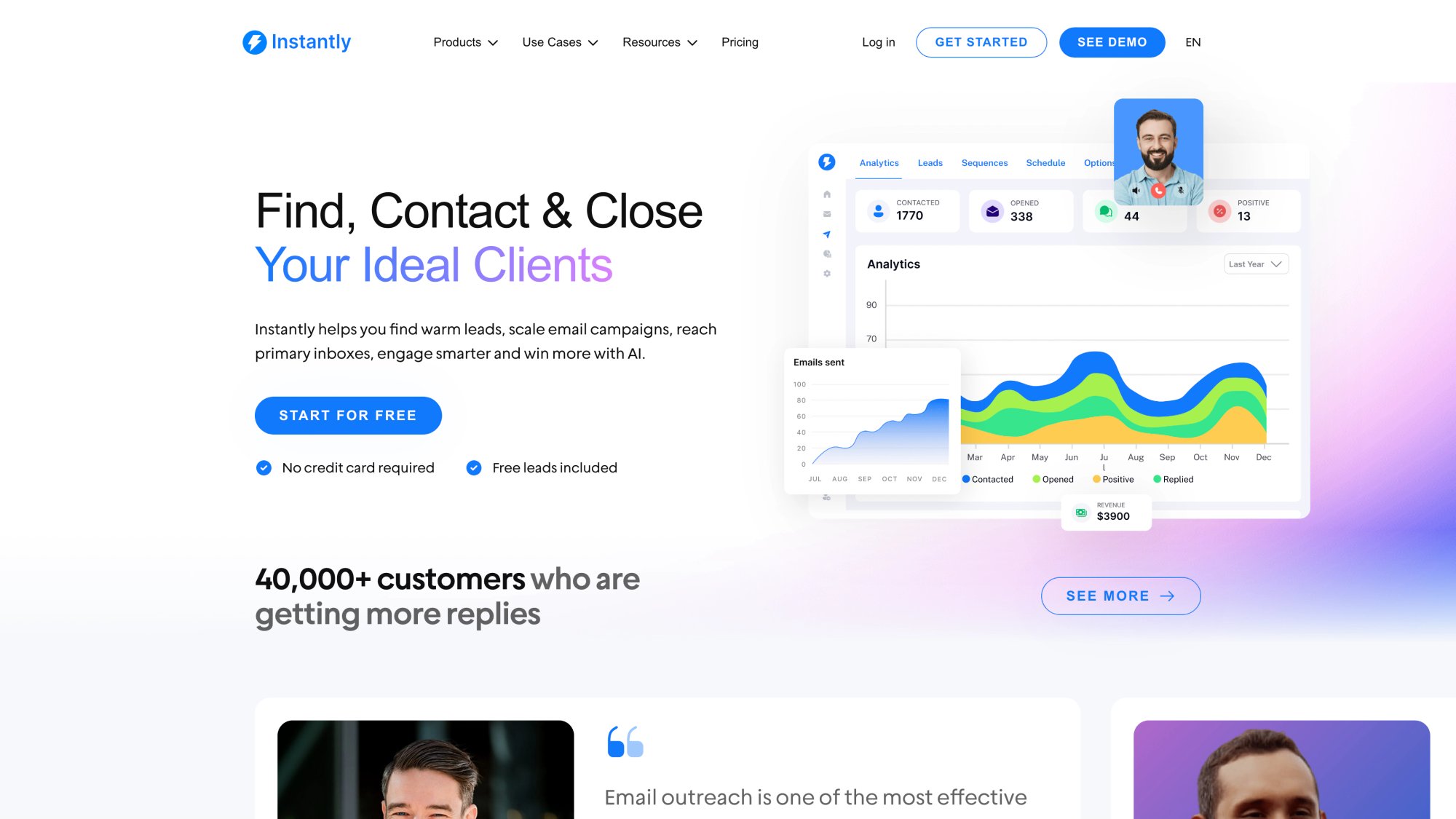
At its core, Instantly is a cold email platform that gives you:
• High-volume sending with "unlimited" inboxes on many plans
• Inbox rotation and warmup across a large internal network
• Lead database with hundreds of millions of B2B contacts
• Campaign builder with sequences, analytics, and unified inbox
• VIP/DFY services where their team handles domain setup, inbox configuration, warmup, and sometimes messaging
The appeal is obvious. One platform that "does it all" from buying DFY accounts to finding leads to sending.
The Instantly platform promises comprehensive cold email infrastructure with unlimited sending capacity, built-in contact data, and automated warmup across a shared network. These features make it a popular choice for agencies and volume-driven teams looking for an all-in-one solution.
Where Users Hit Friction
The most common problems across reviews, Reddit, and comparison articles:
Deliverability Risk in 2025
This year is brutal for bulk email. Gmail and Yahoo now enforce strict authentication rules with spam complaint thresholds around 0.3% and stronger bounce enforcement.
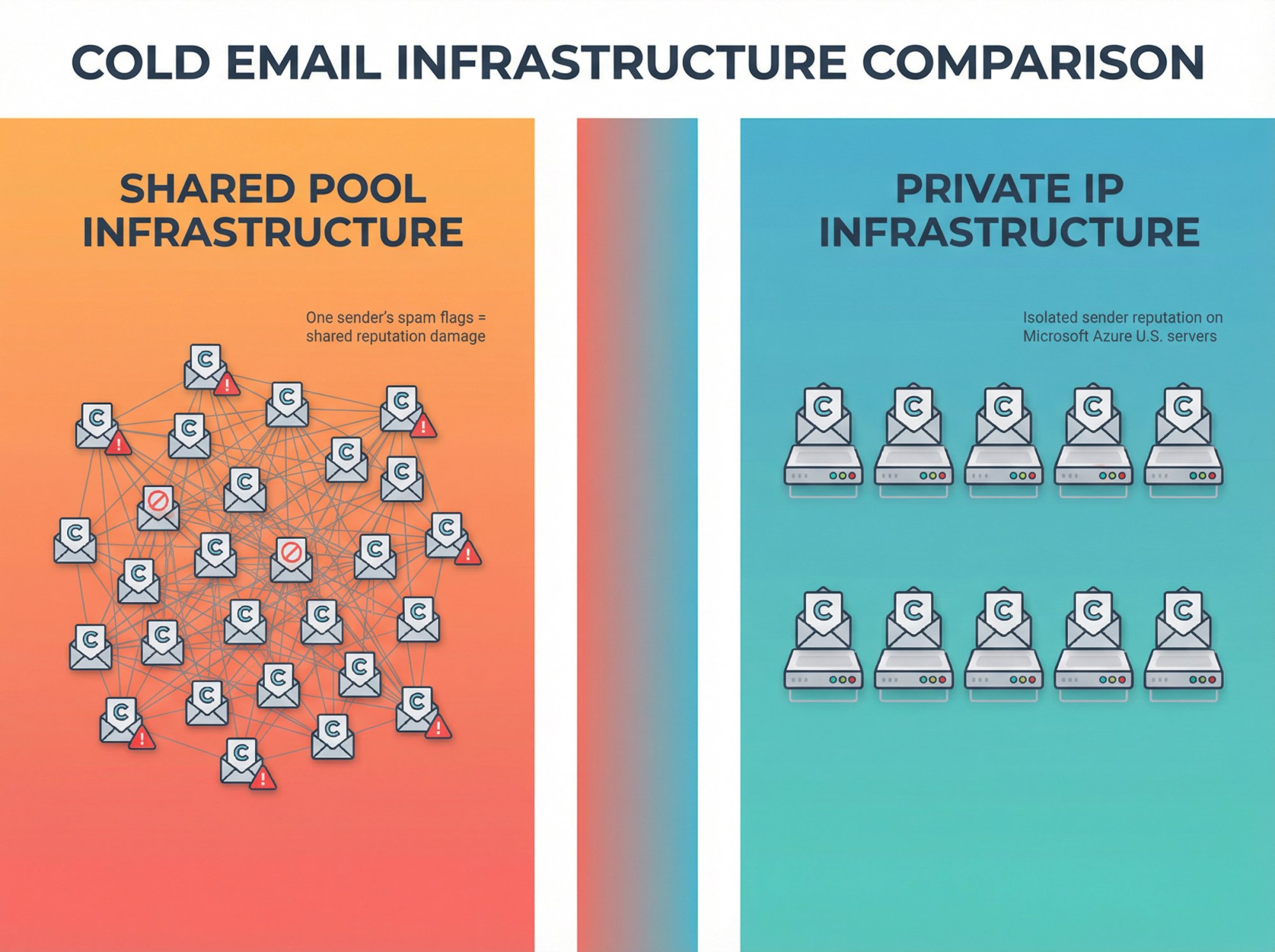
Pooled warmup networks create "noisy neighbor" problems. One sender's bad behavior can hurt everyone sharing infrastructure. Reddit has multiple threads about accounts getting banned even at conservative volumes.
This is why infrastructure matters more than ever.
This is precisely why Outbound System uses private Microsoft Azure infrastructure (to avoid shared pool contamination and maintain 98% inbox placement).
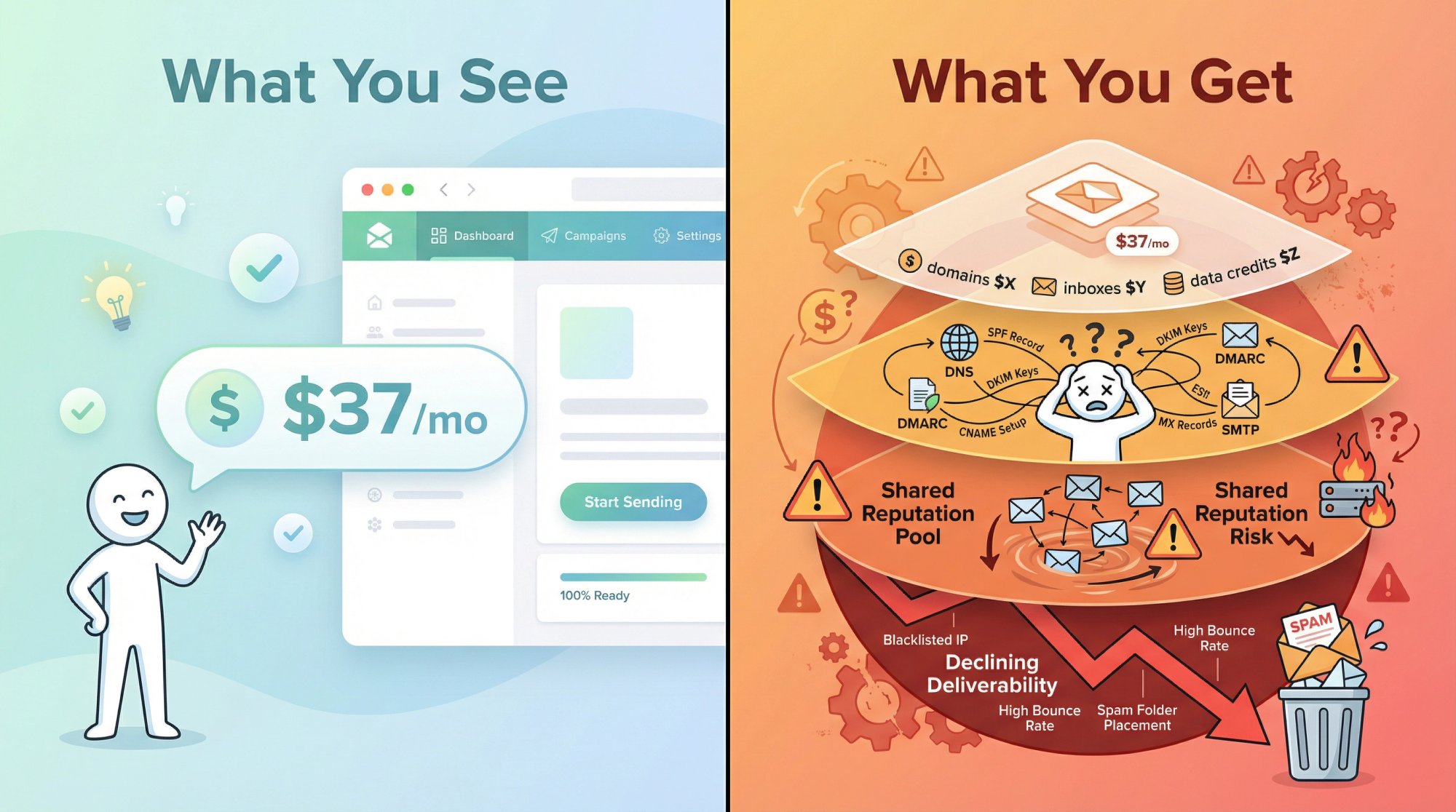
"All-In" Pricing That Hides Complexity
Separate charges for data credits, email accounts, domains, and DFY services mean real cost is "tool + infrastructure + time," not just the base price.
Service Quality for Non-Experts
Power users who understand DNS, DMARC, and list hygiene can get solid results.
Non-technical founders struggle with setup. Recurring themes in reviews include inconsistent support and frustration when deliverability problems appear.
This creates a steep learning curve for non-technical founders.
Agency and Multi-Client Limits
Growth plan workspace structures get limiting when managing many clients. Users complain about lead caps and workspace restrictions that force separate subscriptions.
None of this means Instantly is "bad." It means you need clarity on your job to be done and your tolerance for complexity.
4 Types of Instantly Alternatives Explained
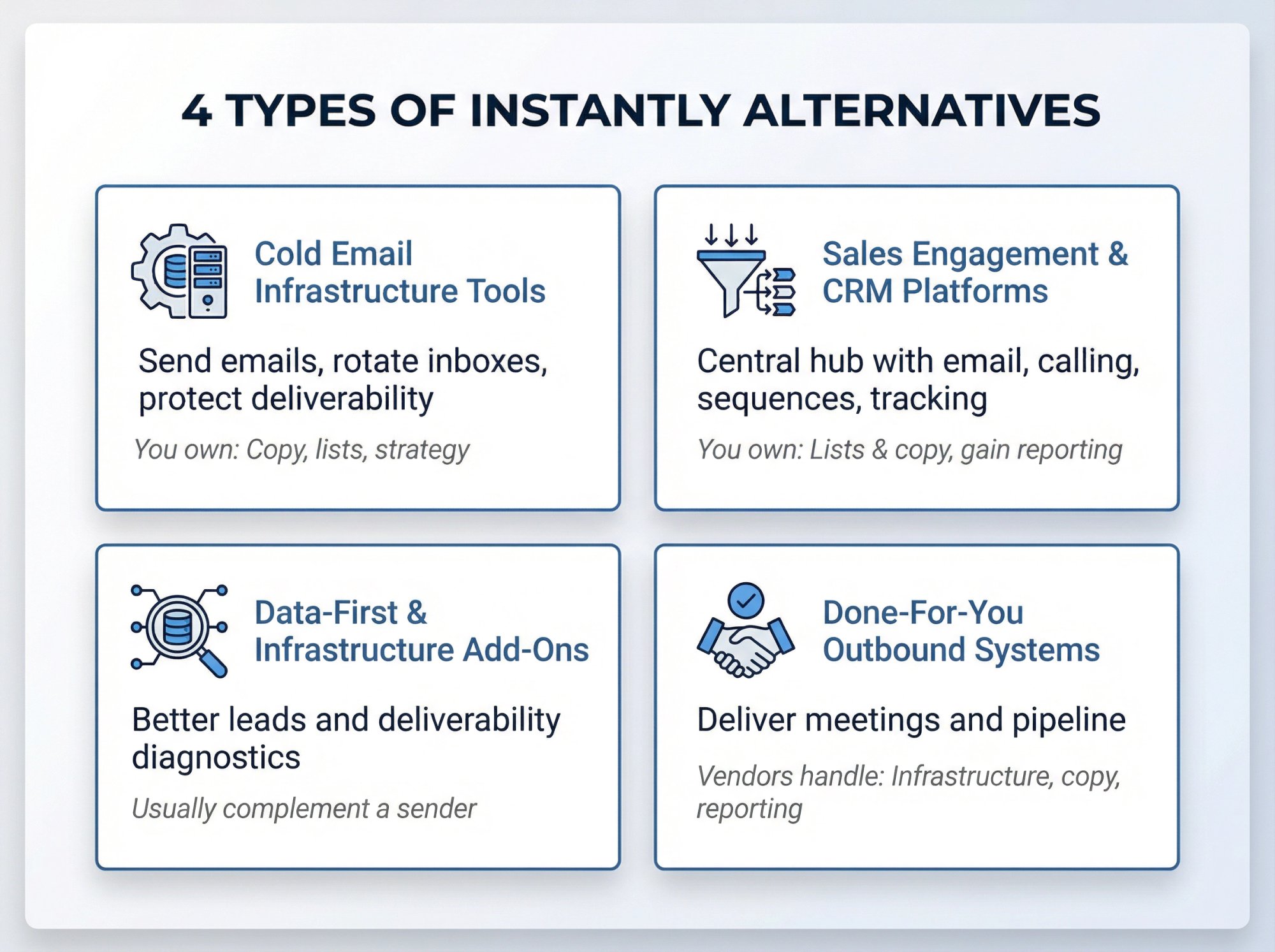
Almost every alternative fits into one of these buckets:
1. Cold Email "Infrastructure" Tools
Core job: Send emails, rotate inboxes, protect deliverability, run sequences
You still own: Copywriting, list building, offer strategy, replying
2. Sales Engagement and CRM Platforms
Core job: Central hub for reps with email, calling, sequences, pipeline tracking
You still own: List building and copy, but you gain deeper sales reporting and multi-channel cadences
3. Data-First and Infrastructure Add-Ons
Core job: Better data (leads) and better diagnostics for deliverability
These usually complement a sender instead of replacing it
4. Done-For-You Outbound Systems
Core job: Deliver meetings and pipeline
Vendors handle: Infrastructure, list building, copy, reporting, and often LinkedIn and calling
We'll look at specific options in each bucket, then show you where Outbound System fits.
Best Cold Email Platforms to Replace Instantly
These are the closest substitutes if you want to keep running outbound yourself.
Saleshandy
Positioning: "Find verified B2B leads and send cold emails in one place." Built to be agency-friendly with unlimited email accounts.
What It Offers
Unlimited email accounts and unlimited clients even on lower tiers
Built-in B2B lead finder with email verification
Unified inbox, sender rotation, analytics
Warmup via partner with dynamic IPs
Saleshandy's interface emphasizes agency scalability with unlimited email accounts across tiers, making cost modeling predictable for multi-client operations. The platform combines sending infrastructure with integrated lead discovery tools.
Pros vs Instantly:
Very agency-friendly pricing (unlimited accounts and clients on entry tiers). Easy to model costs for volume-driven agencies. Deep deliverability focus with inbox placement testing.
Cons vs Instantly:
Lead database is smaller. Smaller ecosystem with fewer plug-and-play templates.
Best for: Agencies wanting predictable per-client costs who care deeply about deliverability controls.
Smartlead
Positioning: High-volume platform with unlimited inboxes and dynamic IPs. Popular with agencies and lead gen shops.
What It Offers
Unlimited email accounts on all main plans
Unlimited warmup and deliverability tools
Central master inbox with reply management
API, webhooks, deliverability utilities
Smartlead positions itself as the high-volume solution with unlimited inboxes across all pricing tiers. The platform's technical dashboard provides advanced deliverability diagnostics and infrastructure controls for users who want granular management.
Pros vs Instantly:
Aggressive volume for the price. Unlimited inboxes and warmup as core entitlement (not upsell). Deep technical tooling with dynamic IPs and infrastructure checkers.
Cons vs Instantly:
No internal lead database at scale. Interface feels more technical for non-specialists.
Best for: Volume-heavy agencies and technical founders comfortable owning deliverability.
Woodpecker
Positioning: Long-standing platform with strong deliverability focus and real-time catch-all verification.
What It Offers
Automatic, real-time verification including catch-alls
Integrated warmup and deliverability tooling
Per-prospect pricing with free tier for small usage
Pros vs Instantly:
Extremely deliverability-obsessed with built-in verification. Transparent volume tiers by contacted prospects.
Cons vs Instantly:
Less suited for massive agency setups with hundreds of inboxes. No huge data marketplace.
Best for: B2B teams who prioritize deliverability over raw volume. Good for founders learning cold email safely.
Mailshake
Positioning: Older, battle-tested tool with simple interface and optional multichannel features.
What It Offers
Email automation with sequences, A/B testing, unified inbox
Optional sales engagement features (calls, social tasks) on higher tiers
Unlimited warmup and campaigns
Pros vs Instantly:
Very simple to learn for founders and small teams. Built-in warmup with solid CRM integrations.
Cons vs Instantly:
Per-seat pricing gets expensive for agencies. Less emphasis on inbox buying and DFY accounts.
Best for: Smaller sales teams wanting reliable, well-documented platform without power user complexity.
QuickMail
Positioning: Outbound platform popular with agencies, focused on reliability and simple pricing.
What It Offers
Multi-inbox rotation and sequences
Agency-friendly client management
Integrations and API for custom workflows
Pros vs Instantly:
Clean focus on outbound without marketplace noise. Well suited for agencies valuing stability.
Cons vs Instantly:
No built-in data marketplace. Feature depth and ecosystem more limited.
Best for: Agencies wanting "just enough" functionality who already have separate tools for data and CRM.
Emailchaser
Positioning: All-in-one platform with heavy focus on affordability.
What It Offers
Cold email sequences, verification, lead tools in one platform
Emphasis on lower entry price
Pros vs Instantly:
Lower headline price and simpler tables. Basic features for small/medium campaigns.
Cons vs Instantly:
Smaller ecosystem and fewer advanced features. Less public information about long-term deliverability.
Best for: Budget-sensitive founders wanting basic cold email without heavy investment.
All-in-One Sales Engagement Platforms vs Instantly
If you have a sales team and care about pipeline tracking, more channels, and deep reporting, you might need a sales engagement platform instead of another cold email tool.
Apollo.io
Positioning: Massive B2B data platform plus sales engagement, sequences, dialer, analytics.
Capability | What You Get |
|---|---|
Database | Hundreds of millions of contacts with technographic and firmographic filters |
Sequences | Email and call workflows with task management |
CRM Features | Integrated reporting, Chrome extension, pipeline tracking |
Apollo.io combines a massive B2B contact database with sales engagement tools, allowing teams to find prospects and execute multi-touch sequences in a single platform. The interface integrates data discovery with outreach execution and pipeline tracking.
Pros vs Instantly:
Far deeper data coverage than most standalone tools. Strong for SDR teams wanting one system for data, outreach, and CRM.
Cons vs Instantly:
Per-seat pricing gets expensive for agencies. Cold email is strong but less specialized on deliverability tricks.
Best for: Funded B2B SaaS, agencies relying on data, SDR teams wanting single pane of glass.
Lemlist
Positioning: Multichannel outreach (email, LinkedIn, calls) with emphasis on personalization like images and video.
What It Offers
Email sequences, LinkedIn tasks, call steps
Image and video personalization including one-to-one visuals
Shared inbox, analytics, team collaboration
Lemlist differentiates through creative personalization capabilities, allowing teams to add custom images, videos, and dynamic content to cold outreach. The platform orchestrates email, LinkedIn, and calling in unified sequences for high-touch campaigns.
Pros vs Instantly:
True multichannel sequences (not just email). Strong personalization features for brands caring about creative touches.
Cons vs Instantly:
Per-seat pricing expensive for many inboxes. Less volume optimization focus.
Best for: Teams wanting high-touch, multichannel outreach with visual personalization, not just raw volume.
Reply.io
Positioning: Full sales engagement suite with email, LinkedIn, calls, SMS, and AI SDR orchestration.
What It Offers
High-volume email, calls, LinkedIn automation
"Jason" AI SDR features for generating messaging and sequences
Strong agency and whitelabel options
Pros vs Instantly:
Multichannel out of the box. Strong alignment with modern SDR needs and AI workflows.
Cons vs Instantly:
Per-seat plus channel add-ons can be complex. Not as purely focused on email infrastructure.
Best for: SDR teams wanting modern sales engagement platform driving most pipeline directly through the tool.
Snov.io
Positioning: Prospecting, verification, outreach, CRM, and deliverability in single platform.
What It Offers
Email finder, company search, LinkedIn prospecting
7-tier email verification and deliverability tools (warmup, placement checks, reputation analysis)
Cold email sequences, CRM, team features
Pros vs Instantly:
Strong balance between data, outreach, deliverability. Unified credits reduce vendor sprawl.
Cons vs Instantly:
Less specialized on sheer inbox count and rotation. Interface can be busy for new users.
Best for: Teams wanting one vendor for list building, verification, sending without complex stack.
Close
Positioning: Sales CRM with built-in calling, SMS, email sequences designed for high-velocity inside sales.
What It Offers
Full CRM with pipeline, custom fields, reporting
Calling and SMS built right in
Email sequences integrated with CRM record
Pros vs Instantly:
Deep CRM plus telephony instead of email-tool-first. Great for teams wanting one system of record for sales.
Cons vs Instantly:
Overkill if you already have a CRM. Less suited for extreme cold email volume.
Best for: B2B sales orgs needing to centralize pipeline and communication rather than squeeze every drop of cold email volume.
Data and Infrastructure Tools for Cold Email
Sometimes the best Instantly alternative isn't another sender. It's better data or infrastructure layered on top of what you have.
Hyperscale
Positioning: AI-driven B2B data and outbound engine that maps your ICP and generates targeted lead lists, often paired with existing sender.
What It Offers
AI-powered ICP modeling and web-scale scraping to find matching accounts
Data enrichment around triggers and technographics
Integrations with outreach tools to push lists into campaigns
Pros vs Instantly:
Stronger focus on "who to email" rather than "how to send." Useful for teams with existing sender but weak data.
Cons vs Instantly:
Still requires a sending platform. Credit-based pricing can be tricky to forecast.
Best for: Companies that can send emails fine but have weak list quality or targeting. For comprehensive B2B lead list building, combining data tools with expert execution often yields better results.
Dedicated Warmup and Deliverability Tools
Even if you stay on a platform or another sender, specialized tools help diagnose and improve inbox placement:
Inbox placement tests and spam folder diagnostics
Independent warmup pools avoiding over-reliance on your tool's internal pool
Reputation monitoring and DMARC/SPF/DKIM checkers
These aren't direct "alternatives" as such, but they're often part of sophisticated stacks. Learn more about email warmup best practices.
When to Choose a Done-For-You Service Over Instantly
This is the part most comparison posts skip.
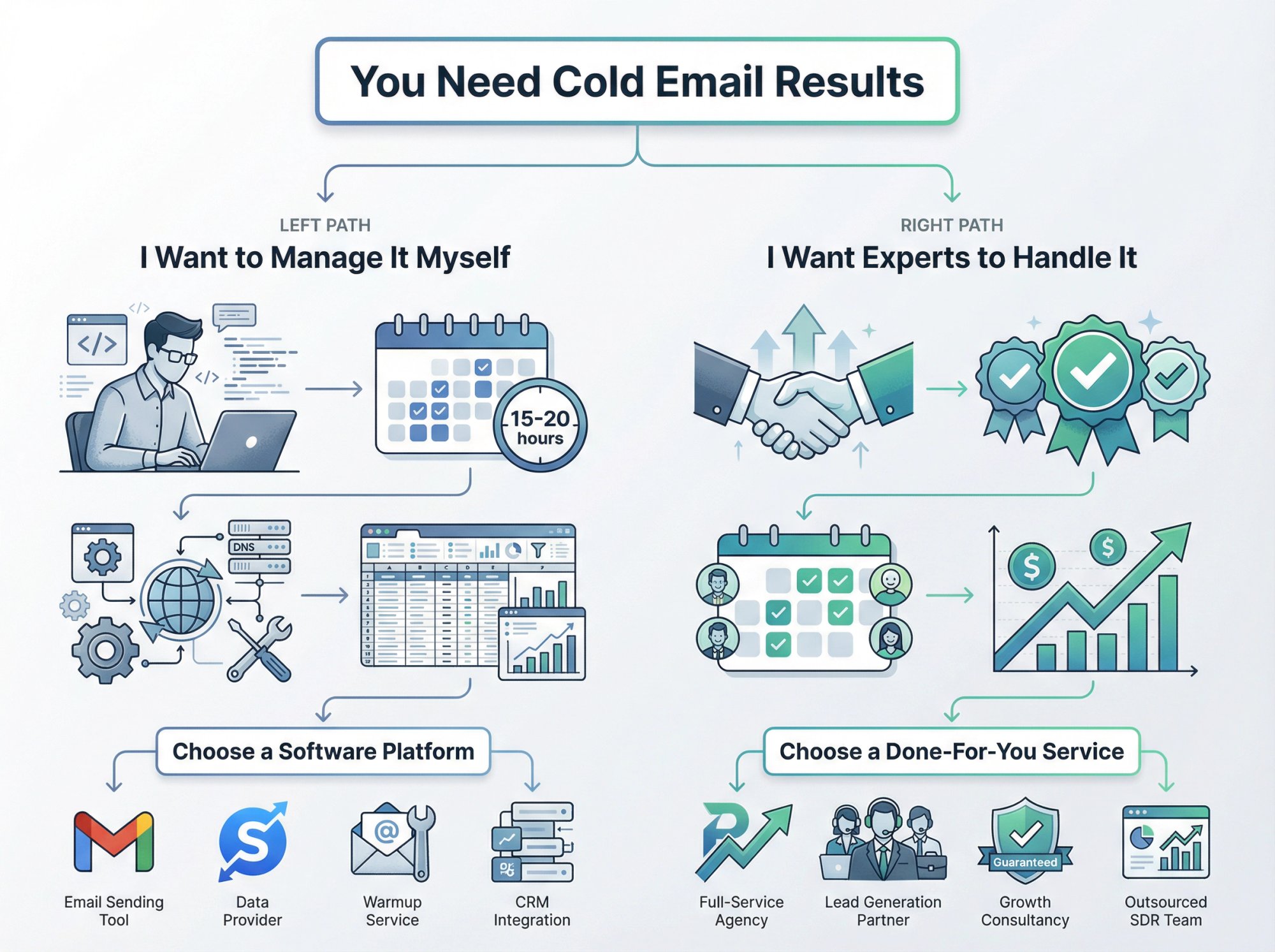
If you don't want to learn authentication details (SPF, DKIM, DMARC), debug Gmail spam issues, spend hours building lead lists, write and iterate cold email copy, and build reporting dashboards...
...then another SaaS tool isn't really an alternative. It's the same job with a different UI.
You're actually looking for a service.
Instantly VIP Service (Their Own DFY Option)
Instantly recognized this themselves. Their VIP service pitches done-for-you outreach with strategy, DFY accounts, and dedicated GTM engineer.
What You Get:
Domain and email setup (DFY accounts)
Evergreen campaigns and AI-driven sequences
Dedicated strategist and Slack access
High email volumes (up to 100K+ monthly depending on tier)
Outbound System: A Done-For-You Alternative to Instantly
Outbound System isn't competing as "another tool." We're competing against the job these platforms are trying to do: deliver B2B meetings and revenue while you avoid becoming a cold email technician.
What We Actually Do
For cold email, we:
① Set up and manage your entire infrastructure on private Microsoft Azure U.S. servers (350-700 inboxes on dedicated U.S. IPs) with advanced warmup and domain pooling. No shared pools where your reputation gets dragged down by other senders.
② Build your target lists using multi-source, 9-step waterfall enrichment so you reach verified ICP contacts, not just any email address.
③ Write human-crafted copy enhanced with AI personalization, using proven cold email copywriting techniques.
④ Run ongoing campaign optimization, A/B tests, and response handling so your team only jumps into booked conversations.
We do the same across LinkedIn lead generation and cold calling if you choose multi-channel campaigns, including LinkedIn profile optimization, scripted call campaigns, and appointment setting.
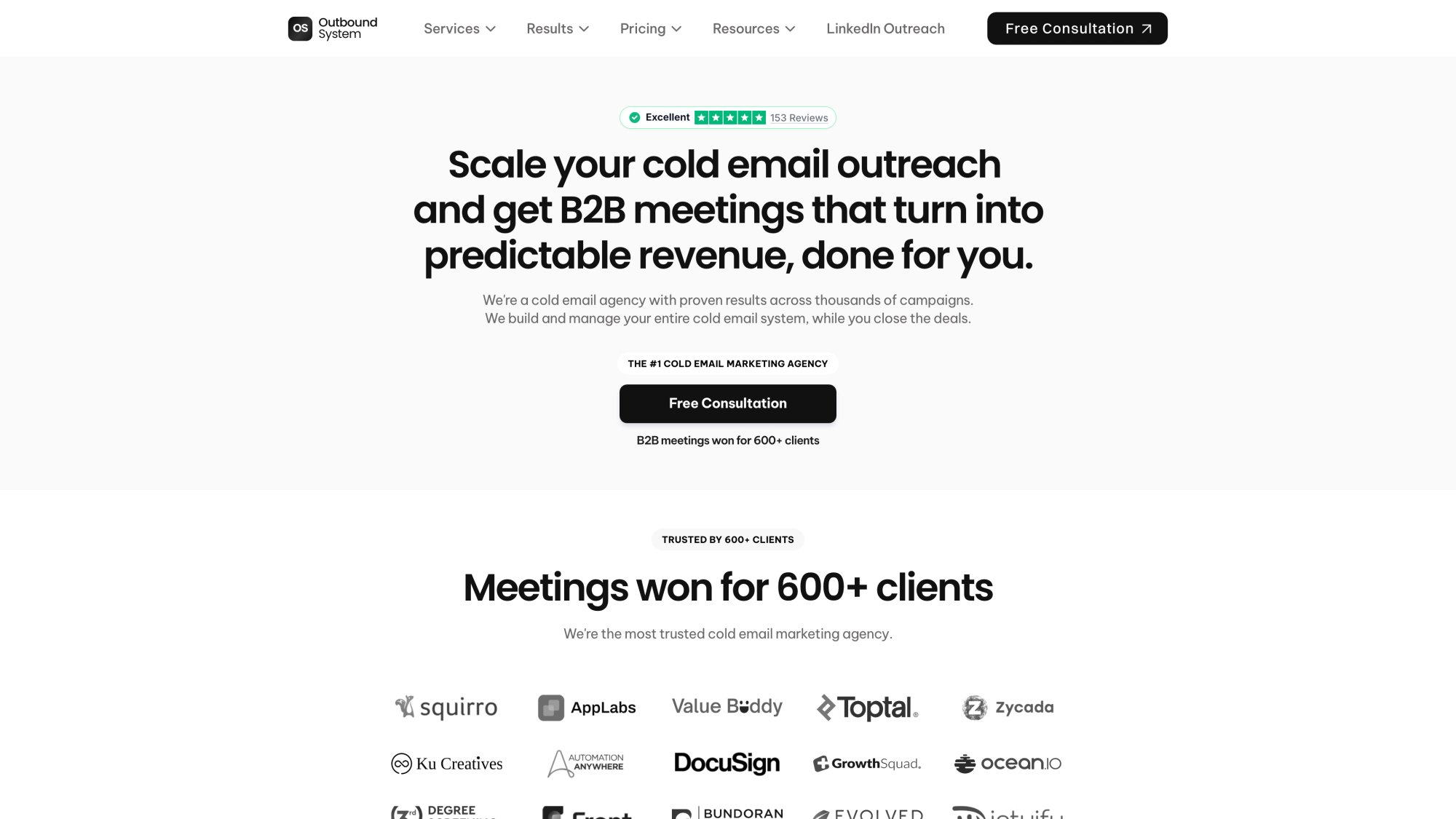
The Outbound System platform presents a clear value proposition: month-to-month contracts starting at $499/month with no long-term commitments, backed by private Microsoft Azure infrastructure and comprehensive done-for-you services. Unlike DIY tools, the service handles infrastructure, copywriting, data enrichment, and campaign optimization so clients focus on closing deals rather than managing technical complexity.
Results and Benchmarks
From our audited aggregate metrics and case studies:
Metric | Performance |
|---|---|
Clients Served | Over 600 B2B companies |
Inbox Placement | 98% (vs typical mid-80s for many senders) |
Reply Rates | 6-7% (vs market average 1-5%) |
Emails Sent | 52 million+ |
Leads Generated | 127,000+ |
Revenue Closed | $26 million+ across campaigns |
Dozens of case studies showing:
28 qualified meetings and a $2.4M pipeline for a GenAI SaaS company
$200K+ in realized net profit for an M&A advisory firm
Hundreds of booked meetings for manufacturing and services companies
These are vendor-reported numbers, but they're consistent across case studies, testimonials, and review platforms like G2 and Trustpilot in 2024-2025.
How Pricing Compares
Our transparent pricing frames our core cold email offer as:
Component | Cost |
|---|---|
Monthly Management | $499/month (month-to-month, no contracts) |
One-Time Setup | $1,500 (domain, inbox, campaign buildout) |
Additional Options | Pay-per-lead, multi-channel (LinkedIn, calling) |
By contrast, many VIP tiers for platforms range from about $1,000 to $10,000/month depending on volume and features.
Our comparison analysis calculates that a comparable level of DFY service through various platforms can run above $2,000/month plus tool and data costs. We argue that our $1,500 setup + $499/month structure saves more than $16,000 per year in many cases.
When a Service Beats Any Tool
A done-for-you system like Outbound System is usually the right alternative if:
You're a founder, partner, or executive whose time is worth more than the cost of hiring experts.
You want pipeline and revenue, not a side hobby learning DNS records.
You're in high-value B2B where each closed deal is worth tens or hundreds of thousands, and burning domains or missing best accounts is very expensive.
In those situations, the real comparison is:
Tool stack cost
Human time for copy, data, deliverability, optimization
Cost of mistakes (burned domains, low reply rates)
versus
All-in service cost
For many B2B firms, the second number is smaller and way more predictable.
How to Choose the Best Instantly Alternative
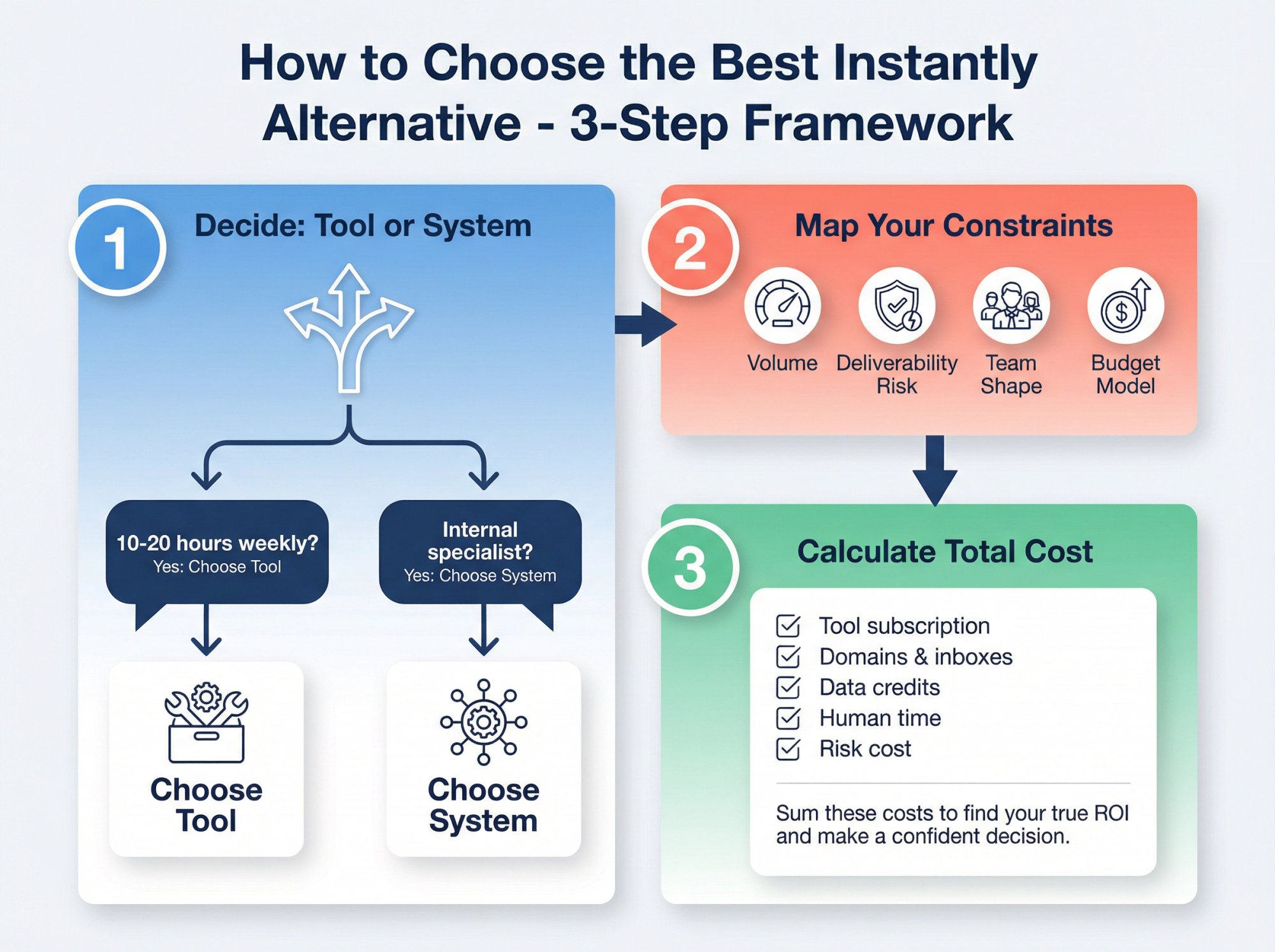
Let's put everything together into a simple framework.
Step 1: Decide if You Want a Tool or a System
Ask yourself:
Do you have someone on the team who will own list building, email copy, deliverability monitoring, and reply handling?
Do you want that person to spend 10-20 hours per week on outbound, consistently, for months?
If the honest answer is "no," then a pure SaaS alternative won't fix your problem. You probably want a system like Outbound System.
If the answer is "yes," then it's worth comparing tools.
Step 2: Map Your Constraints
Consider four constraints:
Volume
Are you sending 500 emails per month, 10,000, or 200,000? High volume favors certain platforms. Understanding how many cold emails you can send per day is critical for planning.
Deliverability Risk Tolerance
If domain reputation damage would be catastrophic, bias toward deliverability-obsessed tools or agencies running private infrastructure.
Team Shape
Agency with many clients? Look for unlimited inboxes, whitelabel, workspace separation.
In-house SDR team? Sales engagement platforms may be better.
Budget Model
Prefer volume-based, flat-fee tools? Various cold email platforms offer this.
Prefer per-seat with deep features? Sales engagement suites work this way.
Prefer fully done-for-you? Outbound System handles everything.
Step 3: Compare Realistic Total Cost of Ownership
For each candidate, calculate:
Tool subscription(s)
Domains and inboxes (registrars, Google/Microsoft accounts, DFY accounts)
Data (credits or third-party vendors)
Human time (copy, data ops, deliverability, reporting)
Risk cost (lost deals from poor deliverability or bad targeting)
This is where many buyers realize:
The "cheap" tool plus human time isn't actually cheaper than a $499/month + setup DFY system if you value your time.
The "expensive" per-seat platform is justified if it becomes the main operating system for a high-output SDR team.
3 Key Decisions Before Switching from Instantly
If you walk away with only one thing, let it be this:
Choosing an Instantly alternative is really choosing a pipeline system, not a vendor logo.
To get real value from this guide, do three things:
1. Be Brutally Honest About Who Will Do the Work
If you don't have or want an internal outbound specialist, keep your life simple and talk to a done-for-you provider instead of auditioning a dozen tools.
2. Make Deliverability a First-Class Decision Factor
2024-2025 changes at Gmail and Yahoo mean that poor authentication, high complaint rates, or noisy warmup pools can destroy your sender reputation.
Tools and agencies investing heavily in infrastructure and data quality aren't "nice to have" anymore. They're the difference between 0.5% replies and 6-7% replies.
3. Optimize for Meetings and Revenue, Not Just Price Per Thousand Emails
Industry studies in 2025 show average cold email reply rates floating around 3-5%, with top performers hitting 8-12% and beyond.
Here's the math that matters.
If a provider consistently delivers twice the replies at a slightly higher monthly cost, your ROI is usually better. Learn more about what makes cold email worth it.
How Outbound System Compares to Instantly
If you're reading this on our site, here's the practical way to think about Outbound System in this landscape:
We're not a software checkbox replacement.
We're a done-for-you outbound system that solves the same job: booking qualified B2B meetings at scale without making you run infrastructure, copy, or data.

Compared to staying on a DIY stack, the tradeoff is:
Slightly higher vendor fee, but:
You don't burn time on infrastructure and deliverability
You don't guess your way through copy and targeting
You get access to the cumulative learnings of tens of millions of sends and thousands of campaigns
If that sounds like the kind of alternative you actually want, the most useful next step is a short strategy conversation with someone who can map your market, ACV, and pipeline goals to a realistic outbound system.
Critical decision framework: When evaluating alternatives, optimize for pipeline ROI, not just monthly subscription cost. The cheapest tool often costs the most in burned time and missed opportunities.
Ready to See What a Real Outbound System Can Do for Your Pipeline?
Book a 15-minute free consultation to discuss your specific situation and see if Outbound System is the right fit.
Instantly Alternatives FAQ: Your Questions Answered
What's the Best Free Alternative to Instantly?
There aren't truly "free" alternatives that match feature sets at scale. Some platforms have free tiers with limited credits, and some offer very low-volume starter plans, but you'll hit limits quickly with any serious outbound volume.
The real question isn't about free tools. It's about total cost of ownership. A $499/month done-for-you service might actually cost less than a "cheap" tool plus the 15 hours per week you'll spend running it.
Why is My Instantly Deliverability So Bad?
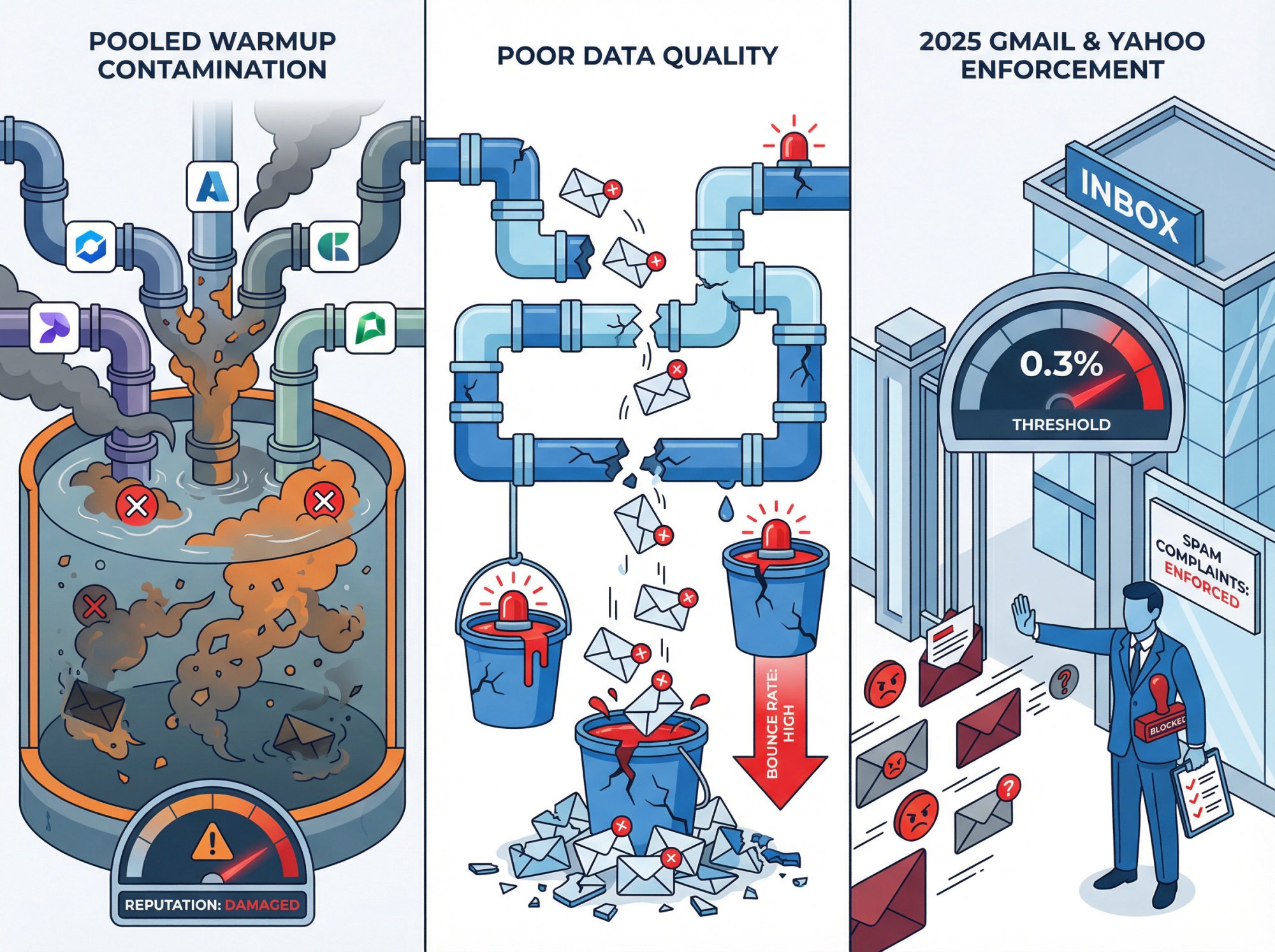
Most deliverability problems come from three sources:
Pooled warmup network contamination. When you share warmup infrastructure with other senders, their bad behavior can hurt your reputation. Multiple Reddit threads describe this problem in 2025.
Poor data quality. If you're buying cheap leads or not properly verifying emails, high bounce rates will destroy your sender reputation fast.
2025 Gmail and Yahoo enforcement. The new authentication requirements and spam complaint thresholds (0.3% max) are catching senders who were fine in 2023-2024.
Agencies like Outbound System solve this with private Microsoft infrastructure, 9-step waterfall enrichment, and proper domain management. We consistently hit 98% inbox placement because we control every part of the stack.
Is Smartlead Better Than Instantly for Agencies?
For most agencies, pricing models with unlimited inboxes and flat-fee plans are easier to manage when you have multiple clients.
Platform pricing can get unpredictable when you're scaling agency operations. You're juggling workspace limits, per-client inbox needs, and separate data credit pools.
That said, if you need a massive built-in lead database, built-in data offerings vary significantly. You'd need to pair some platforms with external data sources.
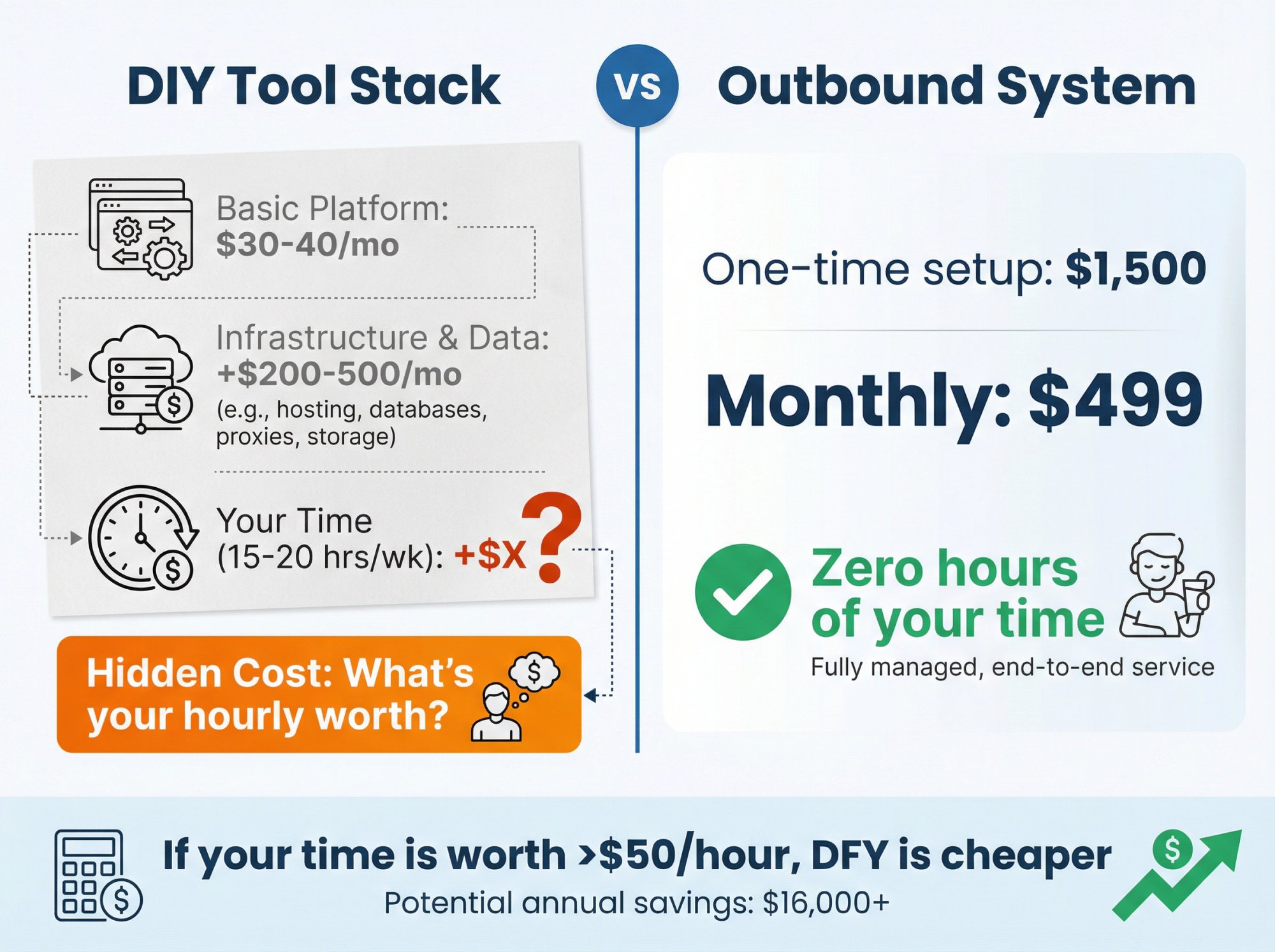
What's Cheaper: Instantly or a Done-For-You Agency?
It depends on how you value your time.
DIY Tool Stack:
Basic platform plans: ~$30-40/month (billed annually)
Plus domains, inboxes, data credits: +$200-500/month
Plus 15-20 hours of your time per week: +$X (what's your hourly worth?)
Outbound System: $1,500 setup + $499/month, zero hours of your time.
If your time is worth more than $50/hour, the done-for-you option is usually cheaper in real dollars. Our comparison analysis breaks down the math showing potential savings of $16,000+ per year.
Can I Use Multiple Cold Email Tools Together?
You can, but it gets messy fast.
Some sophisticated teams use:
Data platforms for prospects
Sending platforms for outreach
Independent warmup services
Verification tools
But now you're managing four vendor relationships, separate billing cycles, and integration maintenance. Most teams underestimate the operational complexity of a multi-tool stack.
This is why all-in-one platforms and done-for-you services like Outbound System are growing. Fewer moving parts means less that can break.
How Do I Migrate from Instantly to Another Platform?
Migration typically involves these steps:
① Export your data (leads, campaigns, analytics)
② Set up new infrastructure in your chosen tool (domains, inboxes, warmup)
③ Rebuild campaigns with your messaging sequences
④ Import and remap leads into new platform
⑤ Gradually shift volume while monitoring deliverability
Most agencies budget 2-4 weeks for a clean migration. If you're going to a done-for-you service like Outbound System, the agency handles infrastructure setup and you just provide your ICP definition and positioning.
What's the Most Important Feature to Look for in an Instantly Alternative?
It's not a feature. It's deliverability infrastructure.
In 2025, with Gmail and Yahoo's strict enforcement, your sender reputation is everything. Look for:
Private IP infrastructure (not pooled shared IPs)
Proper domain warming protocols
Multi-step email verification (not just syntax checks)
Reputation monitoring and diagnostics
Some tools emphasize deliverability heavily. Agencies like Outbound System build entire infrastructure stacks around it (350-700 Microsoft IPs, 9-step enrichment, private servers).
Fancy AI personalization and campaign templates don't matter if your emails land in spam.
Should I Choose a Tool or a Done-For-You Service?
Answer these two questions:
1. Do you enjoy (or at least tolerate) the technical work of cold email? Setting up domains, debugging DMARC records, testing subject lines, cleaning lists, analyzing bounce rates, optimizing send times?
2. Is your time better spent closing deals than running campaigns? If you're a founder, partner, or executive whose hourly value exceeds $100, probably yes.
If you answered "no" to question 1 or "yes" to question 2, you want a service like Outbound System.
If you answered "yes" to question 1 and "no" to question 2, compare various platforms.
How Long Does It Take to See Results from a New Cold Email System?
With a DIY tool: 6-8 weeks minimum from start to consistent results.
Week 1-2: Infrastructure setup (domains, inboxes, warmup)
Week 3-4: First campaigns with testing
Week 5-6: Optimization based on initial data
Week 7-8: Consistent reply flow
With a done-for-you service like Outbound System: 14-21 days to first meetings booked.
We handle infrastructure and campaign setup in parallel during the first two weeks, so you're seeing replies within days of go-live.
The difference is expertise. We've run 52 million+ emails and know what works before your first send.
Data currency note: All pricing, statistics, and benchmarks in this guide are based on publicly available information as of late 2025. Vendors update pricing and features frequently, especially in response to ongoing deliverability rule changes from Gmail, Yahoo, and other providers. Always confirm current pricing and limits on each vendor's official site before making decisions.