Key takeaways
Calling a positive cold email reply or inbound form lead in under 5 minutes converts 73% of leads into booked appointments, compared to 30% to 33% when replying with a Calendly link and 9% when calling after 4 hours.
Verbal phone bookings show up at 75% to 90% (verified at 75% in our Presidential Bank case study), while passive calendar-link bookings suffer a 40% to 50% show rate.
Human SDRs miss the 5-minute window because they are on demos, at lunch, or logged off at 8 PM when business owners check email; an AI appointment setter dials in 15 seconds 24/7.
Because 70% to 80% of warm leads miss the first call from an unknown number, multi-attempt follow-up across 7 to 30 dials is required to capture the full pipeline.
Updated November 2, 2026. Benchmarks drawn from 2026 outbound reply-to-call studies and Outbound System’s production client campaigns.
Why does an AI appointment setter book 2x more meetings than sending a Calendly link?
When a prospect replies positively to a cold email, clicks a LinkedIn message or submits a website form, replying with a calendar link converts only 30% to 33% of leads into booked meetings, and only 40% to 50% of those bookings actually show up. Triggering an AI appointment setter to call the prospect’s phone within 15 seconds to 5 minutes lifts lead-to-booking conversion to 70% to 73% and raises meeting show rates to 75% to 90%.
For the last five years, outbound teams treated a positive reply (“Sure, send me some times”) or a Meta/Google lead form fill as the finish line. The SDR waited two hours, replied with a Calendly link, and watched 70% of interested buyers vanish. In 2026, the highest-performing outbound and paid-lead teams have replaced the passive booking link with an immediate outbound phone call.

How fast do warm leads and positive cold email replies decay?
Every positive cold email reply and inbound form fill has a five-minute clock running on it. The moment a business owner hits “Send” on an email reply or taps “Submit” on an ad form, they are holding their phone or sitting at their desk thinking about the problem. Thirty minutes later, they are in another meeting, driving to a job site, or have completely forgotten your company’s name.
Across 2026 outbound response-time benchmarks (including Liam Sheridan’s analysis of 4.7 million cold emails and Dean Fiacco’s positive-reply studies), booking conversion drops off a cliff as minutes pass:
Time from positive reply or form fill to phone call | Positive-reply to booked-meeting rate | Share of total meetings booked | What the prospect is doing |
|---|---|---|---|
Under 5 minutes (Outbound System calls in 15s) | 73% | 71% of all booked meetings | Still looking at their phone or inbox; remembers your exact message |
5 to 30 minutes | 41% | 16% of all booked meetings | Switched tasks; still recognizes your company name when you call |
30 minutes to 4 hours | 22% | 9% of all booked meetings | In back-to-back calls; screens unknown numbers |
4+ hours (B2B industry median response time) | 9% | 4% of all booked meetings | Forgot they replied; treats your callback like a cold interruption |
That table explains why so many companies spend thousands of dollars on Smartlead, Instantly, HeyReach, Meta Ads or Google Ads and still have empty sales calendars. Their top-of-funnel campaigns are working, but a 4-hour median human response delay is destroying 60% to 80% of the pipeline after the lead already said yes.
What is the “Calendly Link Tax” on your show rate?
Even when a prospect clicks your booking link and picks a time for next Thursday, passive link bookings suffer from a hidden second leak: no-shows.
When someone clicks a link on a screen without speaking to a person, there is zero social contract. By the time Thursday arrives, they do not remember who you are, they skip the Zoom link, and your closer sits in an empty room.
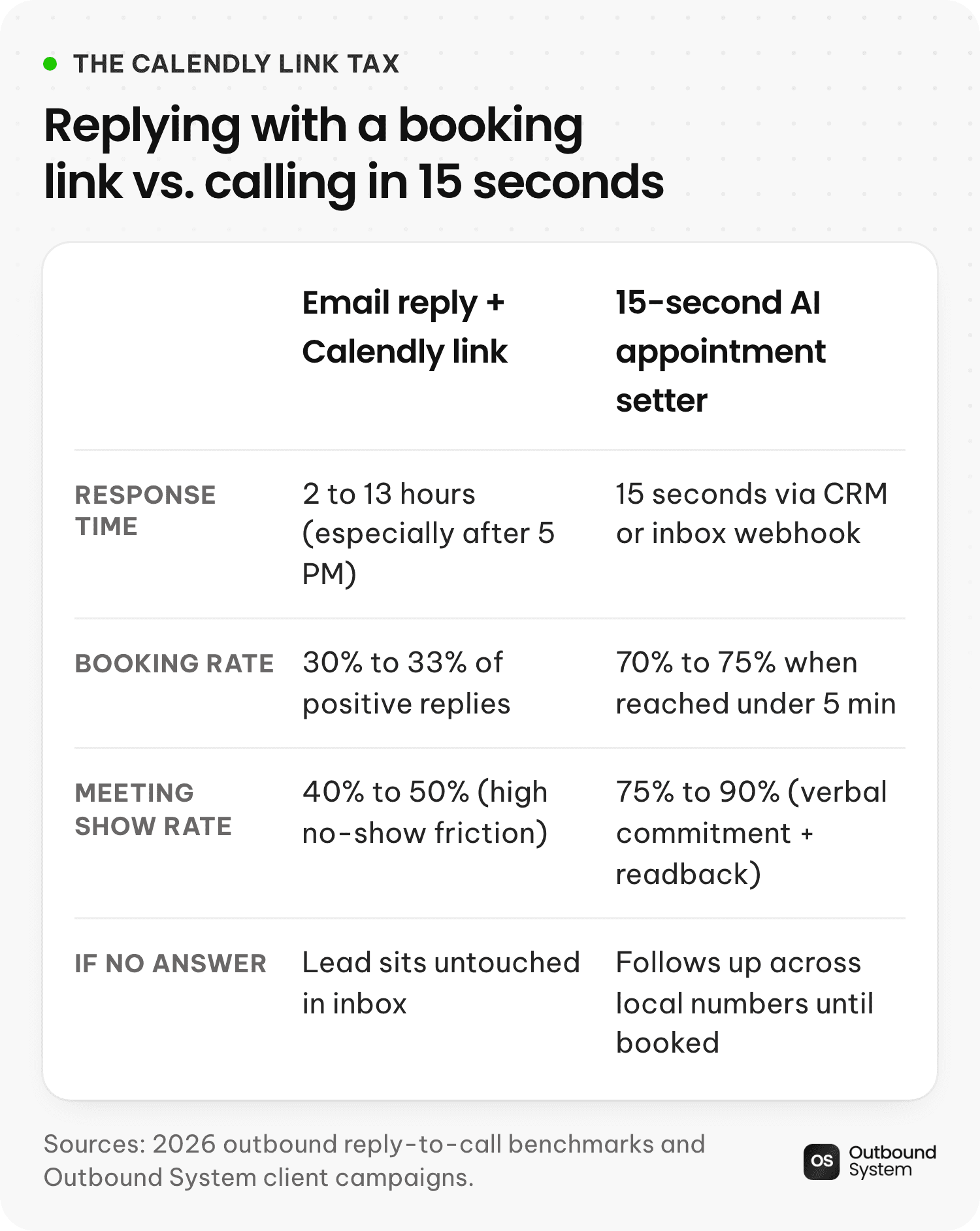
Compare the full funnel math on 100 warm leads or positive replies handled by a calendar link versus a 15-second phone call:
Funnel stage (per 100 warm leads or positive replies) | Email reply + Calendly link | 15-second AI appointment setter call | Net pipeline difference |
|---|---|---|---|
Leads that book a calendar slot | 30 to 33 booked | 70 to 73 booked (when reached in <5 min) | +2.2x more bookings |
Show rate on booked meetings | 40% to 50% show rate | 75% to 90% show rate | Verbal commitment + email read-back |
Held sales conversations per 100 warm leads | 12 to 16 held meetings | 52 to 65 held meetings | ~4x more held sales calls from the same lead spend |
In our own client campaigns, verbal confirmation plus reading the prospect’s email address back on the call consistently locks in high attendance. For example, in our Presidential Bank mortgage campaign, our AI appointment setter booked 15 meetings in month two and 75% of those meetings showed up live.
Why can’t human SDRs consistently hit the 5-minute calling window?
Every sales guru on LinkedIn and X tells founders: “Just have your SDR call every positive reply and form lead within 5 minutes!” And in the comments of every one of those posts, operators admit the exact same bottleneck: staffing a human to dial in 120 seconds all day is nearly impossible.
Here is why human teams fail the 5-minute rule within two weeks:
The 8:00 PM inbox problem: Small business owners, contractors and founders catch up on email and scroll Facebook ads between 7:00 PM and 10:00 PM. When they reply at 8:30 PM and your SDR calls at 9:15 AM the next morning, the lead has been sitting cold for nearly 13 hours.
Reps are busy when the webhook fires: If your SDR is on another call, in a team standup, at lunch, or updating HubSpot when a Slack alert fires at 2:14 PM, that 5-minute window is gone.
Humans quit after 1.4 dials: According to Velocify’s lead-response research, 50% of sales leads are called once and never get a second call. Even when a rep dials a warm lead in 3 minutes, 70% of people do not answer an unknown number on dial one. The rep logs “No answer,” sends a Calendly link anyway, and moves on.
How does an AI appointment setter work from webhook to booked meeting?
An AI appointment setter removes human latency altogether by wiring your lead sources directly to an autonomous outbound dialer. On our speed-to-lead and AI lead reactivation workflows, the entire sequence runs without a human touching the keyboard:
Instant webhook trigger (0 to 5 seconds): A prospect submits a Meta Lead Ad, Google Ads form or website form, or replies positively in EmailBison, Smartlead, Instantly or HeyReach, or moves to a trigger stage in HubSpot, Monday, Salesforce, GoHighLevel or Pipedrive.
Pre-dial normalization and local number selection (5 to 10 seconds): The platform strips any
LLCor title tags from the contact record, checks the lead’s time zone and DNC status, and selects a clean phone number from your dedicated pool of 50 to 200 local numbers that matches the lead’s area code.First outbound call (15 seconds): The AI calls while the prospect is still looking at their screen. It references the exact form or email they just engaged with (“Hey Sarah, saw you just replied to our note about...”), answers basic questions, and asks the 2 to 4 qualification questions your closers require.
Live calendar booking and CRM write-back: While keeping the conversation natural (under 300ms response latency, never saying “hold on”), the AI checks live availability on your Cal.com, Calendly or Housecall Pro calendar, confirms a specific day and time after a 3+ word affirmative agreement, reads the prospect’s email back to verify spelling, and writes the transcript, recording and outcome straight back to your CRM.
Relentless multi-attempt follow-up if they don’t answer: If the call hits voicemail, our live listener hangs up in under 30 seconds without leaving a message (so the number is never reported as spam) and automatically schedules follow-up dials across different times of day until the lead converts or opts out.
In our RYSE Floors case study, connecting Monday triggers to our AI appointment setter and Housecall Pro calendar allowed the AI to qualify homeowners on flooring type, rooms, square footage, ownership and timeline, turning 254 previously written-off Meta Ads leads into 101 live conversations and booking in-home estimates on leads that had been sitting dead for up to 110 days.
Frequently asked questions
What is an AI appointment setter?
An AI appointment setter is an autonomous voice agent that places outbound phone calls to your new inbound leads, positive cold email replies, dead CRM leads or cold prospect lists, qualifies them in a natural two-way conversation, and books confirmed appointments directly onto your sales team’s calendar.
How fast should an AI appointment setter call a new lead?
Within 15 to 60 seconds of the form submission or positive reply during legal calling hours. Leads called within 5 minutes convert to booked appointments at 73%, compared to 41% at 5 to 30 minutes and 9% after 4 hours.
What happens if a warm lead does not answer the first AI call?
Most warm leads miss the first call from an unfamiliar number. Instead of leaving a voicemail that gets flagged as junk, our AI hangs up cleanly on the voicemail greeting and follows up across multiple attempts over subsequent days and hours using your local number pool until the prospect answers.
Can an AI appointment setter call positive replies from Smartlead, Instantly or HeyReach?
Yes. Using a webhook, Zapier, Make or our native CRM syncs (HubSpot, Monday, GoHighLevel, Salesforce, Pipedrive), any lead tagged “Interested” or “Positive Reply” in your email or LinkedIn sequencer can trigger an automatic outbound phone call within seconds.
How much does a managed AI appointment setter cost?
Outbound System runs managed AI appointment setting from $1,499/month (Starter, up to 5,000 dials/month and 50 local numbers), $2,499/month (Growth, up to 10,000 dials/month and 100 local numbers) and $3,999/month (Scale, up to 20,000 dials/month and 200 local numbers), month-to-month. See our full AI appointment setter vs. human SDR cost breakdown or book a demo.
More from our 442,408-call research series: The psychology of AI voice selection (why John and Eric beat studio-polished voices) · The Coordinator Shield script framework · Best time of day to run outbound AI calls (4 PM vs. 9 AM) · How many follow-up calls it takes to book a meeting.
Outbound System
Fixed monthly price, local numbers, and you approve every script. Hear real calls before you decide.

Matthew Johnson is the founder and CEO of Outbound System, which runs cold email, LinkedIn outreach and AI calling for 1,000+ active B2B clients. He has personally sold over $12 million in B2B services, and his team has sent 52 million+ cold emails and helped clients close $26 million in revenue.
About Outbound System
Outbound System runs done-for-you cold email, LinkedIn outreach and AI calling for B2B companies. 1,000+ active clients and 10,400+ campaigns launched.