Key takeaways
Buying 1 or 2 phone numbers and blasting 500 AI calls an hour triggers carrier “Scam Likely” flags within 48 hours and drops pickup rates to 1.4%.
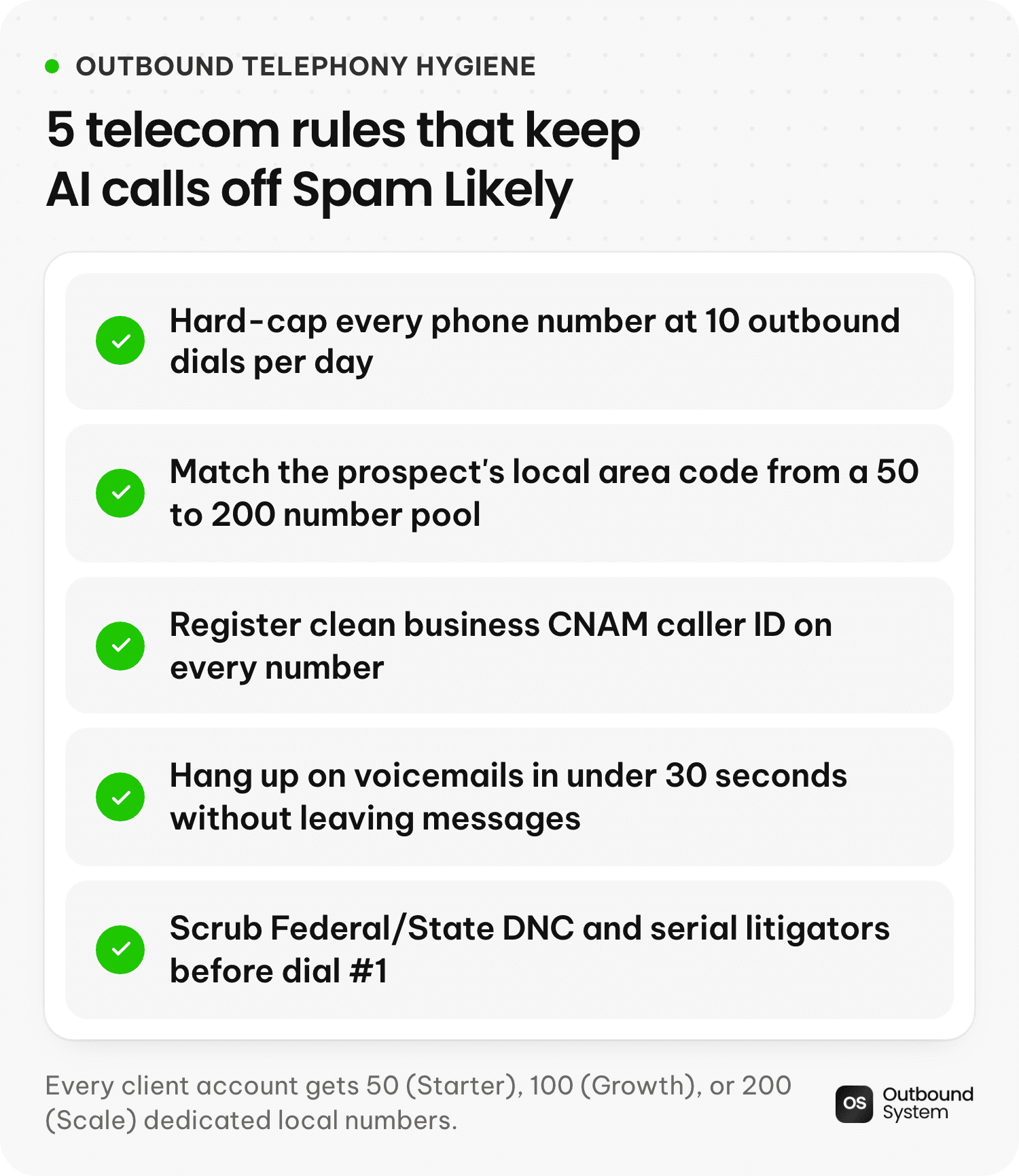
To keep live pickup rates between 15% and 30% across 438,246 calls, we spread dials across 1,136 active local numbers in 191 US area codes and hard-cap every number at 10 dials per day.
Hanging up on voicemails in an average of 28.4 seconds without leaving a message prevents recipients from clicking “Report Junk” on their lock screen.
Pre-dial scrubbing blocked 58,230 of 260,965 numbers (22.3%) for DNC and TCPA litigator flags before a single call was placed.
Updated November 2, 2026. Based on production telephony data across 438,246 outbound AI calls and 1,136 active phone numbers.
Why do outbound AI voice agents get flagged as “Scam Likely”?
Outbound AI voice agents get flagged as “Scam Likely” or “Spam Risk” when a caller sends high daily dial volume through a handful of phone numbers, calls across mismatched area codes, or racks up short hang-ups and “Report Junk” taps from recipients. Once T-Mobile (First Orion), AT&T (Hiya) or Verizon (Transaction Network Services) flags a number, iPhones and Androids silence the call or display a red warning banner, collapsing live pickup rates from 15% to 30% down to 1.4%.
Every week someone posts a video online claiming they built an AI caller in 25 minutes that dials 1,000 leads a day from a $1 VoIP number. What they never post on Friday is the screenshot of their answer rate hitting rock bottom because carrier algorithms tagged their single number as a robo-dialer inside 48 hours. You can have the most realistic AI voice model on earth, and it means nothing if the prospect’s screen says “Scam Likely” when it rings.

How do wireless carriers decide to label a number as spam?
Major US wireless carriers and their analytics engines (Hiya, First Orion and TNS) score outbound phone numbers in real time using five behavioral signals rather than listening to whether your voice is human or AI:
Dial velocity per number (DID): A normal business employee does not dial 300 unique cell phones in an afternoon from one line. When a single number exceeds 20 to 30 cold outbound attempts a day, carrier scoring models flag the velocity spike immediately.
Ultra-short call durations: When recipients see an unfamiliar out-of-state number, decline the call or hang up in 3 seconds, the carrier logs a bad call-completion profile.
Voicemail “Report Junk” taps: On iOS and Android, leaving an unwanted voicemail puts a one-tap “Report Call as Junk” button right under the transcript on the prospect’s screen. Just a handful of junk reports on one number can poison its reputation across an entire carrier network.
Missing STIR/SHAKEN attestation and CNAM: Numbers without verified business identity and registered Caller ID Name (CNAM) start with a lower trust score before the first call is placed.
Dialing honeypots and serial complainers: Carrier analytics providers monitor unallocated numbers and DNC complaint traps. Hitting those numbers on an uncleaned CSV accelerates spam tagging across your entire trunk.
What is the exact telecom math required for 15% to 30% pickup rates?
Keeping live answer rates between 15% and 30% in production has almost nothing to do with prompt engineering. It comes down to strict number-pool math that keeps every individual phone line looking like a normal local business caller.
Here is the exact telephony architecture we run across 438,246 outbound AI calls on our platform:
Telecom metric | DIY single-number setup | Outbound System production standard | Why it matters |
|---|---|---|---|
Active phone numbers in pool | 1 to 5 numbers | 1,136 active numbers (50 to 200 per client account) | Spreads volume so no single number spikes carrier velocity alerts |
US area codes covered | 1 random area code | 191 US area codes (most-populous metros first) | Matches the prospect’s local area code whenever available |
Maximum dials per number per day | 100 to 500+ dials/day | Hard-capped at 10 dials per number per day | Keeps every number under carrier robo-dialer thresholds |
Caller ID Name (CNAM) | Unregistered or generic wireless | Registered to the client’s business name | Displays a real business identity where carriers support CNAM |
Voicemail behavior | Leaves 30-second AI voicemails | Hangs up in 28.4 seconds on average, 0 voicemails left | Eliminates lock-screen “Report Junk” taps from annoyed prospects |
Pre-dial list hygiene | Raw CSV upload | 22.3% of numbers blocked pre-dial (58,230 of 260,965) | Strips DNC, TCPA litigators and wireless complainers before dial #1 |
How many phone numbers do you actually need for outbound AI calling?
Under our 10-dial-per-number daily cap, the number of dedicated local phone lines you need is your daily dial target divided by 10.
Here is how we size dedicated local number pools for each client plan on Outbound System:
Starter Plan ($1,499/mo, up to 250 dials/day): 50 dedicated local numbers across the top US area codes. Even at full daily capacity (250 dials), each number averages just 5 dials a day and never exceeds 10.
Growth Plan ($2,499/mo, up to 500 dials/day): 100 dedicated local numbers across 100 area codes.
Scale Plan ($3,999/mo, up to 1,000 dials/day): 200 dedicated local numbers across nearly every major US metro area code.
When our dialer prepares to call a lead in Dallas (214), Atlanta (404) or Phoenix (602), it first selects a number from your pool that matches the lead’s exact area code and has fewer than 10 dials today. If your pool does not have that exact area code, it selects the least-used number in your pool so volume stays flat across every line.
Why does hanging up on voicemails protect your number reputation?
Across 438,246 outbound dials on our platform, 255,018 calls (58.2%) hit a carrier or personal voicemail greeting. On every single one of those calls, our live audio detector identified the voicemail greeting and hung up in an average of 28.4 seconds without leaving a message.
There are three reasons our AI never leaves voicemails on outbound campaigns:
Voicemails trigger manual spam reports. When a prospect sees a missed call from a local number with no voicemail, they either ignore it or answer the next time you call. When they see a transcribed voicemail from an unfamiliar salesperson on their iPhone screen, iOS displays a prominent “Report Junk” link directly above the transcript.
Voicemails kill pickup rates on Attempts 2 through 8. As we detail in our guide on 15-second AI appointment setting, more than half of outbound appointments are booked on follow-up attempts after the first dial goes unanswered. If you burn the surprise on dial one by leaving a pitch in voicemail, the prospect knows who is calling on dials two through six and screens you out.
Zero wasted per-minute talk charges. In a DIY stack (like Vapi, Retell or Bland), talking to 255,018 voicemail boxes for 60 seconds each burns over 4,250 hours of billed LLM, voice synthesis and telephony minutes talking to machines.
How does pre-dial scrubbing prevent carrier blacklisting?
Before our dialer places a single call to a new list, every phone number runs through our automated compliance and reputation scrubber. Out of 260,965 phone numbers scanned across client campaigns, our system automatically blocked 58,230 numbers (22.3%) before dial one.
Those blocked numbers include Federal and state Do Not Call registrants, known TCPA serial litigators and chronic wireless complainers. Stripping that 22.3% out of your CSV before calling does more than reduce legal risk (covered in our outbound AI calling compliance guide): it removes the exact people most likely to hit “Report Spam” on their phone and poison your number pool for the remaining 77.7% of your list.
Frequently asked questions
Why are my AI outbound calls going straight to voicemail?
If your outbound AI calls go straight to voicemail on the first ring or your pickup rate sits below 3%, wireless carriers have likely flagged your phone numbers as “Scam Likely” or “Spam Risk.” This almost always happens when you push more than 15 to 20 calls a day through a single number or fail to register business caller ID.
How many outbound calls can I make per phone number per day?
To keep numbers clean over months of outbound campaigning, cap each phone number at 10 outbound dials per day. At 250 dials a day, use a rotating pool of at least 50 local numbers; at 1,000 dials a day, use 100 to 200 numbers.
Does local area-code matching still work in 2026?
Yes, when paired with low per-number volume and clean caller ID. Across our pool of 1,136 numbers in 191 area codes, matching the lead’s local area code while keeping each number under 10 dials a day sustains 15% to 30% live pickup rates on B2B and warm consumer campaigns.
Does leaving a voicemail hurt caller ID reputation?
Yes. On modern smartphones, visual voicemail transcripts include a one-tap “Report Junk” button. Hanging up cleanly when a voicemail greeting starts (our platform disconnects in 28.4 seconds on average) avoids triggering junk reports and preserves pickup rates on subsequent follow-up dials.
How do I run outbound AI calling without managing phone numbers myself?
With Outbound System, every plan includes a dedicated, pre-configured pool of 50 to 200 local numbers across up to 191 area codes, automatic 10-dial-per-day caps, CNAM business registration, live voicemail hang-ups and pre-dial DNC scrubbing. See how our managed AI voice agents work or book a demo.
More from our 442,408-call research series: The psychology of AI voice selection (why John and Eric beat studio-polished voices) · The Coordinator Shield script framework · Best time of day to run outbound AI calls (4 PM vs. 9 AM) · How many follow-up calls it takes to book a meeting.
Outbound System
Fixed monthly price, local numbers, and you approve every script. Hear real calls before you decide.

Matthew Johnson is the founder and CEO of Outbound System, which runs cold email, LinkedIn outreach and AI calling for 1,000+ active B2B clients. He has personally sold over $12 million in B2B services, and his team has sent 52 million+ cold emails and helped clients close $26 million in revenue.
About Outbound System
Outbound System runs done-for-you cold email, LinkedIn outreach and AI calling for B2B companies. 1,000+ active clients and 10,400+ campaigns launched.