Key takeaways
Across 442,408 outbound calls after testing 100+ voices, two phone-native voices (John and Eric) account for 86.4% of our dials (382,054) and 94.2% of booked meetings (210 of 223).
Studio-polished “podcast” voices trigger an immediate uncanny-valley alarm over an 8kHz cell line, driving “Are you an AI?” asks up to 1.45% to 3.78% compared to 0.77% for John and 0.80% for Eric.
Eric’s fluent English with a subtle Latin American inflection works because the prospect’s subconscious categorizes the caller as a human rep at an outsourced call center rather than a robot.
Neutral American female voices trigger 15 years of Siri and Alexa conditioning, whereas female voices with regional texture like Jasmine (East Coast) cut AI detection to 0.47%.
Updated November 2, 2026. Based on testing 100+ voice models and production data across 442,408 outbound dials and 58 client accounts at Outbound System.
Why do studio-polished AI voices fail on outbound sales calls?
Studio-polished AI voices fail on outbound sales calls because no human calling from a desk or call floor sounds like an NPR host in a soundproof podcast booth. When a prospect answers an unknown number over an 8kHz cellular phone line and hears a hyper-crisp, studio-equalized voice, their subconscious mind flags it as synthetic within the first three seconds. Across 442,408 production dials after testing over 100 voices, our two “imperfect,” phone-native voices (John and Eric) drove 86.4% of all dials (382,054) and 94.2% of all booked meetings (210 of 223) while holding “Are you a robot?” detection to 0.77% and 0.80%, less than half the detection rate of studio-polished or custom-cloned voices (1.45% to 3.78%).
Almost every week on onboarding calls, a new client listens to our default voice previews through their MacBook speakers and says: “I don’t know about Eric or John. Eric has a slight accent, and John sounds a little hesitant. Can we use a super clean, polished American voice instead?”
Then we show them the conversion data and explain the subconscious psychology of how human beings actually process a phone call.

What does the data show across 442,408 outbound dials by voice persona?
We do not guess which voices work; we split-test them inside live client campaigns using our built-in 50/50 voice A/B router. When we queried our production database across all 442,408 outbound dials and 29,409 connected conversations, the gap between phone-native voices and studio-polished voices was unmistakable:
Voice persona | Voice profile & psychological role | Total dials | Live connected calls | Calls lasting 60+ seconds | “Are you AI?” asks (% of live connects) | Booked meetings |
|---|---|---|---|---|---|---|
John | Calm, non-threatening American male; “perfectly imperfect” with slight natural hesitation | 288,787 | 20,711 | 6,117 (29.5%) | 160 (0.77%) | 191 (61.2% show rate on rated calls) |
Eric | Smooth, confident male; fluent American English with a subtle Latin American inflection | 93,267 | 5,236 | 1,061 (20.3%) | 42 (0.80%) | 19 |
Jasmine | Warm female voice with distinct East Coast regional texture | 41,161 | 2,136 | 520 (24.3%) | 10 (0.47%) | 6 |
Sarah | Conversational female voice with subtle Irish inflection | 11,547 | 679 | 150 (22.1%) | 6 (0.88%) | 1 |
Studio-polished & cloned voices | High-clarity studio clones and neutral default voices | 7,646 | 647 | 299 | 15 (2.32% avg; range 1.45% to 3.78%) | 4 |
Look closely at those numbers:
John and Eric run on nearly 9 out of 10 calls because every time we pit a crisp, “radio-ready” voice against them, the polished voice gets asked “Are you an AI?” two to five times more often.
John alone has booked 191 meetings and held 6,117 conversations over 60 seconds because his calm, unpolished delivery disarms the prospect’s fight-or-flight reflex in the first seven seconds.
Why does “Eric” have a subtle Latin American inflection on purpose?
When clients preview Eric in the dashboard, the most common critique we hear is: “He speaks fluent English, but he has a slight Spanish or Latin American accent. Why wouldn’t we use a 100% neutral midwestern American voice?”
The answer is subconscious categorization.
Before building our AI calling platform, our leadership team spent over a decade in phone sales ($12M+ sold over the phone across 10,400+ campaigns) and managed real human outbound call floors across Egypt, Latin America, and the Philippines. Managing thousands of hours of human cold calls taught us how an American business owner’s brain categorizes an unfamiliar caller in the first four seconds:
When a prospect hears a studio-polished, zero-flaw American voice: It sounds like a podcast studio or an automated commercial. Because no real cold caller sits in a $50,000 recording booth, the prospect’s brain immediately reaches for the AI / robocall bucket. Once that suspicion fires, they test the bot or hang up.
When a prospect hears Eric’s fluent English with a slight Latin American inflection: The prospect’s subconscious mind already has a familiar, 100% human mental bucket for that voice: “This company outsourced their appointment setting or has a call center rep calling for them.”
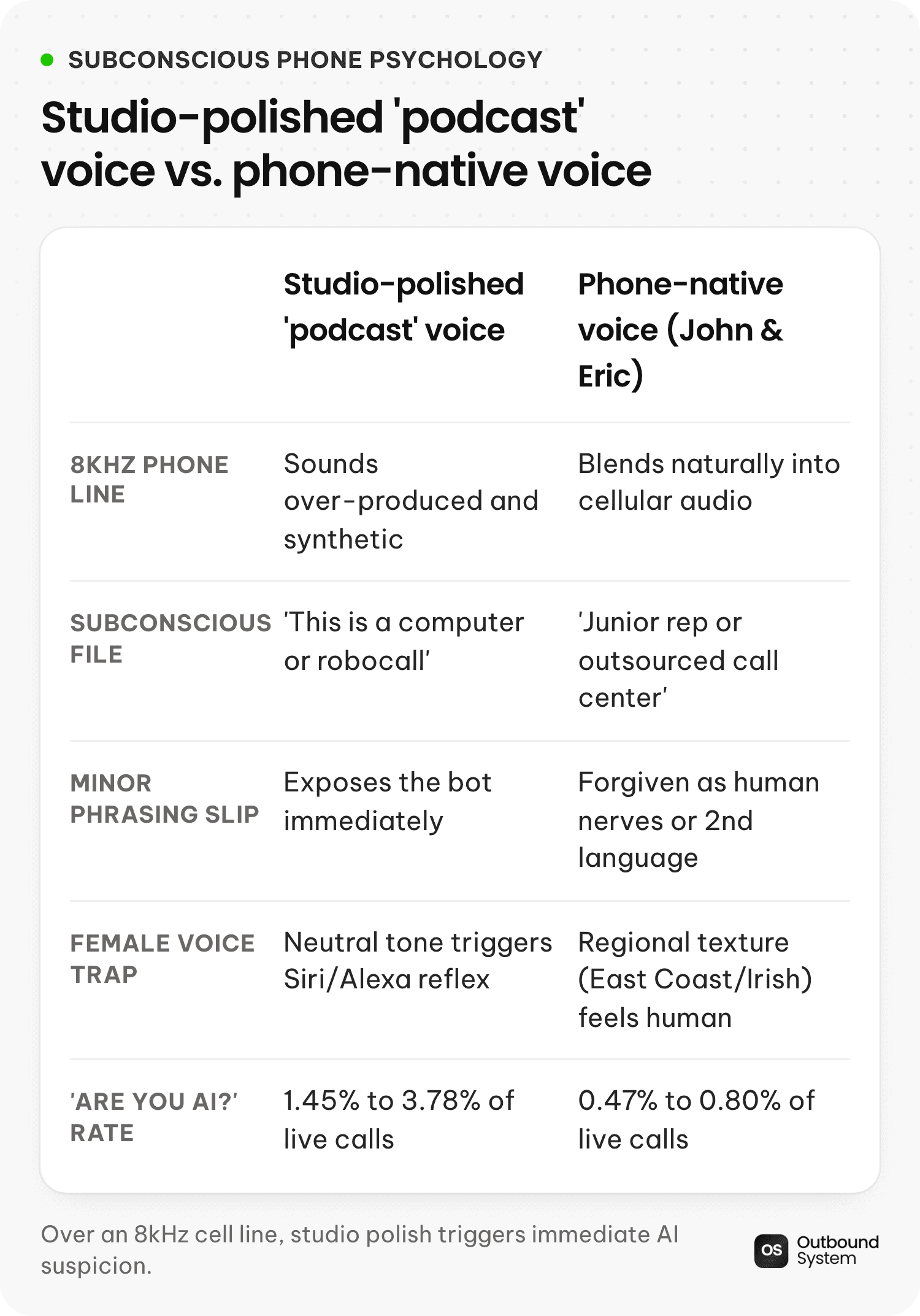
Because businesses in the United States receive calls from nearshore B2B and home-service coordinators every single day, their brain accepts Eric as a real person immediately.
Even better, that subtle inflection creates a second psychological shield mid-conversation: if the AI takes a 300-millisecond beat to process a complex question or phrases a sentence slightly differently than a local contractor would, the prospect’s subconscious writes it off as “English is his second language” instead of “I am talking to a computer.”
Why is “John” our #1 highest-converting voice (“perfectly imperfect”)?
While Eric wins through smooth confidence and the call-center substitution effect, John (288,787 dials, 191 booked meetings, 0.77% AI detection) wins through the exact opposite psychological mechanism: the disarming underdog effect.
Most founders who script their own AI caller try to make the voice sound like an assertive, high-energy Wall Street closer. On a cold outbound call, an aggressive “alpha” voice triggers instant status competition. The business owner feels pitched, puts their guard up, and looks for the fastest way to end the call.
John is what our Head of Customer Success, Brandy Ballantyne, calls “perfectly imperfect”:
Non-threatening tonality: John sounds calm, slightly understated, and unhurried. When a busy roofer, hotel general manager or real estate agent picks up the phone, their nervous system registers: “This guy is not a threat to me. I’ll give him 20 seconds and hear him out.”
Micro-hesitations and human texture: John has subtle vocal texture and occasional slight hesitations that mimic a real 24-year-old coordinator reading a note on his screen.
8kHz cellular line physics: When you listen to a voice preview on your laptop, you are hearing wideband audio. When a prospect answers their iPhone in a truck, the audio has been crushed through narrowband cellular codecs. A studio-clean voice sounds uncannily flat over a phone line, whereas John’s mid-range texture sounds exactly like a guy calling you from an office desk.
Why do neutral female AI voices trigger the “Siri and Alexa Reflex”?
One of the funniest moments from our client kickoff recordings happened on a September 2026 strategy call when Brandy was explaining why we rarely use neutral American female voices. She played a sample of our most neutral female voice (Erica) and explained that prospects associate crisp, neutral female voices with Siri and Alexa. Two seconds later, the client started laughing because Brandy saying the word “Alexa” alongside the neutral voice sample literally woke up the Amazon Echo sitting on his desk!
That is the Siri / Alexa Reflex in action.
Because every smartphone and smart-speaker owner has spent the last 15 years hearing Siri, Alexa, Google Assistant and automated pharmacy lines speak in a crisp, neutral, mid-Atlantic female voice, the human brain is hard-wired to associate that specific vocal profile with a machine.
When a campaign calls for a female voice (for example, calling male contractors or financial executives who respond well to a warm female coordinator), we defeat the Siri/Alexa reflex by choosing voices with unmistakable regional human texture:
Jasmine (East Coast texture): Across
41,161dials and2,136live conversations, prospects asked if Jasmine was an AI only 10 times (0.47%), the lowest AI detection rate of any voice on our platform.Sarah (subtle Irish texture): Across
11,547dials and679live conversations, prospects asked if Sarah was an AI only 6 times (0.88%).
Just like Eric’s subtle Latin American inflection, Jasmine’s East Coast cadence and Sarah’s subtle Irish lilt break the “Siri pattern” in the prospect’s subconscious before the first sentence is even finished.
Does the TCPA require upfront AI disclosure, or only when asked?
A major reason voice psychology matters so much is that if you can keep your AI caller from sounding like a podcast robot in the first five seconds, you do not have to ruin your opener with a robotic disclaimer.
We saw this firsthand when we audited Close CRM’s AI voice agent, Chloe, and our own early Summer 2026 campaigns. When an agent opens a call by announcing “Hi, I am an artificial intelligence voice agent calling on a recorded line,” prospects hang up before hearing a single word of value.
Under federal law (the FCC’s February 2024 TCPA Declaratory Ruling, covered in our outbound AI calling compliance and TCPA guide), AI-generated voices are regulated under the rules for artificial or prerecorded voices, which govern prior express consent, Do Not Call scrubbing, and local calling hours. While you must always verify specific state rules with your legal counsel, federal TCPA rules do not mandate a self-sabotaging robot disclaimer in the first sentence of every consented or B2B call.
Instead, our calling kernel (kernel v36) enforces two rules that protect both trust and conversion:
Never open with an apology or a robot monologue. Open like a normal human coordinator asking for 20 seconds (see our guide on AI voice agent script psychology and the Coordinator Shield).
Always answer 100% honestly if asked. On the
0.77% to 0.80%of live calls where a prospect asks “Are you an AI?” or “Am I talking to a robot?”, our agent never lies and never apologizes. It replies: “Yeah, actually, I am. How am I doing so far?” As we proved in our 438,246-call outbound AI calling benchmarks, 69.5% of prospects who hear that honest, self-aware line stay on the call, and 30.5% talk for over 90 seconds.
How should you A/B test AI voices for your specific industry?
Even though John and Eric win 90%+ of head-to-head tests, every audience has its own unconscious biases. Hospital administrators, car dealership GMs, roofing homeowners and enterprise CTOs do not all react the same way to the same voice.
When we launch a campaign on Outbound System, we follow a three-step voice testing protocol:
Step 1: Start with a 50/50 split between John and Eric (or John and Jasmine). Our campaign router assigns 50% of dials to Voice A and 50% to Voice B on the exact same script and lead list.
Step 2: Judge by held conversation rate (60s+) and booked meetings, never by laptop preview. A voice that sounds “too casual” on your computer speaker often beats a polished voice 2-to-1 over a cell phone line.
Step 3: Lock in the winning voice after 500 to 1,000 dials, then A/B test the opener. Once the voice is validated, 80% of your conversion lift comes from testing the first 15 seconds of the script.
Frequently asked questions
What is the best-converting AI voice for outbound calling?
Across 442,408 production dials on Outbound System, our top-converting voice is John, a calm, non-threatening American male voice with subtle human imperfections (288,787 dials, 20,711 live connects, 191 booked meetings, and a 0.77% AI detection rate). Our second most-used voice is Eric (93,267 dials, 0.80% AI detection), who speaks fluent English with a subtle Latin American inflection.
Why does a slight accent make an AI voice agent convert better?
When a prospect hears a studio-polished, zero-flaw voice over a phone line, their brain flags it as an AI or robocall. When they hear fluent English with a subtle Latin American (Eric), East Coast (Jasmine) or Irish (Sarah) inflection, their subconscious categorizes the caller as a real human working at an outsourced call center or regional office, and forgives minor phrasing quirks as human speech.
Do male or female AI voices perform better in outbound sales?
Male voices (John and Eric) account for 86.4% of our outbound dials because neutral female voices often trigger the “Siri and Alexa reflex,” where listeners subconsciously associate a crisp female voice with a digital assistant. However, when a female voice includes natural regional texture, such as Jasmine (East Coast), it performs exceptionally well with a 0.47% AI detection rate.
Should I clone my own voice for my outbound AI voice agent?
Usually no, unless you have tested it against proven phone-native voices. In our production data, custom-cloned founder voices recorded on studio microphones had a 1.45% to 2.15% AI detection rate (2x to 3x higher than John or Eric) because microphone artifacts and studio EQ stand out unnaturally over an 8kHz phone call.
Can I hear John, Eric and Jasmine live before launching a campaign?
Yes. On Outbound System, you can listen to real unedited call recordings from our voice library, test our live AI agent on your own cell phone, and split-test two voices 50/50 on every campaign. Book a demo to hear how our voices perform in your industry.
Outbound System
Fixed monthly price, local numbers, and you approve every script. Hear real calls before you decide.

Matthew Johnson is the founder and CEO of Outbound System, which runs cold email, LinkedIn outreach and AI calling for 1,000+ active B2B clients. He has personally sold over $12 million in B2B services, and his team has sent 52 million+ cold emails and helped clients close $26 million in revenue.
About Outbound System
Outbound System runs done-for-you cold email, LinkedIn outreach and AI calling for B2B companies. 1,000+ active clients and 10,400+ campaigns launched.