Key takeaways
Outbound sales dialers have evolved through 5 generations: (1) click-to-call speed dialers, (2) single-line power dialers, (3) predictive dialers, (4) multi-line parallel dialers, and (5) autonomous AI voice dialers.
Speed, power and parallel dialers (like PhoneBurner, Kixie, Nooks and Orum) only automate dialing the phone; you still have to pay $7,100 to $10,400/month per human SDR to sit at a desk and talk on every connected call.
Parallel dialers dial 3 to 10 lines at once for one human rep, which creates a 1-to-2-second transfer pause when a prospect says “Hello?” and triggers hang-ups and carrier spam flags.
An autonomous AI voice dialer (Outbound System, $1,499 to $3,999/mo) places dedicated 1-to-1 calls across 50 to 200 local numbers, responds in under 300ms, handles 58.4% voicemails and 7.4% iOS screeners, and books meetings without a human SDR.
Updated November 3, 2026. Based on production telemetry from 442,408 outbound calls on Outbound System and published specifications across the major dialer platforms.
What is a speed dialer in sales (and how does it compare to power, parallel and AI dialers)?
In outbound sales, a speed dialer is software that eliminates manual 10-digit number punching by automatically dialing contacts from a CRM list one after another or across multiple lines at once. In 2026, outbound dialers fall into five distinct categories: (1) Click-to-Call Speed Dialers (40 to 60 dials/day), (2) Single-Line Power Dialers like PhoneBurner or Kixie (100 to 180 dials/day), (3) Predictive Dialers for large B2C call centers, (4) Multi-Line Parallel Dialers like Nooks or Orum (250 to 400 dials/day per human SDR), and (5) Autonomous AI Voice Dialers like Outbound System (250 to 1,000+ dials/day with zero human SDRs required because the AI holds the conversation and books the appointment itself).
Most sales leaders searching for “speed dialers” are trying to solve a simple math problem: 93.0% of outbound dials hit voicemail (58.4%), unanswered rings (34.4%), Apple iOS call screeners (7.4%) or office IVRs (3.8%), leaving human reps with barely two hours of live talk time a day.
Before you buy a dialer seat for your team, here is how all five types of dialers actually work in 2026, what they cost over 90 days, and why autonomous AI voice dialers are replacing parallel dialers.

Side-by-Side Comparison: All 5 Types of Outbound Sales Dialers in 2026
Dialer type | Examples | How it dials | Who talks when a prospect answers? | Answer delay / drop lag | Typical 90-day cost (software + labor) |
|---|---|---|---|---|---|
1. Click-to-Call Speed Dialer | HubSpot Calling, Close CRM, Dialpad, Aircall | Rep clicks 1 number at a time in the CRM | Your human SDR ($7.1k to $10.4k/mo) | 0 ms (rep listens to every ring & voicemail) | $22,000 to $32,000 (1 SDR + CRM seat) |
2. Single-Line Power Dialer | PhoneBurner ($140 to $165/mo), Kixie, JustCall | Auto-dials the next number as soon as a call ends | Your human SDR | 0 ms (1 line at a time) | $23,000 to $33,000 (1 SDR + dialer seat) |
3. Predictive Dialer | Five9, Convoso, NICE CXone | Dials ahead based on algorithm; bridges to next free agent | Call center floor (10+ human agents) | High (1.5 to 3s pause; risks FTC >3% abandonment rule) | $100,000+ (call floor + enterprise license) |
4. Multi-Line Parallel Dialer | Dials 3 to 10 numbers simultaneously per human SDR | Your human SDR | 1 to 2 seconds (AI detects voice, then bridges rep) | $27,400 to $200,000+ (1 to 9 SDRs + custom quote) | |
5. Autonomous AI Voice Dialer | Dials 1-to-1 across 50 to 200 local numbers (10 dials/day cap) | Our autonomous AI voice agent ( | Under 300 ms (dedicated 1-to-1 agent on every line) | $4,497 to $11,997 flat ($1,499 to $3,999/mo, $0 SDR payroll) |
Why do parallel dialers (Nooks, Orum) still hit a wall in 2026?
Between 2022 and 2025, parallel dialers like Nooks and Orum became popular with B2B SaaS teams because they let one human SDR dial 5 lines at once, skipping the unanswered rings.
In 2026, revenue teams are running into four structural problems with human parallel dialers:
You still have to pay $85,000 to $125,000/year per human SDR (and Orum requires a 9-seat minimum): A parallel dialer does not talk to prospects. If you don’t have human SDRs logged into the virtual salesfloor, the software sits completely idle. See our full 90-day AI appointment setter vs. human SDR cost math.
The “Parallel-Dial Pause” ruins the first 3 seconds of the call: When a parallel dialer dials 5 numbers at once and a CEO answers “Hello?”, the software takes 1 to 2 seconds to detect human speech, mute the other 4 lines, beep into your SDR’s headset, and bridge the audio. Worse, if two prospects answer at the exact same second, one prospect gets dropped or hears a recorded message. Every executive in 2026 recognizes that 1.5-second parallel-dial silence and hangs up before your rep says a word.
Human reps still burn out before the 4:00 PM peak window: Across 442,408 production dials on our platform, calling at 4:00 PM ET books 6.5x more meetings per dial than calling at 9:00 AM (
12.5vs.1.9booked meetings per 10,000 dials; see best time to run outbound AI calls). Human SDRs using parallel dialers blitz their lists at 9:00 AM and are mentally fried by 2:30 PM.Parallel dialers miss 15-second speed to lead after hours: When a prospect replies positively to a cold email at 7:45 PM or submits a form while your SDR is in a team meeting, a parallel dialer cannot pick up the phone by itself. Calling within 5 minutes converts 73% of warm leads vs. 9% after 4 hours (see our 15-second speed-to-lead study).
How does an Autonomous AI Voice Dialer work?
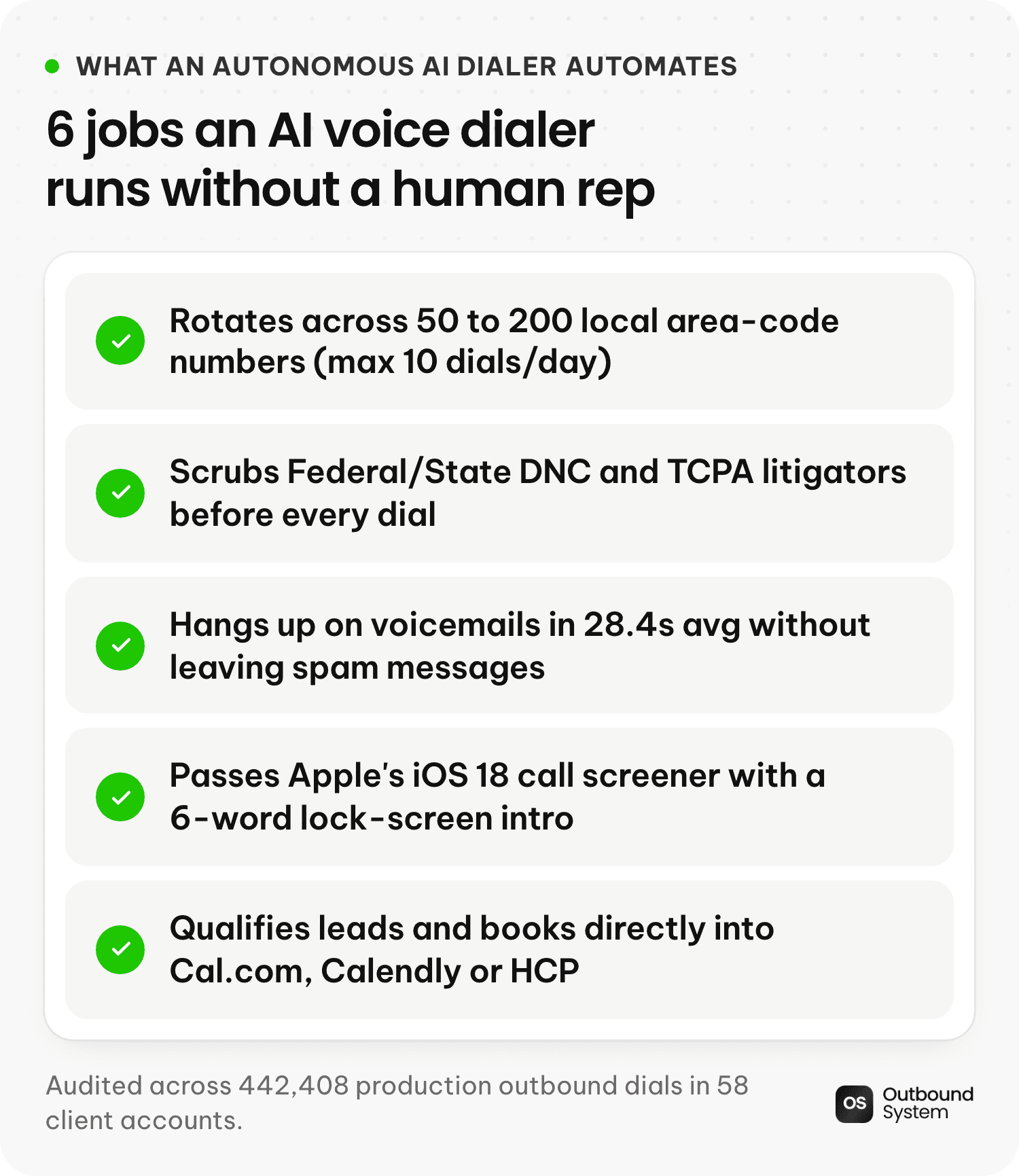
An autonomous AI voice dialer replaces both the dialing software and the manual human dialer seat by assigning a dedicated, sub-300ms AI voice agent to every individual call.
Here is what happens under the hood across 442,408 production dials on Outbound System:
Dedicated 1-to-1 calling (zero parallel-drop lag): Because each call has its own AI agent instance already on the line, there is zero transfer beep and zero multi-line drop when the prospect says “Hello?” The agent greets them by first name in under 300 milliseconds.
50 to 200 local area-code numbers capped at 10 dials per day: Traditional speed and power dialers burn through phone numbers because reps push 100+ calls a day through the same Caller ID. We assign every client 50 (Starter), 100 (Growth) or 200 (Scale) dedicated local numbers across 191 US area codes and hard-cap each number at 10 dials per day (see why AI voice agents show up as Scam Likely).
Automatic voicemail hang-up (
28.4s) and iOS 18 screener navigation (32,412hits): When a call hits voicemail (58.4% of dials), our live listener disconnects cleanly in 28.4 seconds without leaving a spammy voicemail. When a call hits Apple’s iOS live call screener (7.4% of dials), our classifier recognizes Siri in two seconds, delivers a casual 6-word lock-screen intro, and waits quietly for the human to answer (rescuing 1,220 live conversations; see why 90% of DIY AI voice agents fail on live calls).Phone-native voices (
John&Eric) + Coordinator Shield scripts: Our top voices hold “Are you an AI?” detection to 0.77% and 0.80% across 382,054 dials, and our Coordinator Shield opener holds Do Not Call opt-outs to 0.27%.6 to 9 follow-up attempts where 50.5% of meetings are booked: Across 440,648 sequence-tracked dials, Attempt #1 booked 49.5% of meetings and Attempts #2 through #9 booked the other 50.5% (see how many follow-up calls it takes to book a meeting).
Which dialer should your team choose in 2026?
Choose a Click-to-Call or Single-Line Power Dialer (PhoneBurner, Kixie) if you have Account Executives making 20 to 40 warm relationship calls a day to existing pipeline where they want to read account notes before each dial.
Choose a Multi-Line Parallel Dialer (Nooks, Orum) if you already employ an enterprise floor of 9+ full-time human SDRs selling $100k+ ACV contracts who just need to connect faster during morning call blocks.
Choose Outbound System’s Autonomous AI Voice Dialer ($1,499 to $3,999/mo, month-to-month) if you want 5,000 to 20,000 outbound dials a month, 15-second speed-to-lead callbacks, and dead CRM lead revival run completely for you, so your closers only show up to confirmed calendar appointments.
Frequently asked questions
What is the difference between a power dialer and a parallel dialer?
A power dialer dials one phone number at a time automatically as soon as your previous call ends, so there is never a connection delay. A parallel dialer dials 3 to 10 phone numbers simultaneously for a single human rep and bridges the rep onto whichever line answers first, increasing connect speed but introducing a 1-to-2-second transfer pause and dropped calls when two prospects answer at once.
Do speed dialers and parallel dialers cause numbers to be marked as “Spam Likely”?
They can if not configured with strict per-number caps. Whenever a dialer pushes more than 15 to 20 cold calls a day through a single phone number, or drops calls when two prospects answer a parallel dial simultaneously, carrier analytics engines (Hiya, First Orion, TNS) flag the number as “Scam Likely”. Outbound System prevents this by making dedicated 1-to-1 calls across 50 to 200 local numbers hard-capped at 10 dials per number per day.
Can an AI dialer replace both our dialer software and our human cold callers?
Yes. For top-of-funnel appointment setting, speed-to-lead callbacks and old lead reactivation, Candlewood Development replaced three full-time callers with Outbound System and booked 61 qualified meetings, while Presidential Bank booked 15 meetings in month two with a 75% show rate. Test our live AI voice dialer on your cell phone or book a demo today.
Outbound System
Fixed monthly price, local numbers, and you approve every script. Hear real calls before you decide.

Matthew Johnson is the founder and CEO of Outbound System, which runs cold email, LinkedIn outreach and AI calling for 1,000+ active B2B clients. He has personally sold over $12 million in B2B services, and his team has sent 52 million+ cold emails and helped clients close $26 million in revenue.
About Outbound System
Outbound System runs done-for-you cold email, LinkedIn outreach and AI calling for B2B companies. 1,000+ active clients and 10,400+ campaigns launched.